Toyota's Vivid Solar Project: Power with Visual Appeal
Toyota has introduced its Vivid Solar Project, an initiative that integrates solar energy harvesting with aesthetic design. This technology, developed by Toyota’s APPO and TRINA, uses lenticular lenses to conceal solar panels, allowing for visually appealing structures that also generate power.

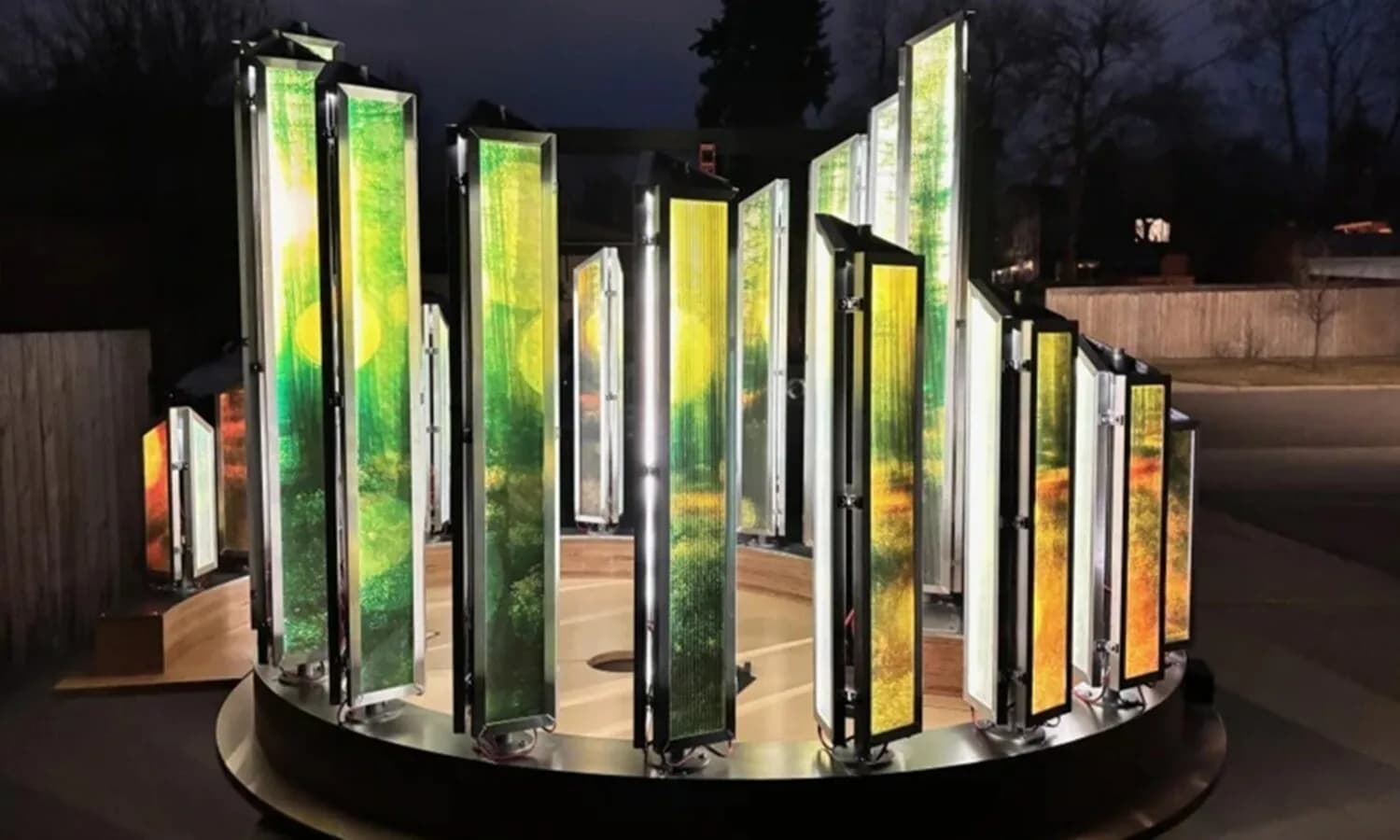
Toyota has unveiled its Vivid Solar Project, an initiative that merges solar energy harvesting with aesthetic design. Developed by teams from Toyota’s Advanced Product Planning Office (APPO) and Toyota Research Institute of North America (TRINA), this technology allows solar panels to be visually integrated into environments without compromising their energy production capabilities. The project aims to make distributed energy infrastructure more appealing and seamlessly embedded within various spaces.
Blending Aesthetics and Energy Harvesting
Toyota's Vivid Solar Project focuses on overcoming the visual limitations often associated with traditional solar panels. The core innovation involves using lenticular technology to conceal the photovoltaic cells, allowing for vibrant designs or branding to be displayed while still capturing sunlight. This approach ensures that energy-generating structures can enhance, rather than detract from, their surroundings.
A 1/6th scale Vivid Solar Sculptural Display was recently showcased at Toyota’s Research & Development (R&D) facility in Saline, Michigan. This self-sustaining, carbon-neutral monument features 11 triangular columns arranged in two opposing semicircular arcs. Designed as a dynamic wayfinding element, it presents different visuals depending on the viewing angle by day and transforms into a luminous beacon at night, demonstrating the project's potential for visually engaging energy solutions.
The Lenticular Technology Behind Vivid Solar
The key to the Toyota Vivid Solar Project lies in its use of lenticular lenses. These tiny, curved lenses are designed to direct a viewer's eye to specific printed artwork from certain angles, effectively hiding the underlying solar panels. Simultaneously, the lenses are engineered to allow sunlight to pass through to the photovoltaic cells, ensuring efficient energy capture. This dual functionality enables a dynamic visual experience without sacrificing environmental performance.
The project originated in 2020 from a request by Toyota Motor Corporation (TMC), building on earlier work by TRINA scientists Debasish Banerjee and Mindy Zhang. TMC had previously developed dynamic color pigments using nanotechnology, such as those found in Lexus vehicle coatings. The Vivid Solar Project expands on this concept, with APPO providing North American funding and support to advance the technology toward commercialization. Over 10 patents, both approved and pending, are associated with this innovative system.
Real-World Applications and Future Potential
The high-performance Vivid technology is designed for broad application, including standard solar arrays. It can incorporate colored or branded panels while retaining more than 90% of the native solar panel's energy harvesting efficiency. For instance, a vehicle-emblazoned graphic on a solar array near Toyota R&D in Saline has successfully operated for two years, maintaining energy retention through the 2025-26 winter.
Another artistic application can be seen at Toyota’s North American Hydrogen Headquarters (H2HQ) in Gardena, California. Here, engineers installed brilliant red VIVID solar "petals" on an existing "Smart flower array" near the entrance. This 2.5 kW showcase array generates 6,000 kWh annually, which is equivalent to the energy consumption of a battery-electric vehicle driving approximately 50 miles per day. Brian Woods, a program manager at APPO and co-project leader, highlighted the technology's potential for display and advertising, suggesting significant return on investment due to its combination of sustainable power and branding opportunities.
The Toyota Vivid Solar Project represents an effort to integrate renewable energy solutions more harmoniously into urban and architectural landscapes. By making solar technology visually appealing, Toyota aims to broaden its adoption and demonstrate how sustainable infrastructure can also be an aesthetic asset.
Galería
6 imágenes
Leave a comment
Comments are moderated and may take a moment to appear. Only your first name and the initial of your last name are shown publicly.
Comments
Be the first to comment.