2021 Hyundai Tucson Engine Monitoring Logic TSB 22-01-028H-1
Hyundai has issued Service Campaign 966 (TSB 22-01-028H-1) to update the engine monitoring logic in various models, including the 2021 Hyundai Tucson. This update enhances knock sensor software to detect abnormal engine bearing noise, which can trigger DTC P132600 and 'Engine Protection Mode'.
 Sarah Mitchell2021 Hyundai Tucson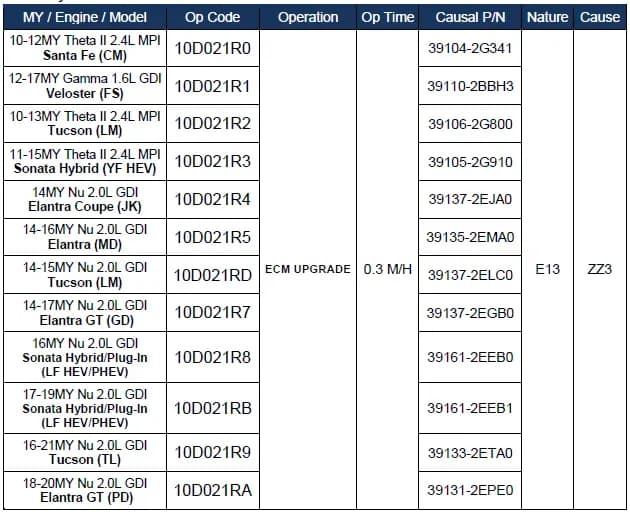
Hyundai has launched Service Campaign 966 (TSB 22-01-028H-1) to enhance the engine monitoring logic in several of its vehicles, including the 2021 Hyundai Tucson. This campaign specifically targets the knock sensor software to improve its detection of abnormal engine bearing noise. Early detection is crucial to prevent potentially severe engine damage.
Symptoms
If your vehicle experiences abnormal engine bearing noise, the knock sensor software, once updated, will detect this condition. When detected, you may observe the following symptoms:
- The Malfunction Indicator Lamp (MIL) will blink continuously.
- The vehicle will enter "Engine Protection Mode".
- You may notice slower acceleration and a reduced maximum speed.
- Engine RPMs will be limited to approximately 1800-2000 RPM.
Fault Codes / DTCs
When the abnormal engine bearing noise is detected and the vehicle enters "Engine Protection Mode", the Engine Control Module (ECM) will record a specific diagnostic trouble code:
- P132600
Diagnosis / Trigger Conditions
The primary trigger for this issue and the subsequent "Engine Protection Mode" is the detection of abnormal engine bearing noise by the knock sensor. The updated software aims to improve the sensitivity and accuracy of this detection, allowing for earlier intervention before significant engine damage occurs.
Repair Procedure Summary
Dealers are instructed to perform an Engine Control Module (ECM) software update as part of Service Campaign 966 (TSB 22-01-028H-1). The procedure involves several key steps:
- Vehicle Check: Technicians must first check the vehicle's information screen via WEBDCS to identify any open campaigns or recalls.
- Battery Voltage Check: Before starting the ECU update, the battery voltage must be checked. If it is below 12 volts, the battery needs to be charged for at least 15 minutes to ensure an adequate state of charge and prevent ECU update failure. The ignition must be cycled OFF/ON before retrying the update if charging was needed.
- ECU Update: All GDS ECU updates must initially be performed in Auto Mode. If the update starts but then fails in Auto Mode, technicians should switch to Manual Mode to complete the process. For additional tablet-based Mobile GDS ECU update information, refer to TSB 15-GI-001.
- Control Unit Reset: After the ECU Upgrade process shows 100% completion, it is critical to "cycle the ignition key again to OFF for at least 30 seconds to reset the control unit." This step is crucial for establishing normal powertrain communication and preventing system errors.
- DTC Clearance & Radio Presets: Any Diagnostic Trouble Codes (DTCs) present after the ECU update must be cleared. If necessary, the customer's radio preset stations should be reprogrammed.
Important Warnings
If the Automatic ECU Upgrade process fails, technicians must "cycle the ignition key to OFF for at least 30 seconds to reset the control unit" before resuming programming using the Manual ECU Upgrade processes. Similarly, after the ECU Upgrade process shows 100% complete, it is mandatory to "cycle the ignition key again to OFF for at least 30 seconds to reset the control unit" to ensure proper system initialization and prevent errors.
Required Tools or Parts
No specific parts are needed for this service campaign, as it primarily involves a software update to the Engine Control Module (ECM).
Owner Action
If you own a 2021 Hyundai Tucson and experience symptoms related to the Hyundai Tucson engine monitoring logic, such as a blinking Malfunction Indicator Lamp or your vehicle entering "Engine Protection Mode" with DTC P132600, you should contact your authorized Hyundai dealer to schedule an appointment. This service campaign is performed free of charge.
Campaign History and Scope
This Service Campaign 966 (TSB 22-01-028H-1) has undergone several revisions and expansions to include a broader range of Hyundai and Kia models and model years. Initially launched as TSB 21-01-023H on March 30, 2021, it has been updated multiple times to incorporate additional vehicles and refine the ECU update procedures. The campaign now covers various Santa Fe, Tucson, Sonata Hybrid, Veloster, and Elantra models equipped with Theta II 2.4L MPI, Nu 2.0L GDI, and Gamma 1.6L GDI engines, reflecting Hyundai's commitment to addressing the engine monitoring logic across its fleet.
NHTSA ID: 10211664
Frequently Asked Questions
- What is Service Campaign 966 (TSB 22-01-028H-1) for the Hyundai Tucson?
- Service Campaign 966 is a Hyundai initiative to update the Engine Control Module (ECM) software in affected vehicles, including the 2021 Hyundai Tucson. This update enhances the knock sensor's ability to detect abnormal engine bearing noise, preventing potential engine damage.
- What does DTC P132600 mean for my Hyundai Tucson?
- DTC P132600 indicates that the engine monitoring logic has detected abnormal engine bearing noise. When this code is stored, your Hyundai Tucson will likely enter 'Engine Protection Mode', limiting engine performance to prevent further damage.
- Will my 2021 Hyundai Tucson enter 'Engine Protection Mode' if this issue occurs?
- Yes, if the updated knock sensor software detects abnormal engine bearing noise, your 2021 Hyundai Tucson will enter 'Engine Protection Mode'. This mode reduces acceleration, limits top speed, and restricts engine RPMs to approximately 1800-2000 RPM, allowing you to drive to a dealer for service.
- Are there any specific actions I need to take after the ECU update for the Hyundai Tucson engine monitoring logic?
- After the ECU update is completed, the technician will clear any Diagnostic Trouble Codes (DTCs). You may need to reprogram your radio preset stations, as this can sometimes be affected by ECU updates. No other specific owner actions are required post-update.
Otras revisiones de este TSB
Related Articles
2021 Hyundai Tucson Health Check: Engine & Paint TSBs
For the 2021 Hyundai Tucson, there are no reported recalls, owner complaints, or federal investigations. However, owners should be aware of several manufacturer service bulletins (TSBs) addressing engine emissions, potential engine bearing issues, white paint peeling, and an anti-theft ignition…
2021 Hyundai Tucson Emissions Logic Update (9C2)
Hyundai Service Campaign 9C2 addresses elevated engine-out emissions in certain 2021 Hyundai Tucson models by updating the Engine Control Module (ECM) software. This update helps ensure compliance with emissions standards and prevents failed inspections.
2015 Hyundai Sonata GDS Event 1383 Campaign Suspended
Hyundai Motor America has temporarily suspended Service Campaign 9C2, related to software GDS event #1383, for the 2015 Hyundai Sonata (LFA) 2.4L. Vehicles will not show this campaign as open in WebDCS during the suspension period.
2021 Hyundai Tucson GDS Event #1383 Engine Investigation
Hyundai is actively investigating a software-related engine issue, identified as GDS event #1383. While primarily concerning 2015 Sonata 2.4L vehicles, this manufacturer communication is linked by NHTSA to the 2021 Hyundai Tucson, indicating an ongoing review for a resolution.
2010-2021 Hyundai Engine Bearing TSB 26-01-033H
Hyundai Technical Service Bulletin (TSB) 26-01-033H is a critical reference for Op codes and part numbers under Service Campaign T6G. This campaign addresses engine bearing inspection and replacement for various Hyundai models from 2010-2021, often triggered by DTC P1326 and "Abnormal Engine Noise."
Leave a comment
Comments are moderated and may take a moment to appear. Only your first name and the initial of your last name are shown publicly.
Comments
Be the first to comment.