2022-2024 Audi e-tron GT Brake Disc Hotspots TSB
Audi Technical Service Bulletin 46 24 56 2073824/1 addresses customer concerns about hotspots and discoloration on the tungsten carbide brake discs of 2022-2024 Audi e-tron GT and RS e-tron GT models. The TSB clarifies that this is a visual complaint that does not affect brake function.
 Sarah Mitchell2023 Audi RS e-tron GT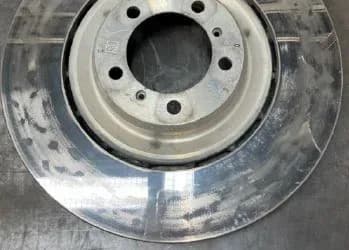
También aplica a
- Audi e-tron GT
- 2022–2024
- Audi RS e-tron GT
- 2022, 2024
Owners of 2022-2024 Audi e-tron GT and RS e-tron GT models equipped with tungsten carbide brake discs may notice visual changes on their brake components. Audi Technical Service Bulletin (TSB) 46 24 56 2073824/1, issued on May 2, 2024, addresses concerns regarding "Hotspots / discoloration visible on the friction surface of the brake disc."
This TSB clarifies that while these visual anomalies may be noticeable, they are considered a cosmetic issue and do not indicate a functional problem with the brake system. The information provided in this bulletin is crucial for understanding the nature of this phenomenon and avoiding unnecessary repairs.
Symptoms
Owners primarily report seeing "Hotspots / discoloration visible on the friction surface of the brake disc." This visual change can appear as uneven color or patterns on the brake disc surface. Despite these visible marks, workshop inspections confirm that there are no abnormalities in the brake disc's axial run-out, indicating that the physical integrity and performance of the disc remain unaffected.
Technical Background
The appearance of hotspots and discoloration on the tungsten carbide brake discs is a result of thermal stress. Brake discs are subjected to various influences during operation, and one significant factor is the heat generated from friction. Depending on an individual's driving style, temperatures can rise to levels that cause a change in the top layer of the tungsten carbide brake disc material. This phenomenon, while visually apparent, is a normal characteristic of the brake disc's design under certain thermal conditions.
Audi emphasizes that this is purely a visual complaint. The presence of these hotspots or discoloration does not compromise the braking performance or safety of the vehicle. Therefore, the Audi e-tron GT brake disc hotspots are not a sign of a malfunction.
Important Warnings for Owners
Audi Technical Service Bulletin 2073824 explicitly states that no measures are required for this phenomenon on the friction surface of the brake discs. Furthermore, the bulletin issues a critical warning regarding part replacement:
- "Replacement of parts due to this phenomenon is not justified. In such a case, we may reject the warranty claim and charge back the cost of the parts."
This means that if a dealer replaces brake components solely based on the visual presence of hotspots or discoloration, Audi may deny the warranty claim and charge the cost of the parts back to the dealership. Owners should be aware that this TSB is informational only and is not applicable to any Audi Warranty for replacement of these parts.
What Owners Should Do
If you observe "Hotspots / discoloration visible on the friction surface of the brake disc" on your 2022-2024 Audi e-tron GT or RS e-tron GT with tungsten carbide brake discs, no action is required. This condition is considered cosmetic and does not affect the function of your vehicle's braking system. There is no repair procedure outlined in TSB 46 24 56 2073824/1 because the issue does not represent a defect or a safety concern. Do not pursue replacement of these parts, as it will not resolve any functional issue and may not be covered under warranty.
Source: NHTSA ID: 11002228, Audi Technical Service Bulletin 46 24 56 2073824/1
Frequently Asked Questions
- Are the hotspots on my Audi e-tron GT's brake discs a safety concern?
- No, according to Audi TSB 46 24 56 2073824/1, the "Hotspots / discoloration visible on the friction surface of the brake disc" are purely cosmetic and do not affect the function or safety of the tungsten carbide brake discs.
- Should I replace my brake discs if I see discoloration or hotspots?
- Audi Technical Service Bulletin 2073824 explicitly states that replacement of parts for this phenomenon is not justified. Warranty claims for such replacements may be rejected, and the cost of parts could be charged back.
- What causes the discoloration on the tungsten carbide brake discs?
- The discoloration is a result of thermal stress on the friction surfaces, which can occur depending on driving style. This leads to changes in the top layer of the tungsten carbide brake disc material, but it does not impact performance.
- Does the Audi e-tron GT brake disc hotspots issue affect braking performance?
- No, despite the visual changes, the TSB confirms that the braking performance and safety of the vehicle are not affected by the hotspots or discoloration on the tungsten carbide brake discs.
Related Articles
2022-2024 Audi e-tron GT / RS e-tron GT Door Paint Damage TSB
If your 2022-2024 Audi e-tron GT or RS e-tron GT has paint damage on the front door, it may be due to the door colliding with the wing panel trim. Technical Service Bulletin 2072290/2 describes the cause and repair procedure for this issue.
2022-2024 Audi e-tron GT Radiator Fan Stuck DTC P2B3000
Audi Technical Service Bulletin 2073599/4 details issues with radiator fans getting stuck (DTCs P2B3000, P2B3200) in 2022-2024 Audi e-tron GT and RS e-tron GT vehicles. This can lead to reduced heating, cooling, drive power, and charging capacity due to foreign objects.
2023 Audi e-tron GT Charging Port Door Not Opening TSB
Audi Technical Service Bulletin (TSB) 2070578/3 provides diagnostic and repair information for 2023 Audi e-tron GT and RS e-tron GT vehicles where the charging port door fails to open or close, or displays incorrect status messages. The issue is typically linked to a faulty charging port door…
2022-2024 Audi e-tron GT High-Voltage Charger Conversion TSB
Audi has issued Technical Service Bulletin (TSB) 11022683 for 2022-2024 e-tron GT and RS e-tron GT models. This bulletin provides information on converting the high-voltage battery charger from a 22kW to an 11kW configuration.
2023-2024 Audi e-tron GT High-Voltage Battery Software Update
Audi has released Technical Service Bulletin 931D, an update for the high-voltage battery diagnostic software in 2023-2024 e-tron GT and RS e-tron GT models. This update addresses potential irregularities indicated by a warning lamp in the instrument cluster.
Leave a comment
Comments are moderated and may take a moment to appear. Only your first name and the initial of your last name are shown publicly.
Comments
Be the first to comment.