2021-2023 Audi e-tron AC Noise from Compressor TSB
Audi has issued Technical Service Bulletin (TSB) 2063467/1 to address a cabin noise issue originating from the air conditioning compressor when the AC system is active in 2021-2023 Audi e-tron and e-tron Sportback models. The noise is often caused by vibrating refrigerant lines or a poorly seated…
 Ahmet Topcu2023 Audi e-tron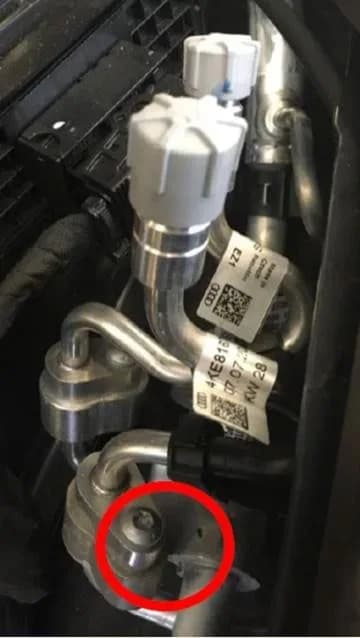
También aplica a
- Audi e-tron
- 2021–2022
- Audi e-tron Sportback
- 2021–2022
Symptoms
Owners of affected Audi e-tron vehicles may notice a distinct noise inside the cabin when the air conditioning system is active. This Audi e-tron AC noise is particularly noticeable when the AC compressor is running and typically disappears when the air conditioning system is turned off. Workshop findings confirm that this symptom is easily reproducible and the noise does not originate from inside the cabin itself.
Diagnosis / Trigger Conditions
The source of the Audi e-tron AC noise has been traced to several potential contact points that cause vibrations to transfer into the cabin. These include:
- Refrigerant Line Contact: Direct contact between adjacent refrigerant lines in the front motor compartment.
- Bowden Cable Clip Interference: Contact between a refrigerant line and the Bowden cable clip for the front hood release.
- Compressor Isolator Spring Misalignment: In some cases, the compressor isolator spring may not be correctly indexed in its rubber mounting, leading to an incorrectly seated compressor isolator assembly. This can create a gap between the rubber isolator and the mounting bracket.
- Service Port Mounting Interference: Contact between the service port mounting block and an adjacent line.
These contact points allow vibrations from the air conditioning compressor to resonate, causing the audible noise inside the vehicle.
Repair Procedure Summary
Technical Service Bulletin 2063467/1 outlines the steps for technicians to resolve the Audi e-tron AC noise issue. The repair focuses on identifying and eliminating the contact points causing the vibration:
- Separate Refrigerant Lines: Technicians will inspect the refrigerant lines for any points of contact. If contact is found, the lines must be separated and secured in a separated position using a hose holder, clip, or tie-wrap.
- Address Bowden Cable Clip Contact: If a refrigerant line is found to be contacting the Bowden cable clip, it must be separated and secured away from the clip. The retaining clip for the refrigerant line allows it to slide, which should be considered when securing the line.
- Adjust Compressor Isolator Spring: The compressor isolator spring assembly will be inspected for proper fit. If poorly seated, the spring and/or rubber mount may need to be twisted to correctly index the spring to the rubber mount, ensuring the isolator assembly lies flat against the bracket.
- Adjust Service Port Mounting: Any interference between the service port mounting block and adjacent lines will be corrected by pushing the service port to create a permanent clearance.
- Documentation: Technicians are required to take photos of the customer's concern and upload them to DOC-IT with the repair order. These photos must include a date stamp, VIN reference, be in focus, and have sufficient light.
Warranty Information
This repair is covered under Audi's warranty program. The claim type is 110, applicable for up to 48 months or 50,000 miles. For Audi Certified Pre-Owned (CPO) vehicles, claim type G10 applies, requiring owner verification. If the vehicle is outside of any warranty, this Technical Service Bulletin is for informational purposes only.
The Service Number for this bulletin is 8744, and the Damage Code is 0020. Labor operations include removing and reinstalling the front storage compartment (7007 1900), separating and securing refrigerant and coolant lines (8744 1399, 70 TU), and correcting the position of compressor isolator assemblies. Diagnostic time (GFF) and road tests before and after the service are listed as having no allowance (0 TU). All warranty claims must adhere to the Audi Warranty Policies and Procedures Manual.
Important Warnings
Owners should be aware that if their vehicle is outside of the specified warranty period, this Technical Service Bulletin serves as informational guidance only, meaning the repair may not be covered free of charge by Audi.
Additional Information
All parts and service references in TSB 2063467/1 are subject to change. Technicians are advised to consult the latest information from the Parts Department, ETKA, and the Repair Manual for current details on fasteners, bolts, nuts, and screws that may require replacement during the repair.
Source: NHTSA ID: 11002246
Galería
12 imágenes
Frequently Asked Questions
- What causes the AC noise in my Audi e-tron?
- The AC noise in your Audi e-tron is typically caused by vibrations from the air conditioning compressor transferring into the cabin. This can happen due to direct contact between refrigerant lines, contact between a refrigerant line and the Bowden cable clip, a poorly seated compressor isolator spring, or interference at the service port mounting block, as detailed in TSB 2063467/1.
- Is the Audi e-tron AC noise covered under warranty?
- Yes, for vehicles within the 48-month or 50,000-mile warranty period, this repair is covered. Certified Pre-Owned (CPO) Audi e-tron vehicles are also covered under claim type G10. If your vehicle is outside of warranty, the Technical Service Bulletin is informational only, and costs may apply.
- How will a technician fix the Audi e-tron AC noise?
- A technician will diagnose the specific contact points causing the vibration. The repair involves separating and securing any contacting refrigerant lines, adjusting the compressor isolator spring if it's poorly seated, and ensuring proper clearance at the service port mounting block. They will also document the repair with photos.
- Which Audi e-tron models are affected by the AC noise issue?
- This issue primarily affects 2021-2023 Audi e-tron and e-tron Sportback models. The TSB also mentions 2019 e-tron and 2020-2023 e-tron Sportback, as well as 2024 Q8 e-tron and SQ8 e-tron variants in its broader scope, though the NHTSA-linked vehicles for this specific document focus on the 2021-2023 range.
Related Articles
Should 2023 Audi e-tron Owners Worry? Recall & TSB Roundup
The 2023 Audi e-tron faces significant safety concerns, including recalls for potential brake pedal detachment and charging cable overheating. Owners have also reported serious issues like unintended acceleration and electrical system malfunctions. This guide covers all known problems and solutions.
2023 Audi e-tron Brake Pedal Recall
Audi has issued a recall (NHTSA ID: 26V240000, Audi Recall 46P7) for certain 2019-2024 E-Tron and 2020-2024 E-Tron Sportback vehicles, including the 2023 Audi e-tron. The recall addresses a potential issue where the brake pedal may detach from the brake booster, leading to a loss of brake function.
2015-2027 Audi Noise Diagnosis with Frequency Analysis App TSB
Audi has released Technical Service Bulletin 2051095/11 detailing the Audi Frequency Analysis app. This app helps technicians diagnose noise complaints more precisely across 2015-2027 Audi models. Learn how the app works, where to download it, and its features for effective vehicle noise analysis.
2023 Audi e-tron AC/DC Charging Not Possible TSB
This manufacturer communication (NHTSA ID 11031035) provides critical information for 2023 Audi e-tron owners facing issues with AC/DC charging. It specifically highlights problems linked to software version 00C6: 0093/3119, which can prevent the vehicle from charging.
2023-2025 Audi Rear Seat Reminder Message TSB 2074943/2
Audi Technical Service Bulletin 2074943/2 explains the instrument cluster message 'Please check rear seats and be aware of door safelock' in various 2023-2025 Audi models. This informational TSB details the rear occupant detection system designed to prevent children and pets from being left in…
Leave a comment
Comments are moderated and may take a moment to appear. Only your first name and the initial of your last name are shown publicly.
Comments
Be the first to comment.