Nissan Reports Operating Profit Amid Challenging Fiscal Year 2025
Nissan Motor Co., Ltd. has released its financial results for fiscal year 2025, which concluded on March 31, 2026. The automaker achieved an operating profit of 58.0 billion yen, though net income remained negative. The company is progressing with its Re:Nissan plan amidst a challenging global…

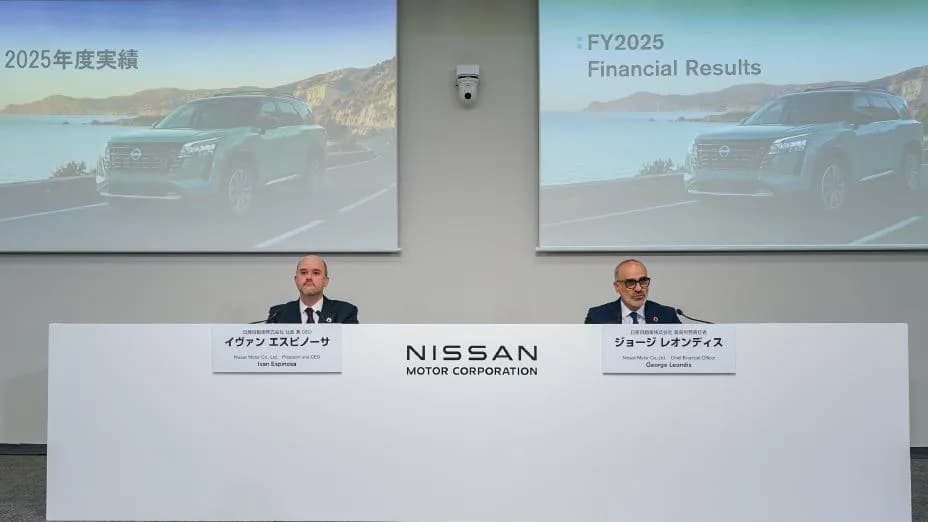
Nissan Motor Co., Ltd. has announced its financial results for the full fiscal year 2025, which ended on March 31, 2026. The company reported a positive operating profit despite navigating a global environment marked by inflationary pressures, tariffs, and varied market performance. Nissan highlighted steady progress under its Re:Nissan strategic plan, aimed at strengthening its business foundation.
Fiscal Year 2025 Performance
For the full fiscal year, Nissan achieved an operating profit of 58.0 billion yen, representing an operating margin of 0.5%. This was attributed to disciplined execution and cost control measures. Global vehicle sales totaled 3.15 million units, contributing to a consolidated revenue of 12.0 trillion yen.
Despite the positive operating profit, net income for the year remained negative at 533.1 billion yen. Automotive free cash flow for the entire fiscal year was also negative, recorded at 480.8 billion yen. However, performance improved significantly in the second half of the year, with automotive free cash flow turning positive and reaching 112 billion yen, signaling early signs of recovery. By the end of the fiscal year, net cash in the automotive business stood at 1.17 trillion yen, with total liquidity maintained at 3.6 trillion yen.
Fourth Quarter Results and FY2026 Outlook
In the fourth quarter of fiscal year 2025, Nissan's consolidated net revenue was 3,429.9 billion yen. Consolidated operating profit for the quarter reached 68.1 billion yen, resulting in an operating profit margin of 2.0%. Net income for the fourth quarter was negative at 282.9 billion yen.
Looking ahead to fiscal year 2026, Nissan anticipates continued challenges, including intensifying competition, foreign exchange fluctuations, ongoing inflation, and geopolitical uncertainties. Despite these headwinds, the company plans to continue advancing its Re:Nissan initiatives. Nissan aims to achieve positive automotive operating profit and free cash flow by the end of FY2026, excluding the impact of tariffs. The company has forecast net revenue of 13.0 trillion yen, an operating profit of 200 billion yen, and a net income of 20 billion yen for FY2026. Nissan does not plan to pay dividends for FY2026 based on this outlook.
Re:Nissan Plan Progress
During fiscal year 2025, Nissan made progress on key initiatives within its Re:Nissan plan, focusing on three main priorities: reducing cost structure, redefining product and market strategy, and reinforcing partnerships. The company made strides toward its 500 billion yen cost reduction target, including 200 billion yen in fixed cost savings and 55 billion yen in variable cost savings.
Production optimization efforts continued, with plans announced to consolidate the global manufacturing footprint from 17 to 10 sites, with execution underway at seven locations. In research and development, Nissan achieved an 18% reduction in engineering cost per hour, moving closer to its 20% target without impacting project timelines. The company also reported improvements in business quality in the U.S. through a retail-driven mix, boosted sales in Japan with focused launches, and implemented a more targeted new energy vehicle (NEV)-led approach in China. These efforts, combined with tighter inventory management and a selective channel strategy, aim to align decisions with value and drive consistent delivery.
Nissan's fiscal year 2025 results indicate a period of foundational strengthening under the Re:Nissan plan, with the company now transitioning towards delivering a more structurally robust business. The focus for fiscal year 2026 will be on disciplined cost management and faster product execution to drive sales and profitability, aiming for sustained positive financial performance despite a complex global market.
Leave a comment
Comments are moderated and may take a moment to appear. Only your first name and the initial of your last name are shown publicly.
Comments
Be the first to comment.