2021-2026 Audi A3/S3/RS3/Q3 Tire Pressure Warning TSB
Audi has released Technical Service Bulletin 2075088/2 to address false tire pressure warnings in the instrument cluster for 2021-2026 A3, S3, RS3, and Q3 models. This issue can be caused by dirt or foreign objects affecting the ABS speed sensors.
 Sarah Mitchell2024 Audi S3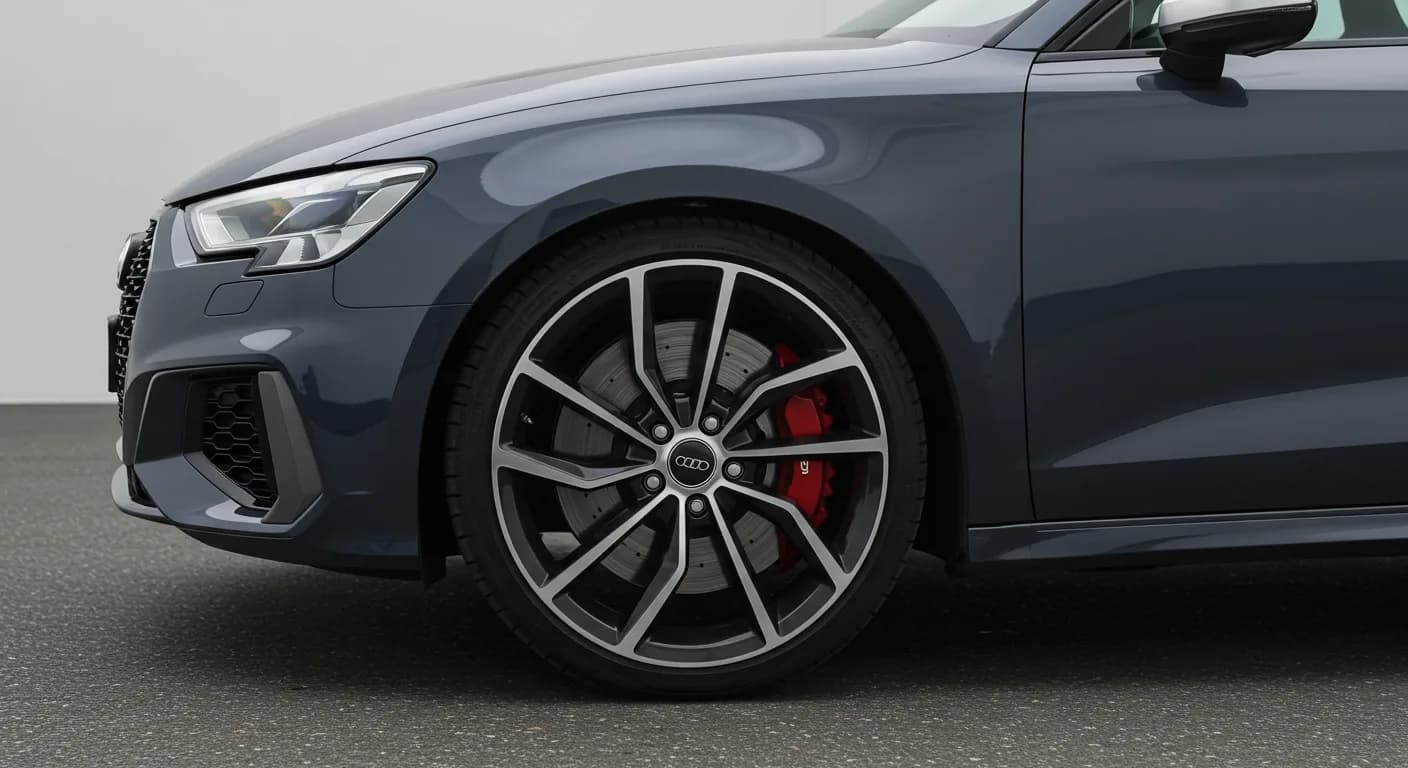
Gilt auch für
- Audi A3
- 2022–2026
- Audi Q3
- 2021–2026
- Audi RS 3
- 2022–2026
- Audi S3
- 2022, 2023, 2025, 2026
Symptoms
Owners of 2021-2026 Audi A3, S3, RS3, and Q3 models may experience a "44 Tire pressure warning in instrument cluster" message, even when there is no actual loss of tire pressure. This false warning can reappear shortly after the tire pressures have been stored or reset in the vehicle's system. The issue is specifically noted as a "tire pressure loss warning display" or "tire pressure information display" activating without cause.
Diagnosis / Trigger Conditions
This persistent Audi S3 tire pressure warning is typically linked to the Anti-lock Braking System (ABS) control unit. Workshop findings indicate that diagnostic trouble codes (DTCs) related to tire pressure warnings are stored in this unit. The technical background explains that if dirt, foreign objects, or grease accumulate around an ABS speed sensor or on the sensor ring of the wheel bearing, the signals from the ABS speed sensor can become distorted. This signal distortion prevents the tire pressure monitoring system from correctly adapting after a reset, causing the warning to reappear quickly.
Repair Procedure Summary
To resolve the false Audi S3 tire pressure warning, technicians should thoroughly inspect the ABS speed sensors and the sensor rings on the wheel bearing. The primary focus is to identify and carefully clean any foreign objects, grease, or dirt from these components. Once all affected dirty components are cleaned, any stored DTCs in the ABS control unit must be erased. This cleaning process aims to restore accurate signal transmission from the ABS speed sensors, allowing the tire pressure monitoring system to function correctly.
Important Warnings for Owners
Audi emphasizes that this repair, identified by TSB 2075088/2, should only be performed if the customer complaint can be clearly reproduced and all specific vehicle criteria (such as model/type, chassis number, engine/motor, gearbox code, PR number(s), part number, software version, and other codes) apply exactly. If the solution is applied to a vehicle that does not meet all criteria, it may not resolve the problem, potentially leading to repeat repairs. In such cases, Audi may reject warranty claims and charge back the cost of parts.
Warranty Information
For warranty claims related to this issue, Audi of America (AoA) provides specific accounting instructions. The relevant service numbers are 4526 for the front sensor ring, 4527 for the rear sensor ring, 4511 for the front speed sensor, and 4515 for the rear speed sensor. The associated damage code for this repair is 010. Dealers must adhere to Audi's warranty guidelines when submitting claims for this service.
Revision History
This Technical Service Bulletin (TSB) 2075088/2 was initially published on September 6, 2024 (Revision 1). A subsequent Revision 2 updated the header to include additional model years.
Source: NHTSA ID: 11025341
Frequently Asked Questions
- What is TSB 2075088/2 about?
- TSB 2075088/2 addresses a common issue in 2021-2026 Audi A3, S3, RS3, and Q3 vehicles where a "44 Tire pressure warning in instrument cluster" appears without actual pressure loss.
- Why does my Audi S3 show a false tire pressure warning?
- The false "tire pressure warning in instrument cluster" in your Audi S3 is typically caused by dirt, foreign objects, or grease accumulating on the ABS speed sensors or their corresponding sensor rings on the wheel bearing. This interferes with the sensor signals, preventing the system from properly adapting tire pressures.
- How is the false tire pressure warning fixed?
- The repair procedure for the false tire pressure warning involves carefully inspecting and thoroughly cleaning the ABS speed sensors and the sensor rings on the wheel bearings to remove any contaminants. After cleaning, any stored diagnostic trouble codes (DTCs) in the ABS control unit are erased.
- Is this repair covered under warranty?
- Yes, if your vehicle meets the specific criteria outlined in TSB 2075088/2, the repair may be covered under warranty. Dealers use specific service numbers like 4526, 4527, 4511, 4515, and damage code 010 for accounting purposes. It's crucial for the dealer to verify the complaint and ensure all vehicle criteria match the TSB.
Related Articles
2024-2025 Audi MMI Emergency Call Fault Software Update TSB
Audi Technical Service Bulletin 2081007/1 addresses MMI function problems and 'Emergency call fault' messages in 2024-2025 Audi A3, S3, RS 3, and Q3 models. A software update for the MMI, OCU, and gateway modules resolves these issues.
2022-2025 Audi Pre Sense Warning, Jolt, or Braking TSB
Audi has released Technical Service Bulletin 2069662/3 to address customer complaints of false 'Audi pre sense' warnings, warning jolts, or unexpected brake engagement in 2022-2025 Audi A3, S3, and RS 3 models. This TSB outlines diagnostic steps for technicians.
2023-2024 Audi A3 / S3 / RS 3 P0A8200 Cooling Fan Fault
Audi has issued Technical Service Bulletin (TSB) 2080516/1 for 2023-2024 A3, S3, and RS 3 models equipped with the 48V MHEV system. It addresses the 'Vehicle electrical system fault' message and diagnostic trouble code P0A8200, related to the hybrid battery cooling fan or low battery charge.
2024-2025 Audi A3, S3, RS 3 Air Flow Intensity Issue TSB
Audi has issued Technical Service Bulletin 2074919/3 for 2024-2025 A3, S3, and RS 3 models regarding a concern where the air flow intensity does not change when the blower level is set higher than 4 in manual AC mode. This is a known software issue.
2024-2025 Audi Virtual Cockpit Display Resets TSB 2076743/2
If your 2024-2025 Audi's virtual cockpit display resets to the on-board computer after the vehicle has been stationary, Technical Service Bulletin 2076743/2 clarifies that this is an intended operational behavior, not a malfunction.
Leave a comment
Comments are moderated and may take a moment to appear. Only your first name and the initial of your last name are shown publicly.
Comments
Be the first to comment.