2022-2024 Audi Q5 / A4 / A5 Engine Faults P060C00 U041600
Audi has released Technical Service Bulletin (TSB) 2076356/4 to address engine control unit drive system faults P060C00 and U041600 in certain 2022-2024 Audi Q5, A4, and A5 models. Owners may notice the 'EPC light is on' or a 'drive system fault' message. The fix involves a software update for the…

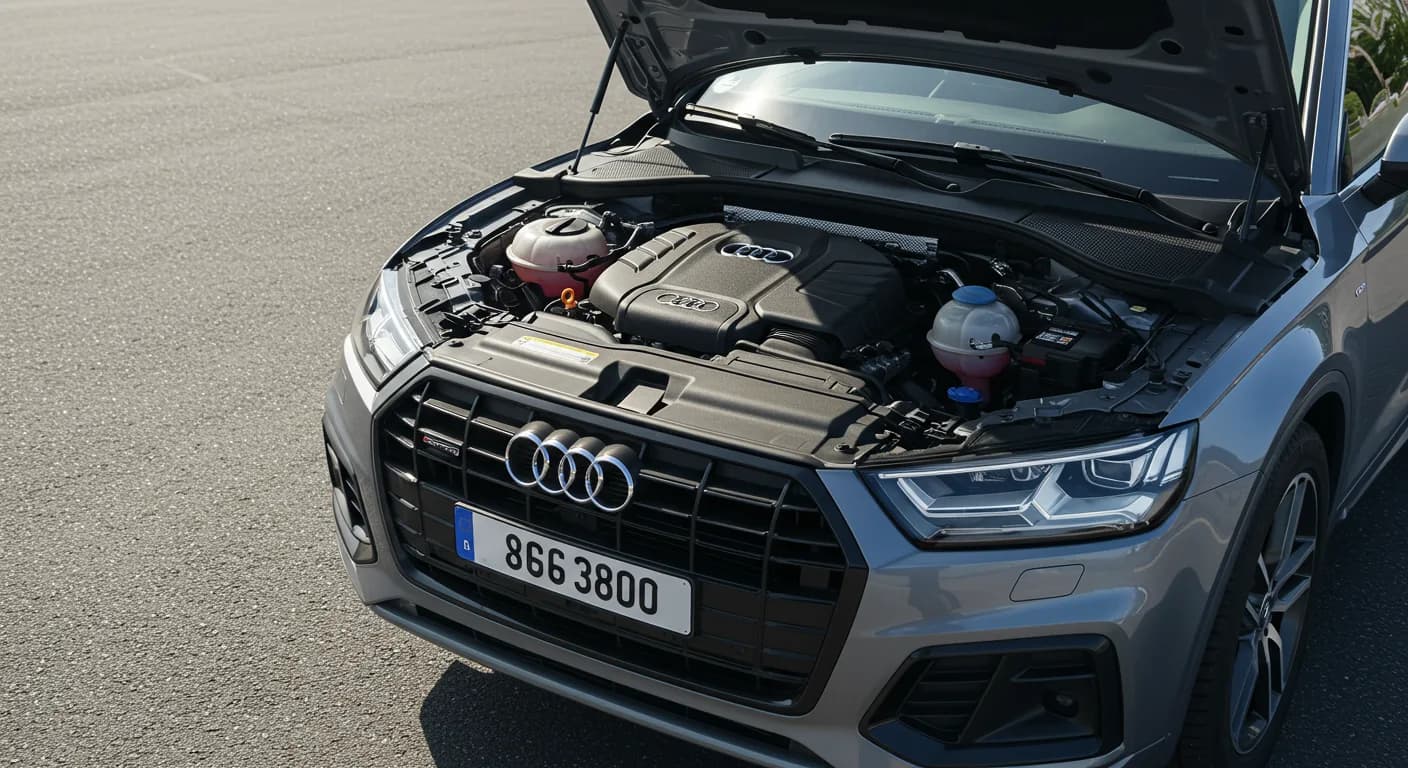
Gilt auch für
- Audi A4
- 2023
- Audi Q5
- 2022, 2024
Symptoms
Owners of affected Audi vehicles may observe specific warnings and messages indicating a potential issue with the engine control unit. The most common indicators include the illumination of the "EPC light is on" on the instrument cluster. Additionally, drivers might see a general "A drive system fault appears in the instrument cluster" message, signaling a problem with the vehicle's powertrain.
Fault Codes / DTCs
When these symptoms occur, a diagnostic scan will typically reveal specific fault codes stored in the engine control unit's memory. These diagnostic trouble codes (DTCs) pinpoint the nature of the software issue:
- P060C00: This code indicates an "Internal Control Module Main Processor Performance with DFCC 44160" fault. It suggests an internal issue with the main processor within the engine control module.
- U041600: This code signifies "Invalid Data Received from Vehicle Dynamics Control Module with DFCC 34193". It points to a communication error where the engine control unit is receiving incorrect data from the vehicle dynamics control module.
These Audi Q5 engine faults P060C00 U041600 are primarily software-related, affecting the DMSA Engine found in the specified models.
Technical Background
Audi has identified that the root cause of these engine control unit drive system faults is a software issue within the engine control unit itself. This software anomaly can lead to the incorrect processing of data or communication errors between critical vehicle modules, triggering the observed symptoms and DTCs.
Important Warnings
Before performing any software update on vehicles equipped with high-voltage components, it is crucial to follow a specific safety protocol. Technicians must remove the high-voltage cable BEFORE entering the SVM code for the software update. Failure to do so could result in the high-voltage battery charging during the update process, which can cause significant damage to the high-voltage components. This critical step ensures the safety of both the technician and the vehicle's electrical system.
Repair Procedure Summary
The resolution for these Audi Q5 engine faults P060C00 U041600 involves updating the software of the Engine control module, specifically the -J623- unit, which is identified by address word 0001. This Technical Service Bulletin (TSB) 2076356/4 supersedes the previous Pending Service Solution (PSS) TSB 2072710, which also addressed these specific engine control unit drive system faults.
The repair process begins by following the comprehensive instructions outlined in TSB 2011732, which details the proper operating procedures for Software Version Management (SVM). After ensuring the high-voltage cable is safely disconnected on relevant vehicles, the engine control unit's software is updated using the SVM action code 01A267. This update installs new software versions, such as 0003 or 0002, depending on the specific model year and existing software part number (e.g., 80A.907.115.B, 80A.907.115.C, 80A.907.115.E, or 8W0.907.115.AM).
Warranty Information
This service is typically covered under warranty. However, if a vehicle is outside of its applicable warranty period, this Technical Service Bulletin is considered informational only, and any repair costs may be the owner's responsibility. Dealers will process warranty claims using Service Number 2470 and Damage Code 0039. The labor operations for the software update are coded as 0151 0010 (referencing the Service Repair Time, SRT, for associated operations) and 0151 0060 (time stated on the diagnostic protocol). All warranty claims must adhere to the Audi Warranty Policies and Procedures Manual, with claims subject to review by Audi Warranty.
Owner Action
If you own a 2022-2024 Audi Q5, 2023 Audi A4, or 2023 Audi A5 and experience the EPC light illuminating or a drive system fault message, it is recommended to contact your authorized Audi dealership. They can diagnose the issue, confirm the presence of DTCs P060C00 or U041600, and perform the necessary software update for the engine control module as per TSB 2076356/4.
NHTSA ID: 11027327
Weitere Revisionen dieses TSB
- 2022-2024 Audi Q5 / A4 EPC Light and Drive System Fault TSBP060C00, U041600
- 2022-2025 Audi A4, A5, Q5 Engine Control Unit Faults P060C00, U041600P060C00, U041600
- 2022-2025 Audi A4/Q5 Drive System Fault P060C00 U041600 TSBP060C00, U041600
- 2022-2025 Audi A4, A5, Q5 Engine Control Unit FaultsP060C00, U041600
- 2022-2024 Audi Q5 EPC Light P060C00 U041600 TSBP060C00, U041600
- 2022-2024 Audi Q5 EPC Light P060C00 U041600 TSBP060C00, U041600
- 2024 Audi Q5 EPC Light & Drive System Fault TSBP060C00, U041600
- 2022-2024 Audi A4/A5/Q5 Lineup Engine ECU Faults P060C00 U041600P060C00, U041600
What Audi Q5 owners report
Counted from the records in our database across 18 model years.
- 1,386
- Owner complaints
- 35
- Recalls
- 4,663
- Service bulletins
- 68
- Crashes reported
- 13
- Fires reported
- 63
- Injuries reported
The 2023 model year
50 complaints, the 11th most of 18 model years on file. Owners reported 7 crashes, 1 fire and 7 injuries for this year, which also has 6 recalls on file.
Engine, the system this article covers, accounts for 338 of 1,386 complaints (24%), including 8 for 2023.
Complaints by model year
| 2010 | 100 | |
|---|---|---|
| 2011 | 143 | |
| 2012 | 168 | |
| 2013 | 92 | |
| 2014 | 106 | |
| 2015 | 100 | |
| 2016 | 78 | |
| 2018 | 209 | |
| 2021 | 74 | |
| 2023 | 50 |
Most-reported systems
- Engine — 338
- Air Bags — 259
- Electrical System — 230
- Fuel/Propulsion System — 140
- Steering — 99
Latest recalls for the 2023 model year
- 25V294000 — Engine (May 2025)
- 25V080000 — Electrical System (Feb 2025)
- 24V898000 — Electrical System (Nov 2024)
Recent owner reports about engine
On July 23, 2026, my 2023 Audi Q5 suddenly lost power while I was driving on the highway, with no prior symptoms before the incident.
Read owner complaints →Total engine failure at ~13.5k miles. 2 out of 4 cylinders and pistons failed, found damage on cylinder walls. Cylinder pressure too high. Failed cylinder leak down test and pressure test. Metal shavings found in oil filter and housing.
Complaints are owner reports filed with NHTSA. They are unverified, and counts depend on how many vehicles were sold, so they are not a failure rate.
Related Articles
2023 Audi Q5 Problems: Engine, Airbag, and EVAP TSBs
The 2023 Audi Q5 has no reported recalls or owner complaints, but several service bulletins address issues like engine faults (P060C00, U041600), airbag warning lights (B120E1B, B100A1B), and EVAP system leaks (P240700, P044200). Owners should be aware of these known problems.
2022-2025 Audi A4, A5, Q5 AC Buttons Not Working TSB
Audi Technical Service Bulletin 2078655/2 details issues with non-functional air conditioning operating unit buttons in 2022-2025 Audi A4, A5, and Q5 models, logging DTC B131207. This bulletin outlines symptoms, diagnostic steps, and the recommended repair procedure for technicians.
2022-2025 Audi Q5 MIL On with DTC U060B00
Audi has issued Technical Service Bulletin 2074392/2 for 2022-2025 Q5 models. It addresses a Malfunction Indicator Lamp (MIL) illuminated due to Diagnostic Trouble Code U060B00, indicating lost communication with the turbocharger/supercharger boost sensor. The fix involves repairing wiring at…
2023-2024 Audi Q5 Turbocharger Boost Control DTC P256300
Audi has issued a manufacturer communication regarding a 'turbocharger boost control position sensor circuit range/performance' fault (DTC P256300) affecting 2023-2024 Audi Q5 models. This document outlines initial diagnostic steps and emphasizes contacting Audi Helpline before attempting any…
2021-2024 Audi Q5/SQ5 Airbag Warning Light On TSB
Audi Technical Service Bulletin 2072023/2 addresses the airbag warning light illuminated with DTC B120E1B in 2021-2024 Audi Q5 and SQ5 models. The issue stems from non-optimal wiring routing causing tension on the driver airbag release valve connector, leading to increased resistance.
Leave a comment
Comments are moderated and may take a moment to appear. Only your first name and the initial of your last name are shown publicly.
Comments
Be the first to comment.