2021-2026 Jeep Wrangler / Gladiator Door Hem Corrosion
This Technical Service Bulletin (TSB 31-001-26) addresses filiform corrosion on the door hem area of 2021-2026 Jeep Wrangler and Gladiator vehicles. The TSB details a repair procedure involving corrosion removal, refinishing, and application of protective coatings to resolve the issue.
 Ahmet Topcu2026 Jeep Wrangler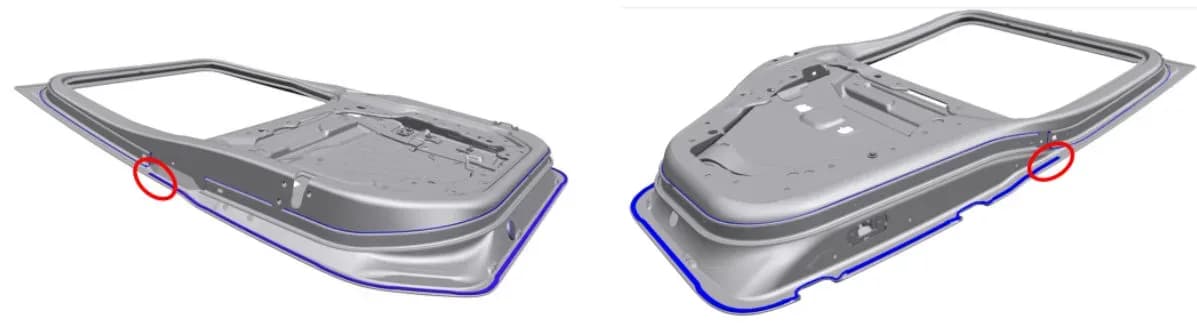
Also applies to
- Jeep Gladiator
- 2021–2026
- Jeep Wrangler
- 2021–2025
Owners of 2021-2026 Jeep Wrangler and Gladiator vehicles may notice a specific type of degradation on their vehicle doors. This issue, identified as "Filiform corrosion at the hem area of the door," is a form of corrosion that can affect the aluminum body panels. Technical Service Bulletin (TSB) 31-001-26, issued on February 17, 2026, provides a detailed repair procedure for this condition.
This TSB is applicable to Jeep Wrangler (JL) models from 2018-2026 and Jeep Gladiator (JT) models from 2020-2026, specifically for vehicles sold in North America, Enlarged Europe, China, Middle East & Africa, and South America markets. The primary cause of this problem is identified simply as corrosion.
Symptoms
The main symptom customers may experience is "Filiform corrosion at the hem area of the door." This type of corrosion appears as thread-like filaments growing under the paint film, often originating from a scratch or break in the coating. If you observe this on your vehicle's door hems, it indicates the presence of this specific corrosion issue.
Diagnosis and Trigger Conditions
Diagnosis for this issue is straightforward. If a customer reports or a technician observes the symptom of "Filiform corrosion at the hem area of the door," the repair procedure outlined in TSB 31-001-26 should be performed. There are no specific fault codes (DTCs) associated with this body panel corrosion.
Repair Procedure Summary
The repair for the Jeep Wrangler door corrosion involves a multi-step process to remove the existing corrosion and refinish the affected area. The procedure, detailed in TSB 31-001-26, includes:
- Door Removal and Preparation: The affected door is removed and placed on a padded stand to protect its exterior surface. The trim panel and carrier plate are also removed.
- Corrosion Removal: Factory-applied seam sealer is removed, and any pitted areas are cleaned using a 3M Clean & Strip disc or equivalent abrasive wheel.
- Sanding and Cleaning: The existing OEM coating is feathered-edged beyond the bare aluminum areas using 320-400 grit sandpaper. The area is then cleaned with PPG SX533 Aluminum Cleaner, followed by PPG SX503 Aluminum Conditioner.
- Masking and Priming: The inside of the door is masked using a reverse taping technique to prevent paint build-up. One to two coats of F4921 Epoxy Primer are applied, with care taken to melt in the edges of the primer.
- Seam Sealer Application: 2K seam sealer is applied in the hinge opening areas and along the exposed hem seam. Special attention is given to reducing the width and feathering the seam sealer near blend areas.
- Refinishing: After ensuring no pits or sanding marks are visible (applying primer surfacer if needed), basecoat color is applied to achieve color match and hiding. This is followed by a clearcoat application.
- Final Protection: Masking tape is applied to drain holes to prevent overspray. Finally, 3M Cavity Wax or an equivalent product is applied to the inside of the door shell between the door skin and frame for additional protection against future Jeep Wrangler door corrosion.
Required Tools or Parts
To perform the repair for this Jeep Wrangler door corrosion, specific materials are required:
- 3M Clean & Strip Disc
- PPG SX533 Aluminum Cleaner
- PPG SX503 Aluminum Conditioner
- F4921 Epoxy Primer
- 3M Cavity Wax
These parts are listed as NPN (No Part Number specified), indicating they are generic or commonly available workshop supplies.
Important Warnings
Owners and technicians should be aware of specific instructions provided in the TSB:
- CAUTION! Allow one-hour dry time or force dry for 25 minutes at 60 °C (140 °F) for the epoxy primer to dry before applying seam sealer.
- NOTE: For SA (South America) market only, after applying this TSB, it is not necessary to send DID-I or DID-A (Dealer Information Document - Inspection or Dealer Information Document - Authorization).
- NOTE: If pits or sanding/grinding marks are noticeable, apply primer surfacer (not shown) to achieve filling.
- NOTE: Allow clearcoat to air dry overnight or force dry for 25 minutes at 60 °C (140 °F).
Owner Action
If you observe "Filiform corrosion at the hem area of the door" on your 2021-2026 Jeep Wrangler or Gladiator, it is recommended to schedule an appointment with an authorized Jeep service center. The repair, identified by Labor Operation Numbers 23-75-53-07 (front doors) and 23-75-54-07 (rear doors), has an estimated labor time of 3.9 hours per door. The failure code associated with this repair is ZZ. A material allowance of $46.46 is also noted. This repair is reimbursable within the provisions of the vehicle's warranty.
Source: NHTSA ID: 11029684
Gallery
16 images
Frequently Asked Questions
- What is filiform corrosion on Jeep Wrangler and Gladiator doors?
- Filiform corrosion is a type of corrosion that appears as thread-like filaments growing under the paint film, typically starting from a small defect in the coating. For 2021-2026 Jeep Wrangler and Gladiator vehicles, it specifically affects the aluminum body panels at the door hem area.
- How does TSB 31-001-26 address door hem corrosion?
- TSB 31-001-26 outlines a comprehensive repair procedure. This involves removing the affected door, cleaning and sanding the corroded areas, applying specialized aluminum cleaner, conditioner, epoxy primer, seam sealer, and then refinishing with basecoat and clearcoat. Finally, a cavity wax is applied for long-term protection against future Jeep Wrangler door corrosion.
- What parts are used in the repair for Jeep Wrangler door corrosion?
- The repair requires several materials, including a 3M Clean & Strip Disc, PPG SX533 Aluminum Cleaner, PPG SX503 Aluminum Conditioner, F4921 Epoxy Primer, and 3M Cavity Wax. These are generally standard workshop supplies used in body repair.
- Is the repair for door hem corrosion covered under warranty?
- Yes, according to TSB 31-001-26, the repair for filiform corrosion at the door hem area is reimbursable within the provisions of your vehicle's warranty. It's recommended to contact your authorized Jeep dealer for specific warranty coverage details.
Related Articles
2026 Jeep Wrangler Problems: Recalls, Complaints & TSBs
The 2026 Jeep Wrangler faces a recall for insufficient child seat anchor welds, alongside numerous service bulletins addressing issues like unresponsive power tops, degrading steering alignment, heated steering wheel malfunctions, and driver assistance system errors. This profile details known…
2026 Jeep Wrangler Child Seat Anchor Recall
Chrysler (FCA US, LLC) has issued a recall (NHTSA ID: 26V224000, FCA ID: 27D) for certain 2026 Jeep Wrangler vehicles. The recall addresses insufficient welds on the second-row, right-side child seat tether anchors, which could reduce restraint effectiveness during a crash.
2024-2026 Stellantis UGDO Inoperable TSB 08-134-26
If your 2024-2026 Stellantis vehicle's Universal Garage Door Opener (UGDO) is inoperable or you have questions about its HomeLink® programming, Technical Service Bulletin (TSB) 08-134-26 provides guidance. Learn about DTC B251D1-00 and the recommended steps.
2026 Jeep Wrangler Heated Steering Wheel TSB 08-119-26
A Technical Service Bulletin (TSB 08-119-26) has been issued for the 2026 Jeep Wrangler regarding issues with the heated steering wheel not getting hot enough or not working. The fix involves a software update to the Comfort Seat Wheel Module (CSWM).
2026 Jeep Wrangler DASM Software Update TSB
This TSB, identified as 2026 Jeep Wrangler manufacturer_communication, addresses Driver Assistant System Module (DASM) issues in the 2026 Jeep Wrangler. It covers DTCs like C2206-00 and C2318-49, which can cause warning messages such as 'ACC/FCW Unavailable Service Required'.
Leave a comment
Comments are moderated and may take a moment to appear. Only your first name and the initial of your last name are shown publicly.
Comments
Be the first to comment.