2023 Hyundai Tucson Hybrid DTC Misdiagnosis & Oil Dilution TSB
Hyundai has released Technical Service Bulletin (TSB) 23-EE-002H for 2023 Tucson Hybrid and Plug-in Hybrid vehicles. This TSB provides an Engine Control Module (ECM) and Hybrid Control Unit (HCU) software update to resolve issues like DTC misdiagnosis for codes such as P1441, P1A77, P00B7, P2118…
 Sarah Mitchell2023 Hyundai Tucson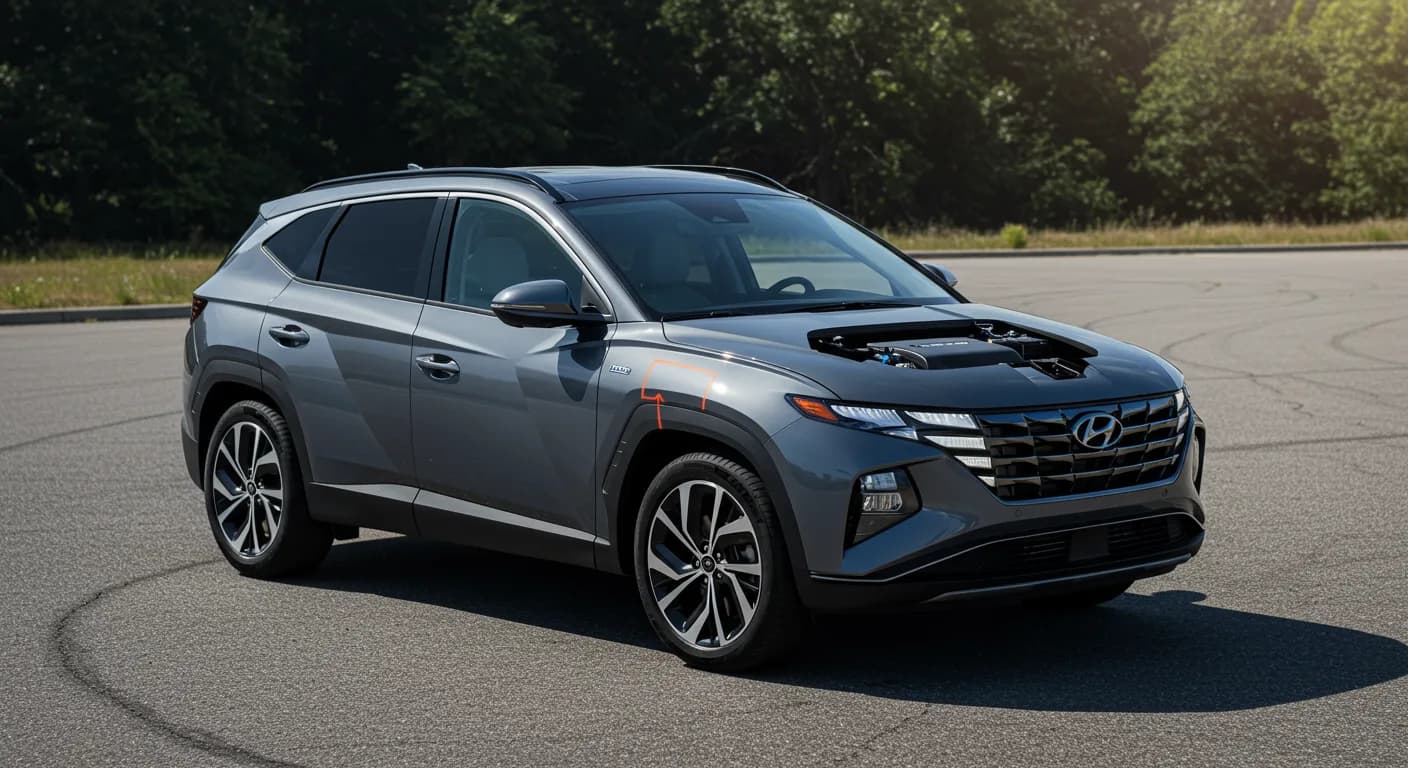
Hyundai has issued Technical Service Bulletin (TSB) 23-EE-002H to improve the performance and diagnostic accuracy of 2023 Tucson Hybrid (NX4 HEV) and Tucson Plug-in Hybrid (NX4 PHEV) vehicles equipped with 1.6L Gamma II turbocharged engines. This bulletin supersedes previous TSB 22-FL-003H and focuses on resolving issues related to Hyundai Tucson DTC misdiagnosis and engine oil dilution through a software upgrade for the Engine Control Module (ECM) and Hybrid Control Unit (HCU).
The software update aims to correct several misdiagnosis conditions and improve engine operation, particularly during cold weather. Owners experiencing warning lights or unusual engine behavior should be aware of this important update.
Symptoms and Misdiagnosis Conditions
This TSB addresses several specific Diagnostic Trouble Codes (DTCs) and their associated symptoms or misdiagnosis conditions:
- P1441 (EVAP System Flow During Non-Purge Condition): This code may be misdiagnosed due to insufficient pressure deviation margin when driving at constant speed with a low engine load. The software update includes logic improvements to eliminate this misdiagnosis.
- P1A77 (Check Generator Belt): Misdiagnosis can occur due to poor synchronization release when the engine is stopped. The update improves logic to release synchronization even if the CAM signal is active.
- P00B7 (Engine Coolant Flow Low/Performance): This relates to an ITM control error caused by a temporary ball valve stuck. The software improves the ITM cleaning logic, increasing the number of cleaning attempts from one to five times.
- P2118 (Throttle Actuator Control Motor Current Range/Performance) / P0401 (EGR Flow Insufficient Detected): These codes indicate issues with throttle actuator control and EGR flow.
- P0236 (Turbocharger System Boost Sensor A Circuit Range/Performance) / P0299 (Turbocharger underboost): These codes are often triggered by EGR condensate freezing. The update changes the EGR Flow diagnosis condition from -40℃ to -7℃ to prevent false triggers.
- P2B60 (Engine Coolant Flow Control Valve Position Sensor Circuit Range/Performance): This code indicates insufficient control at the end point when the ITM cleaning logic completes its operation. The software update improves the ITM cleaning logic for better control.
Oil Dilution Issue
Beyond DTC misdiagnosis, the TSB also addresses an engine oil dilution problem. Some vehicles may experience increased oil consumption and emit white smoke. This occurs because fuel dilutes the engine oil due to frequent transitions between Electric Vehicle (EV) mode and Engine mode, especially during the winter season.
The software update modifies the fuel injection strategy for temperatures below 10℃ and adds an oil heating function based on the driving pattern. This aims to mitigate the oil dilution issue and improve engine longevity.
Diagnosis and Trigger Conditions
The root cause for many of these DTCs is often a misinterpretation by the Engine Control Module (ECM) or Hybrid Control Unit (HCU) under specific driving or environmental conditions. For instance, the Hyundai Tucson DTC misdiagnosis for P1441 occurs under low engine load, while P0236 and P0299 are linked to EGR condensate freezing in cold weather. The software improvements are designed to refine these diagnostic parameters, preventing false error codes and ensuring more accurate system monitoring.
Repair Procedure Summary
The repair involves performing a software upgrade for the Engine Control Module (ECM) and Hybrid Control Unit (HCU) using the Global Diagnostic System (GDS). Technicians must first verify the vehicle's current ECU/HCU ROM ID against the provided tables to confirm applicability.
- Preparation: Attach a 12V battery charger to the vehicle before starting the GDS ECU/HCU Update. This is crucial as Tucson Plug-in/Tucson Hybrid models use a smaller battery, and a power interruption can cause issues.
- GDS Update: Initially perform the GDS ECU/HCU Update in Auto Mode using GDS Event #911 for the ECU, and GDS Event #939 (HEV) or #940 (PHEV) for the HCU.
- Recovery (if needed): If the ECU Update fails in Auto Mode, disconnect the battery cables and touch them together for one minute. Reconnect the battery cables, attach the battery charger, and then perform the update in Manual Mode to recover. Refer to TSB 15-GI-001 (GDS Mobile) for general instructions.
- Post-Update: After the ECU Update is completed, check for any Diagnostic Trouble Codes and erase them.
Required Tools or Parts
- 12V Battery Charger: Essential for maintaining stable voltage during the software update process.
- Global Diagnostic System (GDS): Used to perform the ECU/HCU software upgrade.
- Causal Part Numbers: 39131-2MNCO (for NX4 HEV) and 39131-2MNDO (for NX4 PHEV) are specified for warranty claims related to the ECM/HCU upgrade.
Important Warnings
Technicians and owners should be aware of the following critical instructions:
Frequently Asked Questions
- What is the purpose of Hyundai TSB 23-EE-002H?
- TSB 23-EE-002H aims to resolve various Diagnostic Trouble Code (DTC) misdiagnosis issues and address engine oil dilution problems in 2023 Hyundai Tucson Hybrid and Plug-in Hybrid vehicles through an Engine Control Module (ECM) and Hybrid Control Unit (HCU) software update.
- Which DTCs are specifically addressed by this TSB?
- This TSB addresses misdiagnosis for DTCs including P1441 (EVAP System Flow), P1A77 (Check Generator Belt), P00B7 (Engine Coolant Flow), P2118 (Throttle Actuator Control), P0401 (EGR Flow), P0236 (Turbocharger Boost Sensor), P0299 (Turbocharger underboost), and P2B60 (Engine Coolant Flow Control Valve Position Sensor).
- How does the TSB fix the oil dilution issue in the Hyundai Tucson?
- The software update modifies the fuel injection strategy for temperatures below 10℃ and incorporates an oil heating function based on driving patterns. This helps prevent engine oil from being diluted by fuel, which can occur during frequent transitions between EV and Engine modes, especially in winter.
- What is required before performing the software update?
- Before performing the GDS ECU/HCU Update, a 12V battery charger must be attached to the vehicle. This prevents a battery saver condition from occurring, as Tucson Plug-in/Tucson Hybrid models utilize a smaller battery.
- What should I do if the ECU Update fails in Auto Mode?
- If the ECU Update fails in Auto Mode, you should disconnect the battery cables and touch them together for one minute. Then, reconnect the battery cables, attach the battery charger, and perform the update in Manual Mode to recover.
Related Articles
Should 2023 Hyundai Tucson Owners Worry? Fire Risk & TSBs
The 2023 Hyundai Tucson faces a significant fire risk recall (NHTSA ID 23V526000) related to its Idle Stop & Go oil pump. Additionally, owners may encounter various issues addressed by service bulletins, including engine misfires, Check Engine Light warnings, Bluelink connectivity problems, and…
2022-2023 Hyundai Tucson Check Engine Light DTC P218100
Hyundai has issued Technical Service Bulletin 26-EM-004H for 2022-2023 Tucson (NX4, NX4A) vehicles experiencing a Check Engine Light due to DTCs P218100, P2181F0, or P2181F1. The fix involves replacing the Integrated Thermal Management (ITM) module and updating the Engine Control Module (ECM) and…
2021-2023 Hyundai Misfire DTCs TSB 26-FL-001H
Hyundai Technical Service Bulletin 26-FL-001H addresses engine misfire diagnostic trouble codes (DTCs) P0300, P0301, P0302, P0303, and P0304 in certain 2021-2023 Hyundai Santa Fe, Santa Cruz, Sonata, and Tucson vehicles. The issue stems from internally leaking GDI fuel injectors.
2022-2024 Hyundai Santa Cruz / Tucson Manual Speed Limit Assist
This communication explains the Manual Speed Limit Assist (MSLA) feature in 2022-2024 Hyundai Santa Cruz and Tucson vehicles, detailing its function, activation, and how it helps drivers maintain speed limits.
2021-2025 Hyundai Bluelink Connectivity AVN Pinhole Reset
Hyundai has issued Service Campaign 25-01-024H to address a loss of Bluelink connectivity or interruptions in service functions. This issue, often linked to Verizon's network, is resolved by performing an AVN pinhole reset.
Leave a comment
Comments are moderated and may take a moment to appear. Only your first name and the initial of your last name are shown publicly.
Comments
Be the first to comment.