2021 Hyundai Engine Oil Consumption TSB 21-EM-003H
This Hyundai Technical Service Bulletin 21-EM-003H provides comprehensive inspection and repair guidelines for 2021 Hyundai vehicles equipped with 4-cylinder gasoline engines that are experiencing engine oil consumption. It outlines a multi-step process including initial oil level checks, mileage…
 Ahmet Topcu2021 Hyundai Tucson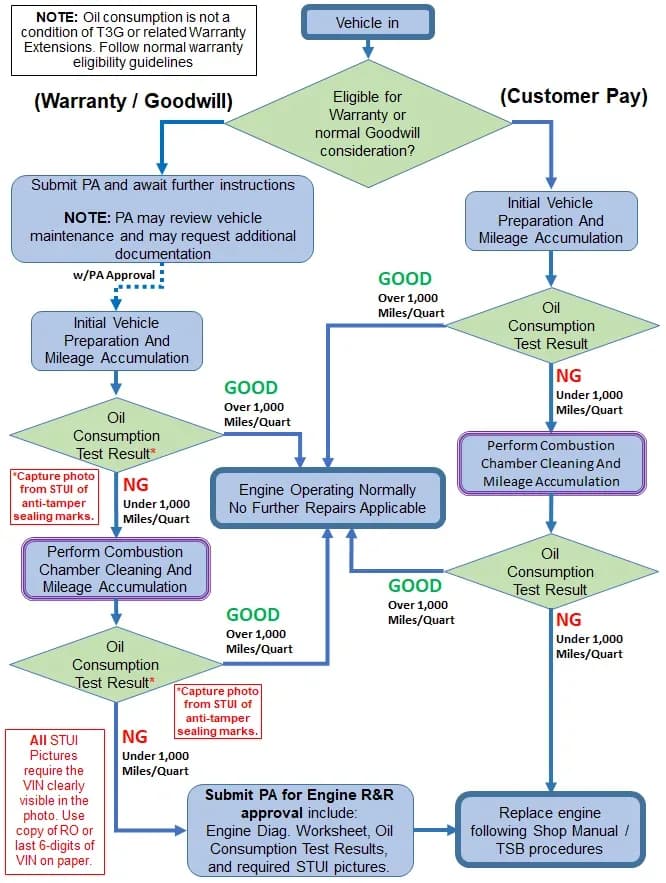
Also applies to
- Hyundai Accent
- 2021
- Hyundai Elantra
- 2021
- Hyundai Kona
- 2021
- Hyundai Palisade
- 2021
- Hyundai Santa Fe
- 2021
- Hyundai Sonata
- 2021
- Hyundai Veloster
- 2021
- Hyundai Venue
- 2021
▸ Show 2 more▾ Show fewer
Hyundai has issued Technical Service Bulletin (TSB) 21-EM-003H to address concerns regarding engine oil consumption in various 2021 Hyundai models equipped with 4-cylinder gasoline engines. This bulletin provides a comprehensive set of inspection procedures and repair guidelines for technicians to diagnose and resolve instances of excessive Hyundai engine oil consumption.
The TSB details a multi-stage process, starting with an initial oil level inspection, followed by a controlled mileage accumulation test, and potentially a combustion chamber cleaning procedure if the oil consumption exceeds specified limits. For severe cases where cleaning is insufficient, engine replacement guidelines are also provided.
Important Warnings
Owners and technicians should be aware of specific conditions and warnings outlined in TSB 21-EM-003H:
- "NOTE: Oil consumption is not a condition of T3G or related Warranty Extensions. Follow normal warranty eligibility guidelines" This means warranty claims for oil consumption must adhere to standard warranty eligibility criteria.
- "The procedure outlined in this TSB does not apply if the engine is exhibiting abnormal noise or showing signs of internal damage. Diagnose the existing condition and repair accordingly." If the engine has other severe issues, this TSB's procedure is not the starting point.
- "Never turn the engine 'ON' until the cleaning procedure has been fully completed." This is a critical safety and procedural warning during the combustion chamber cleaning.
- "Any residual cleaning fluid may escape out of the spark plug holes during the initial cranking process. To prevent any fluid splatter, insert shop towels onto each of the spark plug tubes when cranking. Immediately wipe any splashed residue from the vehicle." This advises technicians on how to manage cleaning fluid during engine cranking.
Symptoms of Engine Oil Consumption
Owners may notice their 2021 Hyundai vehicle requires frequent oil top-offs between scheduled oil changes, indicating potential Hyundai engine oil consumption. While the TSB does not list specific dashboard warning lights, a low oil level warning could appear if the oil level drops significantly.
Diagnosis and Inspection Process
The inspection process for Hyundai engine oil consumption involves several key steps:
Initial Vehicle Preparation and Inspection
- Review Maintenance History: Technicians first check the vehicle's service records to ensure proper engine oil and filter changes have been performed according to the owner's manual. Poor maintenance can contribute to oil consumption due to carbon deposits, oil sludge, or abnormal wear.
- Initial Oil Level Check: The engine oil level is checked. If it's below the 'L' mark, the level is recorded, and any external oil leaks are inspected and repaired. Oil is then refilled to the 'F' line using 5W-30 viscosity oil with API Service Grade SN Plus or newer.
- Anti-Tamper Sealing: The oil drain plug and oil filter are sealed using an anti-tamper marking product, such as Steelman Security Seal (P/N 00232-19083), to prevent unauthorized tampering during the test period. This step is not applicable if the service is customer-paid.
- Mileage Accumulation: After initial preparation, the vehicle must be driven for at least 1,000 miles before the next inspection. Technicians use Op Code 21000F00 for this initial preparation visit.
After Mileage Accumulation Inspection
- Re-check Sealing and Leaks: After 1,000 miles, the anti-tamper seals on the oil filler cap, oil filter, and drain plug are checked. Any damage to the seals or new oil leaks require repeating the initial inspection and mileage accumulation.
- Oil Level Re-check and Calculation: The engine oil level is re-checked and refilled to the 'F' line. The amount of oil added and the driving distance are used to calculate the oil consumption rate in Miles/Quart.
If the oil consumption is above 1,000 Miles/Quart, the vehicle passes the inspection, and no further repair is needed. Op Code 21000F02 is used for this outcome. However, if the oil consumption is under 1,000 Miles/Quart, the vehicle proceeds to the combustion chamber cleaning procedure.
Combustion Chamber Cleaning Procedure
If the oil consumption test indicates excessive consumption, the next step is a combustion chamber cleaning. This procedure can also be performed as routine maintenance every 36,000 miles to maintain engine cleanliness.
- Engine Warm-up: The engine is idled for about 10 minutes to reach normal operating temperature.
- Spark Plug Removal: The fuel pump relay is removed, and the fuel control and ignition coil connectors are disconnected. All four spark plugs are then removed. An air blow gun is used to clear debris from the spark plug tubes.
- Cleaning Fluid Injection: Valvoline Intake Cleaner (P/N 00232-19103) is injected into each cylinder through the spark plug hole. A minimum of 50cc and a maximum of 66.5cc per cylinder is specified.
- Cylinder Pressurization: Each cylinder is pressurized to 30-45 PSI for 3 minutes using an air bleeding tool (09580-3D100) or a pressurized cylinder leak-down testing tool. The crank must be rotated to Top Dead Center (TDC) on the compression stroke for each cylinder to ensure the cleaning fluid reaches the piston ring lands.
- Fluid Agitation: Hoses and adaptors (from Cleaning Kit KQ234-C6100FFF) are connected between cylinders (1-3 and 2-4). The engine is then cranked for 3 seconds, three times, to agitate the cleaning fluid within the combustion chambers.
- Soaking: The cleaning fluid is allowed to soak in the combustion chamber for at least 8 hours, preferably overnight.
- Fluid Removal: After soaking, the remaining cleaning fluid is removed from the combustion chambers using a suction tool, pneumatic fluid evacuator, or syringe.
- Engine Cranking: The engine is cranked for 3 seconds, repeated two more times after 5-second intervals, to expel any remaining fluid. Shop towels are inserted into the spark plug tubes to prevent fluid splatter.
- Oil and Filter Change: The engine oil and filter are replaced according to the vehicle's shop manual, using 5W-30 Full Synthetic oil (API SN PLUS/SP, ILSAC GF4/GF5 or higher).
- Reassembly and Final Steps: Spark plugs, fuel control, and ignition coil connectors are reinstalled, ensuring lock tabs are secure. The fuel pump fuse is reinstalled. The engine is idled for 10 minutes, with brief increases to 3,000 RPM, to clear combustion chambers. The engine oil level is topped off to 'F'. Op Code 21000F01 is used for this visit.
- Post-Cleaning Mileage Accumulation: The vehicle must again accumulate at least 1,000 miles to determine the effectiveness of the cleaning. A final oil consumption inspection is performed. If consumption is now above 1,000 Miles/Quart, the repair is complete (Op Code 21000F02). If still under 1,000 Miles/Quart, engine replacement is required (Op Code 21000F03).
Required Tools or Parts
To perform the inspection and repair procedures outlined in TSB 21-EM-003H, specific parts and tools are required:
- Cleaning Fluid: P/N 00232-19103 (Valvoline Professional Series Intake Cleaner #884526, 18oz bottle). One bottle is used per vehicle.
- Cleaning Kit: P/N KQ234-C6100FFF (Complete kit including adaptors, hoses, syringe, and pressurization adaptor).
- Individual components: KQ234-C6101FFF (Adaptor 4EA), KQ234-C6102FFF (Hose 2EA), KQ234-C6103FFF (Syringe & Hose 2EA), KQ234-C6104FFF (Pressurization Adaptor 1EA), KQ234-C6105FFF (KIT case 1EA).
- Security Seal: P/N 00232-19083 (Steelman Security Seal). Each tube can be used for at least 20 vehicles.
- Air Bleeding Tool: P/N 09580-3D100 (or equivalent pressurized cylinder leak-down testing tool).
For engine replacement, specific long-block and service kit part numbers are listed in the TSB, varying by model, engine type (e.g., 2.4 GDI, 2.0 T-GDI, 1.6 GDI), and model year. Examples include 21101-2GK50QQHRM for Sonata (YFa 11-14MY) and 21111-2GK50QQH for corresponding service kits.
Warranty Information and Operation Codes
Hyundai provides specific Operation Codes (OP CODES) for warranty claims related to this TSB:
- 21000F00: Engine Oil Inspection (Initial Vehicle Preparation) - 0.6 M/H
- 21000F01: Engine Oil Inspection (After Mileage Accumulation), Combustion Chamber Cleaning and Tamper Sealing - 2.3 M/H
- 21000F02: Engine Oil Inspection (After Any Mileage Accumulation) Inspection Test Result: OK (No Engine R&R) - 0.6 M/H
- 21000F03: Engine Oil Inspection (After Cleaning and Retest) Inspection Test Result: NG (Requires Engine R&R) - 0.6 M/H
Various engine replacement OP CODES (e.g., 21000F04 through 21000F15) are also provided, depending on the specific model, engine, and drivetrain (2WD/4WD). An additional OP Code, 21000F17, is used for RADAR ADJUSTMENT on vehicles equipped with Smart Cruise Control (SCC) if engine replacement is performed.
Owner Action
If you own a 2021 Hyundai model with a 4-cylinder gasoline engine and suspect your vehicle is consuming excessive oil, it is recommended to schedule an appointment with an authorized Hyundai dealer. They will be able to perform the inspection and repair procedures outlined in TSB 21-EM-003H to diagnose and address the Hyundai engine oil consumption issue.
Source: NHTSA ID: 10189989
Gallery
14 images
Frequently Asked Questions
- What is Hyundai TSB 21-EM-003H about?
- Hyundai TSB 21-EM-003H provides detailed inspection procedures and repair guidelines for 2021 Hyundai vehicles equipped with 4-cylinder gasoline engines that are experiencing excessive engine oil consumption.
- How is engine oil consumption diagnosed under TSB 21-EM-003H?
- Diagnosis involves an initial oil level check, sealing of the oil drain plug and filter with Steelman Security Seal (P/N 00232-19083), a 1,000-mile driving test, and a subsequent oil level re-check and calculation of the oil consumption rate. If consumption is below 1,000 Miles/Quart, further action is needed.
- What is the primary repair for excessive oil consumption according to this TSB?
- The primary repair is a combustion chamber cleaning procedure using Valvoline Intake Cleaner (P/N 00232-19103) and specialized cleaning tools. If this cleaning does not resolve the issue, engine replacement may be required.
- Are there specific warranty codes for this issue?
- Yes, Hyundai uses specific Operation Codes (OP CODES) for warranty claims. For example, 21000F00 is for the initial inspection, 21000F01 for cleaning and sealing, and 21000F03 if engine replacement is ultimately needed after cleaning.
- Which models are covered by this TSB?
- This TSB applies to various 2021 Hyundai models equipped with 4-cylinder gasoline engines, including the Tucson, Veloster, Santa Fe, Kona, Palisade, Accent, Venue, Elantra, and Sonata.
Related Articles
2021 Hyundai Tucson Health Check: Engine & Paint TSBs
For the 2021 Hyundai Tucson, there are no reported recalls, owner complaints, or federal investigations. However, owners should be aware of several manufacturer service bulletins (TSBs) addressing engine emissions, potential engine bearing issues, white paint peeling, and an anti-theft ignition…
2021 Hyundai Tucson Emissions Logic Update (9C2)
Hyundai Service Campaign 9C2 addresses elevated engine-out emissions in certain 2021 Hyundai Tucson models by updating the Engine Control Module (ECM) software. This update helps ensure compliance with emissions standards and prevents failed inspections.
2015 Hyundai Sonata GDS Event 1383 Campaign Suspended
Hyundai Motor America has temporarily suspended Service Campaign 9C2, related to software GDS event #1383, for the 2015 Hyundai Sonata (LFA) 2.4L. Vehicles will not show this campaign as open in WebDCS during the suspension period.
2021 Hyundai Tucson GDS Event #1383 Engine Investigation
Hyundai is actively investigating a software-related engine issue, identified as GDS event #1383. While primarily concerning 2015 Sonata 2.4L vehicles, this manufacturer communication is linked by NHTSA to the 2021 Hyundai Tucson, indicating an ongoing review for a resolution.
2010-2021 Hyundai Engine Bearing TSB 26-01-033H
Hyundai Technical Service Bulletin (TSB) 26-01-033H is a critical reference for Op codes and part numbers under Service Campaign T6G. This campaign addresses engine bearing inspection and replacement for various Hyundai models from 2010-2021, often triggered by DTC P1326 and "Abnormal Engine Noise."
Leave a comment
Comments are moderated and may take a moment to appear. Only your first name and the initial of your last name are shown publicly.
Comments
Be the first to comment.