2016-2017 Honda Civic Cylinder Head Gasket Warranty Extended
Honda has issued Service Bulletin 26-097, extending the warranty for cylinder head gasket issues in certain 2016-2017 Civic and Civic Si vehicles. This addresses problems like overheating, coolant loss, and misfire, even if specific DTCs are not present.

Also applies to
- Honda Civic
- 2017
- Honda Civic Si
- 2017
Honda has released Service Bulletin 26-097, Version 3, dated September 25, 2026, to address potential issues with the cylinder head gasket in certain 2016-2017 Honda Civic 1.5L Turbo 6MT and 2017 Honda Civic Si models. This bulletin extends the warranty coverage for this condition, which can lead to various engine problems.
The warranty extension is designed to ensure customer satisfaction and confidence, covering repairs related to reduced cylinder head gasket effectiveness. This is particularly important for owners experiencing symptoms of engine trouble. The coverage is valid until May 31, 2027, regardless of the vehicle's time in service or mileage.
Symptoms
Owners of affected 2016-2017 Honda Civic vehicles may experience several symptoms related to a compromised cylinder head gasket. These include engine overheating, noticeable coolant loss, and engine misfire. These issues can significantly impact vehicle performance and reliability.
Fault Codes / DTCs
In some cases, the engine control unit may store diagnostic trouble codes (DTCs) ranging from P0300 to P0304. These codes indicate a misfire condition in one or more cylinders:
- P0300: Random/Multiple Cylinder Misfire Detected
- P0301: Cylinder 1 Misfire Detected
- P0302: Cylinder 2 Misfire Detected
- P0303: Cylinder 3 Misfire Detected
- P0304: Cylinder 4 Misfire Detected
It is important to note that the presence of these DTCs is not a requirement for the repair under this warranty extension. An ALL DTC check result with or without DTCs P0300 through P0304 is acceptable for warranty claims.
Diagnosis / Trigger Conditions
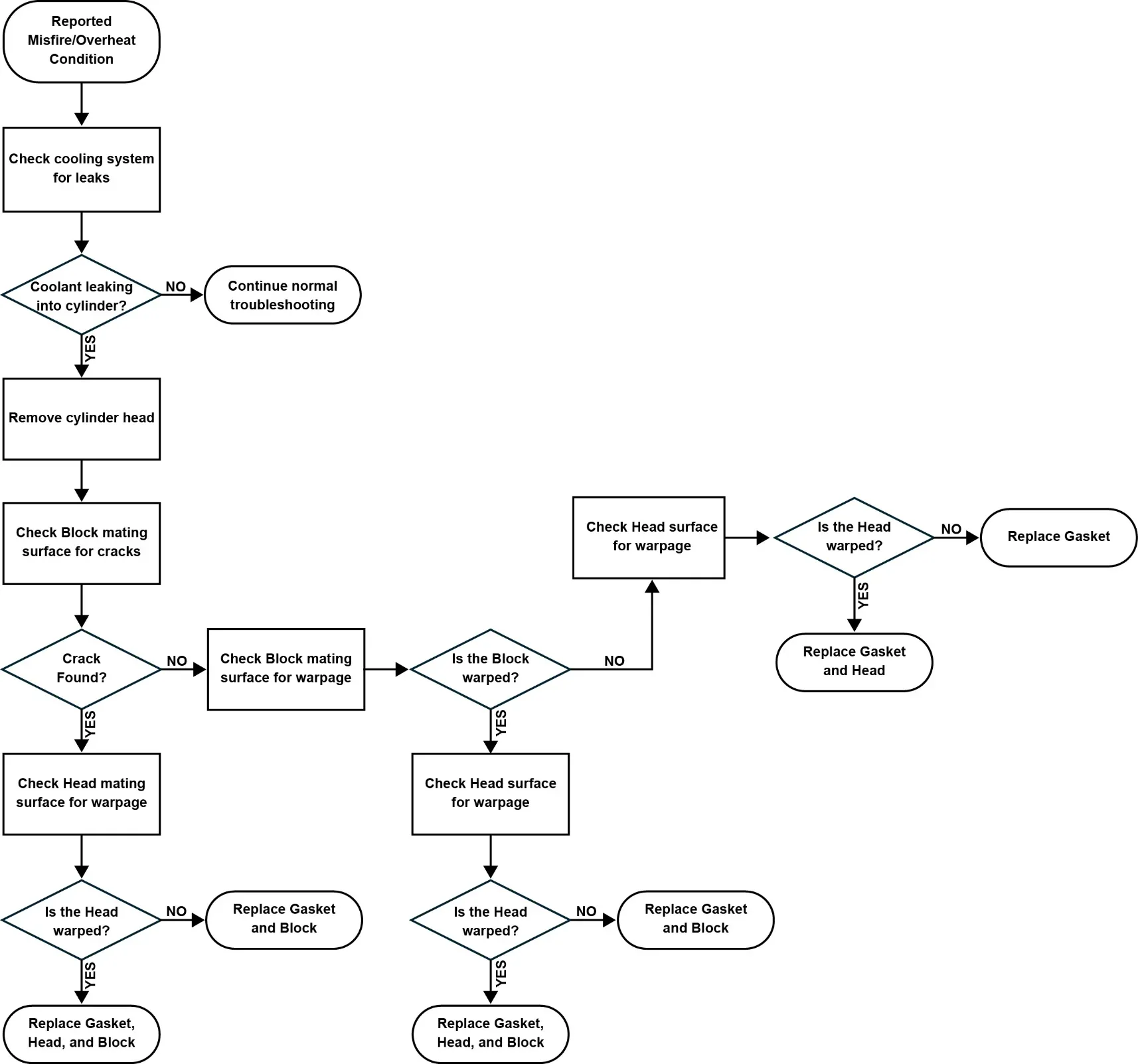
Diagnosis for the Honda Civic cylinder head gasket issue begins with a cold engine. Technicians will perform an ALL DTC Check using i-HDS and document any stored PGM-FI DTCs. The cooling system is then checked for leaks, and a pressure tester is installed after topping off coolant if necessary. The engine is run until it reaches normal operating temperature, and the cooling system pressure is checked.
Following this, all four spark plugs are removed, and a borescope is used to inspect the cylinders for coolant leaks at the head gasket. This involves inserting the borescope through the spark plug hole, focusing on the area where the cylinder head meets the block, and scanning 360 degrees. If coolant is observed on the cylinder wall, a picture is taken with the VIN, repair order number, date, and engine number clearly visible. If coolant is leaking into the cylinders, the repair procedure is initiated.
Important Warnings
Several critical warnings are highlighted in Service Bulletin 26-097 for technicians and owners:
- Claims submitted without the ALL DTC check printout in PDF format will be denied.
- Borescope images showing coolant leaks must be submitted with the warranty claim; claims without this image will be denied.
- Replacement of the cylinder head or engine short block requires prior approval from the Repair Validation Team. Warranty claims that include these replacements without prior approval will be denied.
- Do not call for approval if the cylinder head and engine block are within specifications.
- During cylinder head removal, specific steps (such as removing VTC Oil Control Solenoid Valve B, Injectors, CMP Sensor A/B, Camshaft, and Rocker Arm Assembly) should not be performed at certain times as outlined in the procedure.
- When removing cylinder head bolts, loosen them in sequence, 1/3 turn at a time, repeating until all bolts are loose, to prevent warpage.
- Do not use power tools to remove gasket material or residue from the engine block mating surface, as this can damage the cylinder head and block.
- Do not press the clutch pedal after the clutch slave cylinder has been moved, and do not disconnect the clutch line joints.
- Do not wipe off the grease from the change wire ends (C) during removal.
- Do not loosen a head bolt back to the specified angle if it was tightened beyond the specified angle during the torque process.
- Do not remove bolt (C) from the transmission mount; if removed, the transmission mount must be replaced as an assembly.
Repair Procedure Summary
The repair for the Honda Civic cylinder head gasket issue depends on the extent of the damage, determined by inspecting the cylinder head and engine block for warpage. There are three main repair procedures:
Repair Procedure #1: Head Gasket Only This procedure is for vehicles where neither the cylinder head nor the engine block is warped. It involves removing the cylinder head, inspecting for coolant leaks, checking for warpage, and replacing the head gasket. The process includes removing all gasket material, installing a new cylinder head gasket (part number 12251-59B-A01), and torquing the cylinder head bolts in a specific sequence to 30 N-m (22 lb-ft), followed by an additional 165° for new bolts or 140° for reused bolts. Engine oil and transmission fluid are drained and refilled, and the PCM is reset.
Repair Procedure #2: Head Gasket and Cylinder Head Replacement If the cylinder head is warped but the engine block is not, this procedure is followed. It includes all steps from Repair Procedure #1 but also involves replacing the entire cylinder head assembly (part number 10003-5AA-A00 or 10003-5PA-A00). Parts like the VTC Oil Control Solenoid Valve B, fuel rail, and injectors are swapped from the old cylinder head to the new one.
Repair Procedure #3: Head Gasket and Short Block Replacement This is the most extensive repair, performed when the engine block is warped, regardless of the cylinder head's condition. This procedure involves replacing the engine short block (part number 10002-5AA-A01 or 10002-5AA-A04), along with the cylinder head gasket and potentially the cylinder head if it's also warped. This requires significant engine and transmission disassembly, including removing the alternator, A/C compressor, starter, driveshafts, and separating the engine from the manual transmission. The flywheel, clutch disc, and pressure plate are transferred to the new short block with specific torque specifications.
All procedures conclude with resetting the Maintenance Minder for engine oil, coolant, and transmission fluid, and performing PCM Reset, CKP Pattern Clear/Learn, and PCM Idle Learn procedures.
Required Tools or Parts
Various specific tools and parts are required for these repairs. Key items include:
Special Tools:
- Cooling System Pressure Tester (SVTS272A)
- Snap-on 5.5 mm Borescope (BK5600Dual55 or equivalent)
- Universal Lift Eyelet (07AAK-SNAA600)
- Support Eyelet (07AAK-SNAA120)
- Spacer 4X.375 (07AAB-59BA110)
- Engine Support Hanger Tool (AART1256)
- Straight Edge 18" (07AAJ-59BA110)
- Feeler Gauge (07AAJ-59BA120)
- Torque Angle Gauge (TA360 or Commercially Available)
- Clutch Alignment Tool (07ZAF-PR8A100)
- Remover Handle (07936-3710100)
- Ring Gear Holder (07LAB-PV00100)
- Ring Gear Holder Set (070AB-5S1A100)
Key Replacement Parts (depending on repair procedure):
- GASKET, CYLINDER HEAD (NIPPON LEAKLESS) (12251-59B-A01)
- GASKET, HEAD COVER (12341-59B-013)
- FILTER, OIL (15400-RTA-003 or 15400-PLM-A02)
- GENERAL ASSY., CYLINDER HEAD (10003-5AA-A00 or 10003-5PA-A00)
- GENERAL ASSY., CYLINDER BLOCK (10002-5AA-A01, 10002-5AA-A04, or 10002-5AM-A04)
- THERMOSTAT SET (06193-59B-306)
- OIL SEAL, CONTROL VALVE (15832-RAA-A01)
- Long Life Antifreeze/Coolant Type 2 (08CLA-P99-0F0A8)
- Honda Manual Transmission Fluid (08798-9031)
- Honda 0W-20 Motor Oil (08798-9163)
- Hondabond HT (08718-0004)
- Various bolts, nuts, O-rings, and gaskets as detailed in the bulletin.
Owner Action
Owners of affected 2016-2017 Honda Civic vehicles will receive a notification of this campaign. If you experience symptoms such as overheating, coolant loss, or misfire, or if your vehicle falls within the affected model years, it is recommended to contact an authorized Honda automobile dealer. The dealer can perform an iN VIN status inquiry to confirm your vehicle's eligibility for this warranty extension. All eligible repairs will be performed free of charge under the extended warranty, which expires on May 31, 2027.
This warranty extension applies to any eligible vehicle, regardless of whether it has been declared a total loss, sold for salvage, or has a branded title.
Source: NHTSA ID 11037709
Gallery
43 images
What Honda Civic owners report
Counted from the records in our database across 46 model years.
- 16,711
- Owner complaints
- 94
- Recalls
- 1,769
- Service bulletins
- 1,775
- Crashes reported
- 179
- Fires reported
- 1,484
- Injuries reported
The 2016 model year
1,082 complaints, the 3rd most of 46 model years on file. Owners reported 36 crashes, 4 fires and 16 injuries for this year, which also has 5 recalls on file.
Engine, the system this article covers, accounts for 1,163 of 16,711 complaints (7%), including 95 for 2016.
Complaints by model year
| 2001 | 1,079 | |
|---|---|---|
| 2002 | 702 | |
| 2003 | 551 | |
| 2006 | 1,462 | |
| 2007 | 1,270 | |
| 2008 | 981 | |
| 2016 | 1,082 | |
| 2017 | 606 | |
| 2018 | 752 | |
| 2022 | 889 |
Most-reported systems
- Air Bags — 2,938
- Steering — 2,631
- Power Train — 1,883
- Electrical System — 1,666
- Engine — 1,163
Latest recalls for the 2016 model year
- 26V332000 — Air Bags (May 2026)
- 23V858000 — Fuel System, Gasoline (Dec 2023)
- 16V725000 — Parking Brake (Oct 2016)
Recent owner reports about engine
The contact owns a 2016 Honda Civic. The contact stated that while the vehicle was running with the A/C unit activated, there was an abnormal odor inside the cabin of the vehicle.
Read owner complaints →Blown Head gasket failure due to coolant leak into cylinders Evaporator Leak for A/C due to condenser and compressor shaft.
Complaints are owner reports filed with NHTSA. They are unverified, and counts depend on how many vehicles were sold, so they are not a failure rate.
Related Articles
2016-2021 Honda Civic Cylinder Head Gasket Warranty Extension
Honda has issued Service Bulletin 26-008, extending the warranty coverage for cylinder head gasket issues on 2016-2021 Civic models with the 1.5L Turbo CVT engine. This addresses concerns like overheating, coolant loss, and misfire.
What's Going Wrong with the 2024 Honda CR-V: Manufacturer Investigations
While the 2024 Honda CR-V has no recalls or owner complaints, Honda is actively investigating several potential issues. These include concerns with A/C compressor seizure, inoperative rearview cameras, and front wiper motor malfunctions. Owners should be aware of these emerging concerns.
2025 Honda Civic Health Check: Recalls and Bulletins
The 2025 Honda Civic has one recall for a fuel pump issue that poses a fire risk. Owners may also encounter issues like a Malfunction Indicator Light with DTC P0087, A/C compressor seizure, or a black and white rearview camera display, as detailed in numerous service bulletins.
2025 Honda CR-V Health Check: Recalls and Bulletins
The 2025 Honda CR-V currently has no recalls or owner complaints. However, Honda has issued numerous service bulletins, primarily addressing an active investigation into A/C compressor seizure, as well as issues with the LKAS warning light, rear cameras, and fuel fill door clips.
2023 Honda Civic Problems: Recalls, Complaints & TSBs
The 2023 Honda Civic has faced two safety recalls concerning the driver's seat and VSA modulator. While no owner complaints or federal investigations have been reported, several service bulletins address potential issues like EPS gearbox problems, engine oil leaks, and rearview mirror detachment.
Leave a comment
Comments are moderated and may take a moment to appear. Only your first name and the initial of your last name are shown publicly.
Comments
Be the first to comment.