2021-2023 Audi Front Brake Shield Rattling Noise TSB
Audi Technical Service Bulletin 2068629/1 addresses rattling and grinding noises originating from the front brake system's brake shields in various 2021-2023 Audi models. This TSB outlines the inspection and repair procedure for technicians, including specific part recommendations.
 Ahmet Topcu2023 Audi S3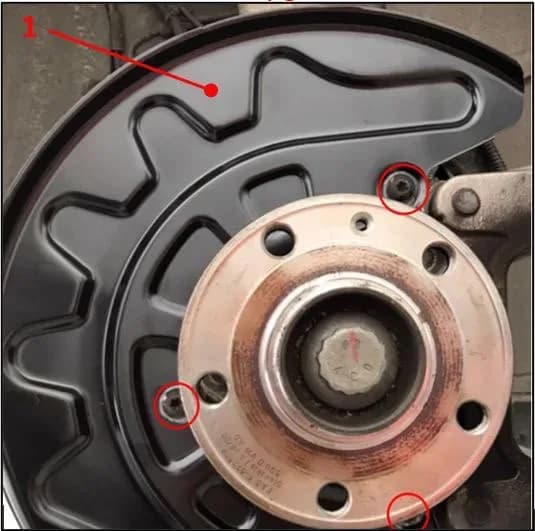
Also applies to
- Audi A3
- 2022–2023
- Audi Q3
- 2021–2023
- Audi RS 3
- 2022–2023
- Audi S3
- 2022
- Audi TT
- 2021–2023
- Audi TT RS
- 2021–2022
- Audi TTS
- 2021–2023
▸ Show 1 more▾ Show fewer
Owners of certain 2021-2023 Audi models may notice a distinct "rattling/grinding noises from front end/front brake system (brake shield)". This issue is specifically addressed by Audi Technical Service Bulletin (TSB) 46 22 37 2068629/1, released on November 18, 2022. The TSB provides detailed instructions for technicians to diagnose and resolve the noise originating from the front brake shields.
This bulletin applies to a range of Audi vehicles, including the 2021-2023 Audi A3, S3, Q3, TT, TTS, and RS 3. The primary concern is the proper seating and condition of the front brake shields, which can cause audible disturbances if damaged or corroded.
Symptoms
If you own a 2021-2023 Audi model covered by this TSB, you might experience "rattling/grinding noises from front end/front brake system (brake shield)". These noises typically occur during driving and are indicative of an issue with the front brake shield's integrity or mounting.
Important Warnings for Owners
Audi has issued specific guidance regarding the inspection and repair of this condition:
- Do not replace unnecessary parts: If the front brake shields are inspected and found to have no damage or excessive corrosion, technicians are instructed not to replace them, as this will not resolve the
Audi front brake shield rattling noise. - Warranty considerations: If your vehicle is outside of its warranty period (beyond 48 months or 50,000 miles), this Technical Service Bulletin is for informational purposes only. Repairs may not be covered under warranty.
- Corrosion protection for new parts: When new brake shields are installed, technicians must apply cavity preservative sealant (part number D 329 215 M1) to the mounting points and contact surfaces of the securing bolts. This prevents future corrosion that could lead to a recurrence of the
Audi front brake shield rattling noise.
Repair Procedure Summary
Addressing the Audi front brake shield rattling noise involves a specific sequence of steps for technicians, as detailed in TSB 46 22 37 2068629/1 and the ELSA repair manual under "Chassis>>Brake System>>Front Brakes>>Brake Shield, Removing and Installing."
- Wheel Removal: Both front wheels are removed to gain access to the brake components.
- Brake Component Disassembly: The front brake calipers, brake carriers, and brake discs are carefully removed.
- Brake Shield Inspection: Technicians thoroughly check both front brake shields for the brake discs. The shields must be securely seated and free from damage or excessive corrosion. Figure 1 in the TSB illustrates the splash plate for the brake disc and the contact surfaces of the securing bolts.
- Replacement Decision: If damage or significant corrosion is detected, the brake shields are replaced. If no issues are found, the original brake shields are retained.
- Brake Component Reassembly: The front brake calipers, brake carriers, and brake discs are reinstalled.
- Wheel Reinstallation: Finally, the front wheels are reinstalled.
Required Parts and Tools
For the repair described in TSB 2068629/1, specific materials are required:
- Fasteners: Any necessary fasteners, bolts, nuts, and screws should be sourced according to the ETKA parts catalog and the repair manual.
- Cavity Preservative Sealant: Part number D 329 215 M1 is required to protect new brake shields from corrosion at their mounting points. Approximately 0.1 units are needed.
- Brake Shield: If replacement is necessary, the new brake shield(s) should be ordered via ETKA (Quantity 01 or 02, depending on need).
Warranty Information
Warranty claims related to this issue are processed under specific guidelines. The claim type is 110 for vehicles up to 48 months or 50,000 miles. For Certified Pre-Owned (CPO) vehicles, claim type G10 applies, requiring owner verification. The service number for this procedure is 4617, with a damage code of 0015. The operation code for removing and installing the front brake disc is 4650 19XX. Diagnostic time for a road test prior to service is 10 labor units (0121 0002).
All warranty claims must adhere to the Audi Warranty Policies and Procedures Manual and are subject to review by Audi Warranty.
Sources: NHTSA ID: 10226838, TSB 46 22 37 2068629/1
Gallery
2 images
Frequently Asked Questions
- What is the Audi TSB 2068629/1 about?
- Audi Technical Service Bulletin 2068629/1 addresses rattling and grinding noises that can come from the front brake system's brake shields in various 2021-2023 Audi models. It provides a repair procedure for technicians to inspect and, if necessary, replace these shields.
- Which Audi models are affected by the front brake shield rattling noise?
- This TSB applies to 2021-2023 Audi A3, A3 Cabriolet, S3, RS 3, TT, TTS, TT Roadster, and Q3 models. If you hear a 'rattling/grinding noises from front end/front brake system (brake shield)', your vehicle might be affected.
- Will my Audi's front brake shield repair be covered under warranty?
- Repairs for the Audi front brake shield rattling noise are typically covered under warranty for vehicles up to 48 months or 50,000 miles (Claim Type 110). For CPO vehicles, Claim Type G10 applies. If your vehicle is outside of these warranty parameters, the TSB serves as informational guidance only, and repairs may not be covered.
- What is the repair for the Audi front brake shield rattling noise?
- The repair involves removing the front wheels and brake components to inspect the brake shields. If damage or excessive corrosion is found, the shields are replaced. New shields require the application of cavity preservative sealant (part number D 329 215 M1) to prevent future corrosion.
Related Articles
2023-2024 Audi A3, S3, RS 3 Driver Assist System Faults
Audi has released Technical Service Bulletin (TSB) 2079574/2 to address various driver assist system complaints in 2023-2024 Audi A3, S3, and RS 3 vehicles. Owners may see warning messages like 'Traffic sign recognition: fault' or 'Adaptive cruise assist not working' due to an intermittent front…
2017-2023 Audi A3, S3, TT Transmission Oil Leak TSB 2067365/3
Audi has released Technical Service Bulletin 2067365/3 to address oil leaks near the transmission cooler in various 2017-2023 Audi A3, S3, and TT models equipped with the DQ-381 transmission. This bulletin outlines diagnostic steps and repair procedures for technicians.
2022-2024 Audi A3, S3, RS 3 Airbag Control Module DTC P000000
Audi has released Technical Service Bulletin (TSB) 2070322/5 to address communication and configuration issues with the airbag control module (J234) in 2022-2024 A3, S3, and RS 3 models, often indicated by DTC P000000. This TSB outlines a software update remedy.
2022-2023 Audi MIB3 MMI Software Update TSB
Audi has released Technical Service Bulletin 2079134/2 addressing various MMI functionality issues and 'Emergency call fault' messages in 2022-2023 A3, S3, RS 3, e-tron GT, and RS e-tron GT models. A software update for the MIB3 system and connectivity box is available to resolve these concerns.
2023-2024 Audi S3 / A3 Driver Assist System Fault TSB 2079574/1
Audi has released Technical Service Bulletin 2079574/1 for 2023-2024 Audi S3 and A3 models experiencing various driver assist system malfunctions, including warning messages like 'Traffic sign recognition: fault'. The fix involves a software update for the front camera.
Leave a comment
Comments are moderated and may take a moment to appear. Only your first name and the initial of your last name are shown publicly.
Comments
Be the first to comment.