2021-2024 Audi Coolant Leak & P0299 DTC TSB 2070349/5
Audi Technical Service Bulletin 2070349/5 details diagnosis and repair for coolant leaks, coolant warning lamp, engine warning lamp, and potential DTC P0299 in 2021-2024 Audi models with 2.9L/3.0L V6 TFSI engines. The TSB identifies the mechanical coolant pump as a common source.
 Ahmet Topcu2024 Audi Q8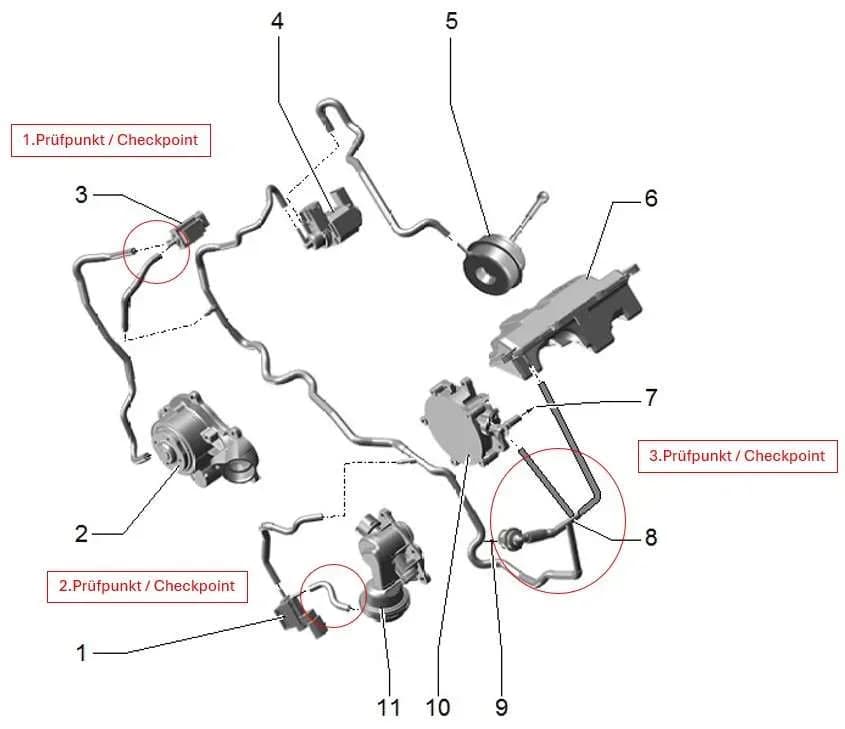
Also applies to
- Audi A6
- 2021–2024
- Audi A6 allroad
- 2021–2024
- Audi A7
- 2021–2024
- Audi A8 L e
- 2021
- Audi Q7
- 2021–2024
- Audi Q8
- 2021–2023
- Audi RS 5
- 2021–2024
- Audi S4
- 2021–2024
- Audi S5
- 2021–2024
- Audi S6
- 2021–2024
- Audi S7
- 2021–2024
- Audi SQ5
- 2021–2024
▸ Show 6 more▾ Show fewer
Audi has released Technical Service Bulletin (TSB) 2070349/5 to provide guidance for diagnosing and repairing coolant loss, warning lamp illumination, and diagnostic trouble code (DTC) P0299 in various 2021-2024 Audi models. This TSB, most recently revised on December 1, 2025, helps technicians identify and resolve issues related to the mechanical coolant pump and associated vacuum system components.
This bulletin specifically applies to 2021-2024 Audi Q8, S4, S5, RS 5, A6, A6 allroad, S6, A7, S7, SQ5, and Q7 vehicles equipped with 2.9L or 3.0L V6 TFSI engines. Owners experiencing an Audi coolant leak P0299 or related symptoms should be aware of this service information.
Symptoms of an Audi Coolant Leak
Owners of affected Audi vehicles may observe one or more of the following symptoms:
- Coolant loss/leak: Visible signs of coolant leaking from the vehicle.
- Coolant warning lamp: An illuminated warning light on the instrument cluster indicating low coolant levels or a cooling system issue.
- Engine warning lamp on: The check engine light may illuminate, sometimes in conjunction with other coolant-related issues.
Associated Fault Codes
In addition to the visible symptoms, a diagnostic scan may reveal specific fault codes. The TSB notes that the DTC "P0299: Turbo/Super Charger Underboost" may be logged. This can occur if the changeover valve N649 is impaired by coolant entering the vacuum system, leading to functional restrictions.
Understanding the Audi Coolant Leak P0299 Issue
Workshop findings indicate that the mechanical coolant pump is frequently the source of the leak. However, it's crucial to distinguish between a genuine leak and normal operational conditions. For instance, traces of coolant (small quantity) on the drip cup, as illustrated in Figure 1 of the TSB, are considered normal. Up to 3 ml of coolant may escape over 100 hours of operation due to lubrication and cooling of the seal, and this does not constitute a reason for a complaint.
Similarly, dried deposits on the vacuum connection, shown in Figure 2, are not a clear indication of a leak. Technicians are advised to precisely locate the leak to avoid repeat or incorrect repairs. It's also important to ensure that any coolant level drop isn't merely due to insufficient bleeding from a previous repair.
Important Warnings for Owners and Technicians
Audi provides several critical advisories within TSB 2070349/5:
- Warranty Claims: "If the vehicle is outside of any warranty, this Technical Service Bulletin is informational only."
- Repair Accuracy: "Try to reproduce the customer complaint (based on the description/cause of the issue), so that it can be clearly assigned to this TSB. The following repair must only be carried out if all the criteria (model/type, chassis number, engine/motor, gearbox code, PR number(s), part number, software version, code, etc.) apply exactly. Otherwise, this solution will not eliminate the problem and repeat repairs may be necessary. In such a case, the warranty claim may be rejected, and the cost of the parts may be charged back."
- Documentation: "Documentation is required" for certain repair steps, particularly when replacing components due to leaks, including photographing the production date of the coolant pump if it is found to be leaking (as shown in Figure 4).
These warnings emphasize the importance of accurate diagnosis and adherence to the TSB's guidelines to ensure effective repair and proper warranty coverage.
Diagnosing the Coolant Leak
Diagnosing the Audi coolant leak P0299 issue involves a systematic approach. Technicians are instructed to assess the leak using the following steps:
- Check Vacuum Line and Valve N649: Inspect the vacuum line and changeover valve N649 (Checkpoint 1 in Figure 3, a diagram of vacuum system checkpoints) for any traces of coolant. This requires disconnecting these components.
- If coolant traces are visible, the mechanical coolant pump should be replaced.
- If no coolant traces are visible, proceed to the next step.
- Clean and Dry: Thoroughly clean and dry any suspected leak areas and traces of coolant.
- Fill Cooling System: Fill the cooling system to its maximum level.
- Visual Check: Perform a visual inspection to assess for leaks at both idling speeds and higher engine speeds (approximately 2500 rpm).
- Cooling System Leak Check: Utilize the workshop manual (ELSA) to check the cooling system for leaks.
- Reassess Leak: Re-evaluate the suspected leak.
- If no coolant leak is detected during the test, further observation of the vehicle is recommended, and no parts replacement is necessary.
- If a coolant leak is detected, the component causing the damage must be replaced. All leaks must be documented with photos or videos. If the coolant pump is the source, its production date (Figure 4) should also be photographed.
Repair Procedure Summary
If a leak is confirmed, the repair procedure outlined in TSB 2070349/5 focuses on replacing the faulty components and ensuring the integrity of the vacuum system. The TSB provides detailed instructions for technicians to follow.
- Mechanical Coolant Pump Replacement: If traces of coolant are found at the vacuum line or valve N649, or if the coolant pump is identified as the source of the leak after thorough testing, the mechanical coolant pump must be replaced.
- Vacuum System Inspection and Repair: The leak from the coolant pump can potentially contaminate other components of the vacuum system. Technicians must systematically check checkpoints 2 and 3 (Figure 3) for coolant residue. These checkpoints include the connection to vacuum line N645/coolant shut-off valve and the vacuum distributor in the area of the vacuum pump.
- If fresh coolant is found, contaminated components such as the entire vacuum line, valve N545, coolant shut-off valve, and vacuum reservoir must be replaced. An attachment (ea839_vacuum_system.pdf) provides a precise overview of the vacuum system components.
- If no coolant residue is visible at checkpoints 2 and 3, only the changeover valve N649 should be replaced, and the vacuum line between the coolant pump and valve N649 should be cleaned using compressed air.
Warranty Information
For warranty claims related to TSB 2070349/5, Audi specifies a Service Number of 1950 and a Damage Code of 0050. The bulletin details various labor operations with associated Standard Repair Times (SRT) and Technical Units (TU) for tasks such as removing and installing noise insulation, checking and topping up coolant, checking for leaks, and replacing specific components like the coolant pump, regulating valves N649 and N545, vacuum pump, and various vacuum reservoirs depending on the specific model and engine configuration. All warranty claims must adhere to the Audi Warranty policies and Procedures Manual.
Additional Information
Audi reminds technicians that all part and service references in TSB 2070349/5 are subject to change. It is essential to consult the Parts Department and/or ETKA for the latest information. The Repair Manual should also be checked for any fasteners, bolts, nuts, and screws that require replacement during the repair process.
NHTSA ID: 11027324
Gallery
3 images
Frequently Asked Questions
- What are the common symptoms of an Audi coolant leak?
- Common symptoms include visible coolant loss or leakage, an illuminated coolant warning lamp on the dashboard, and potentially an engine warning lamp turning on. These can indicate an Audi coolant leak P0299 issue.
- Can a coolant leak cause the "P0299: Turbo/Super Charger Underboost" DTC?
- Yes, according to Audi TSB 2070349/5, the DTC "P0299: Turbo/Super Charger Underboost" may be logged if the changeover valve N649 becomes impaired by coolant entering the vacuum system, leading to functional restrictions.
- Is a small amount of coolant on the drip cup always a problem?
- No, the TSB clarifies that traces of coolant (small quantity) on the drip cup, up to 3 ml over 100 hours of operation, are considered normal due to seal lubrication and cooling. This is not typically a reason for a complaint.
- What is the primary cause of the Audi coolant leak P0299 issue?
- Workshop findings from TSB 2070349/5 indicate that the mechanical coolant pump is frequently found to be the source of the coolant leak in affected 2.9L and 3.0L V6 TFSI Audi models.
- What should I do if my Audi shows signs of a coolant leak?
- If your Audi exhibits symptoms like coolant loss, a coolant warning lamp, or an engine warning lamp, it is recommended to have your vehicle inspected by an authorized Audi service facility. They can properly diagnose the issue using TSB 2070349/5 and perform the necessary repairs.
Related Articles
2023-2025 Audi MMI Emergency Call Fault Software Update
Audi has released Technical Service Bulletin 2079680/3 to address MMI function problems and 'Emergency call fault' messages in 2023-2025 Audi Q7, Q8, A6, A7, A8, and other models. A software update is available.
2024-2025 Audi Bluetooth / Smartphone Interface Connection Issue
Audi has identified a software issue causing slow Bluetooth and smartphone interface connections in certain 2024-2025 models. A solution is expected by Q2 2026, and component replacement is not recommended as it will not resolve the problem.
2024-2025 Audi MIB3: No Tiles in Main Menu, Phone Controls Not Working
This Technical Service Bulletin (TSB 2080958/2) addresses an issue in 2024-2025 Audi vehicles equipped with the MIB3 infotainment system where owners may find 'no tiles in main menu' or encounter a phone menu with 'controls are not working'. A software update is available.
2024-2025 Audi MMI Connectivity and Infotainment TSB
Audi Technical Service Bulletin 2079416/4 provides an overview of customer service packages for MLB and MQB vehicles with MIB3 systems, addressing common infotainment and connectivity complaints in 2024-2025 Audi models. Learn about diagnostic steps and related software updates.
2021-2025 Audi Q8/SQ8/RS Q8 Window Reversal TSB
If your 2021-2025 Audi Q8, SQ8, or RS Q8 window opens again after attempting to close it, Technical Service Bulletin 2080696/1 details a software issue. This TSB addresses the diagnostic trouble code B148754 related to the window regulator and provides a software update.
Leave a comment
Comments are moderated and may take a moment to appear. Only your first name and the initial of your last name are shown publicly.
Comments
Be the first to comment.