2012-2026 Audi Front Axle Guide Link Bush Noises TSB
Audi Technical Service Bulletin (TSB) 2076605/2 addresses customer complaints of sporadic rattling and clacking noises from the front axle in various Audi models from 2012-2026. This TSB explains that these noises originate from an air bubble within the guide link hydro-bush.
 David Chen2023 Audi Q8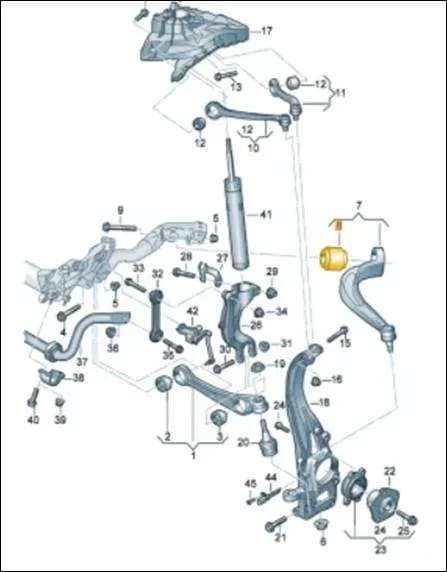
Also applies to
- Audi A4
- 2021–2025
- Audi A4 allroad
- 2021–2025
- Audi A5
- 2021–2024
- Audi A6
- 2021–2025
- Audi A6 allroad
- 2021–2026
- Audi A7
- 2021–2025
- Audi A7 e
- 2021–2022
- Audi A8 L e
- 2021
- Audi Q5
- 2021–2025
- Audi Q5 e
- 2021, 2023, 2024, 2025
- Audi Q7
- 2021–2026
- Audi Q8
- 2021, 2022, 2024, 2025, 2026
- Audi RS 5
- 2021–2024
- Audi RS 6 Avant
- 2021–2026
- Audi RS 7
- 2021–2026
- Audi RS Q8
- 2021–2026
- Audi S4
- 2021–2025
- Audi S5
- 2021–2024
- Audi S6
- 2021–2025
- Audi S7
- 2021–2025
- Audi S8
- 2021–2025
- Audi SQ5
- 2021–2025
- Audi SQ7
- 2021–2026
- Audi SQ8
- 2021–2026
▸ Show 18 more▾ Show fewer
Owners of a wide array of Audi models, specifically the A4, A5, A6, A7, A8, Q5, Q7, and Q8, manufactured between 2012 and 2026, may occasionally encounter sporadic rattling or clacking noises emanating from the front axle of their vehicle. This phenomenon is comprehensively addressed by Audi Technical Service Bulletin (TSB) 2076605/2, a crucial document for understanding the technical underpinnings of these sounds. The TSB delves into the specific design and function of the guide link bush, providing valuable insights into the root cause of these noises and offering guidance for technicians on accurate identification. This bulletin is particularly relevant for those experiencing Audi Q8 guide link bush noises or similar sounds in other affected models, as it serves to clarify the nature of the issue rather than prescribing a repair solution. The information contained within TSB 2076605/2 helps both owners and service professionals understand that these front axle sounds, while potentially concerning, are often a characteristic of the component's intended operation.
TSB Revision History
Audi Technical Service Bulletin 2076605/2 has undergone revisions to ensure comprehensive information is provided. Initially published on January 15, 2025, as Revision 1, the bulletin was later updated to Revision 2. This subsequent revision included a revised header to add specific model years and models, broadening the scope of the document. The current release date for this bulletin is September 29, 2025, indicating that it is scheduled for future publication.
Symptoms of Front Axle Noises
Customers frequently report experiencing sporadic rattling or clacking noises originating from the front axle. These sounds are most pronounced when the vehicle is operating at low speeds, specifically below 12 mph. The noises are particularly noticeable when driving over common road imperfections such as curbs or uneven road surfaces, including cobblestones. These conditions induce specific vibrations that can trigger the audible noises. The nature of these complaints, as categorized by Audi's internal system, includes 'entire vehicle -> vehicle areas -> vehicle front noises, vibrations -> pinging > no instruction <', 'entire vehicle -> vehicle areas -> vehicle front noises, vibrations -> noise left', 'entire vehicle -> vehicle areas -> vehicle front noises, vibrations -> noise > no instruction <', 'entire vehicle -> vehicle areas -> vehicle front noises, vibrations -> pinging left', 'entire vehicle -> vehicle areas -> vehicle front noises, vibrations -> noise right', and 'entire vehicle -> vehicle areas -> vehicle front noises, vibrations -> pinging right'. These detailed complaint types help technicians understand the specific nuances of what the customer is experiencing, guiding their initial assessment of the Audi Q8 guide link bush noises or similar issues.
Technical Background: The Guide Link Hydro-Bush
The fundamental reason behind the sporadic rattling and clacking sounds, often perceived as Audi Q8 guide link bush noises, stems from a specific characteristic of the guide link hydro-bush itself. This component, vital for the vehicle's front suspension system, is manufactured with an intentional air bubble enclosed within its structure. This design choice is not a defect but rather a sophisticated engineering solution aimed at optimizing several aspects of vehicle performance and comfort. When the vehicle traverses uneven road surfaces, such as those encountered over curbs, cobblestones, or rough asphalt, the front axle experiences rapid and intense vibrations. These external forces cause the guide link hydro-bush to undergo dynamic changes in its internal pressure. The high-frequency fluctuations in pressure directly impact the volume of the encapsulated air bubble. It is this volumetric change of the air bubble that generates the distinct rattling or clacking sounds that customers report. The phenomenon is particularly noticeable under certain 'unfavorable climatic conditions,' suggesting that temperature or humidity might influence the material properties of the bush or the behavior of the air bubble. Despite the audible output, the air bubble serves a critical functional purpose. It acts as a decoupling element, effectively isolating the cabin from 'micro-amplitudes' – small, high-frequency vibrations that would otherwise transmit through the suspension system. This decoupling significantly enhances the vehicle's interior acoustics, creating a quieter and more refined driving experience, especially on less-than-perfect road surfaces. Furthermore, this specific design of the hydro-bush contributes positively to the vehicle's steering behavior, offering a more precise and stable feel. Therefore, while the noise might be a concern for owners, Audi considers the bush to be functioning precisely as intended by its engineering specifications, delivering its designed benefits for acoustics and handling.
Important Considerations for Diagnosis
When a customer reports symptoms such as 'noises, vibrations -> pinging' or 'noises, vibrations -> noise' from the front axle, particularly those resembling Audi Q8 guide link bush noises, technicians must approach diagnosis with specific considerations outlined in Audi Technical Service Bulletin 2076605/2. A critical warning from Audi is to avoid investigating these noises when the ambient temperature is below 32°F (0°C). The rationale behind this directive is that at freezing temperatures, the rubber compounds used in all running gear bushes, including the guide link hydro-bush, become significantly harder. This hardening can alter the acoustic characteristics of the noise, potentially leading to misdiagnosis or an inability to reproduce the complaint accurately. Beyond temperature, environmental contaminants such as snow, ice, and road grit can also interfere with the precise analysis of the noise, making it difficult to pinpoint the exact source. To ensure accurate identification of the guide link bush as the source of the noise, Audi recommends using specialized diagnostic equipment. The PICO tool, specifically identified by the part number VAS 611015, is highlighted as a primary tool for this task. This tool is designed for advanced noise, vibration, and harshness (NVH) analysis, allowing technicians to precisely locate and characterize subtle sounds. Further information regarding the use of this tool can be found by consulting TSB 2070568. Alternatively, technicians can access the Audi Knowledge Tank, an extensive internal database, by using the search term 'PICO' to retrieve relevant technical documentation and procedures. The objective of using these tools and following these guidelines is to 'identify that the noises are coming from the guide link bush,' which is visually represented as item 8, marked in yellow, in Figure 1 of the TSB. This systematic approach ensures that the reported 'control arm bearing noises, vibrations -> noise left' or 'right' are accurately traced to their source, confirming if they are indeed the characteristic sounds associated with the guide link hydro-bush.
Scope of Affected Vehicles
This Technical Service Bulletin 2076605/2 applies to a broad range of Audi vehicles, encompassing various models and model years sold within the United States market. Specifically, the bulletin addresses concerns for Audi A4, A5, A6, A7, A8, Q5, Q7, and Q8 models. The affected model years span from 2012 through 2026, indicating a wide production period during which vehicles incorporating this guide link hydro-bush design were manufactured. The extensive list of 'Sales types' detailed in the TSB, including various 'Type' designations such as 4A*, 4G*, 4H*, 4K*, 4M*, 4N*, 8W*, F5*, and FY*, further underscores the widespread applicability of this informational document across Audi's product lines. This broad scope means that many Audi owners, from those with older models to those with brand-new vehicles, could potentially experience the described front axle noises. The TSB's purpose is to provide a consistent technical explanation for these noises across this diverse fleet, ensuring that service personnel are equipped with the correct information regardless of the specific Audi model they are working on.
What Owners Should Know
For owners of Audi A4, A5, A6, A7, A8, Q5, Q7, and Q8 models from 2012 to 2026 who are experiencing Audi Q8 guide link bush noises or similar front axle sounds, it is crucial to understand the specific context provided by Audi Technical Service Bulletin 2076605/2. This bulletin serves a unique purpose: it is purely 'informational only.' This designation carries significant implications. Firstly, it means that the presence of these rattling or clacking noises from the guide link hydro-bush is not considered a manufacturing defect that requires a repair or replacement. Audi's engineering assessment, as conveyed in the TSB, is that 'The bush functions as it should under all conditions.' The sounds are an inherent characteristic of its design, which prioritizes improved interior acoustics and steering behavior through the use of an internal air bubble. Consequently, there is 'No production solution' outlined in the bulletin, nor is there a prescribed 'Service' procedure to eliminate these noises. This is a key differentiator from many other TSBs that detail specific repair steps. Secondly, the bulletin explicitly states that it is 'not applicable to any Audi Warranty.' This is a critical piece of information for owners, as it indicates that any diagnostic efforts or attempts to 'fix' these noises would typically not be covered under the vehicle's standard warranty. Owners should be prepared for potential charges if they insist on further investigation or component replacement, as the manufacturer considers the part to be operating within its design parameters. The TSB includes a direct instruction to service personnel: 'NOTICE Please explain the technical background to the customer.' This directive underscores Audi's intent for transparency, ensuring that owners receive a clear explanation of why these noises occur and why a repair is not deemed necessary. Understanding this technical background can help owners manage expectations and avoid unnecessary service appointments for a condition that is, from an engineering standpoint, a normal operational characteristic.
Conclusion
In summary, Audi Technical Service Bulletin 2076605/2 provides a detailed explanation for the sporadic rattling and clacking noises that some owners of 2012-2026 Audi A4, A5, A6, A7, A8, Q5, Q7, and Q8 vehicles may hear from their front axle. The core message of this bulletin is that these noises, including Audi Q8 guide link bush noises, are typically a result of an air bubble intentionally integrated into the guide link hydro-bush during manufacturing. This design feature, while occasionally producing sound, is critical for enhancing interior acoustics and steering performance. Owners should be aware that this is an informational bulletin, indicating that the component is functioning as designed and therefore no repair is typically required or covered under warranty. For any concerns, it is always recommended to consult with an authorized Audi service center, who can use diagnostic tools like the PICO tool VAS 611015 to confirm the source of the noise, keeping in mind the temperature-related diagnostic limitations.
Source: NHTSA ID: 10255531
Frequently Asked Questions
- What causes rattling or clacking noises from my Audi's front axle?
- According to Audi TSB 2076605/2, these noises are typically caused by an air bubble enclosed within the guide link hydro-bush during manufacturing. This air bubble can create rattling or clacking sounds when the vehicle's front axle experiences vibrations from uneven surfaces, especially at low speeds.
- Does the guide link bush noise indicate a defect or safety issue?
- No, the Audi TSB 2076605/2 states that the guide link bush functions as it should under all conditions. The air bubble, while causing noise, is part of the design intended to improve interior acoustics and steering behavior. This TSB is informational and does not indicate a defect requiring repair.
- Can technicians diagnose the guide link bush noise?
- Yes, technicians can use specialized tools like the PICO tool VAS 611015 (referenced in TSB 2070568) or consult the Audi Knowledge Tank (using search term 'PICO') to identify if the noises are indeed coming from the guide link bush. However, it's advised not to investigate these noises below 32°F (0°C) as cold temperatures can harden rubber bushes and affect diagnostic accuracy.
- Is the guide link bush noise covered under Audi warranty?
- Audi Technical Service Bulletin 2076605/2 explicitly states that it is 'informational only and not applicable to any Audi Warranty.' This implies that while the phenomenon is recognized, it is not considered a warrantable repair item.
Related Articles
2023-2026 Audi Frequency Analysis App TSB 2051095/11
Technical Service Bulletin 2051095/11 introduces the Audi Frequency Analysis app, a specialized diagnostic tool for technicians to accurately identify and address noise complaints in 2023-2026 Audi vehicles. This app helps pinpoint the source of various vehicle noises.
2021-2025 Audi Models Engine Control Module Software Update 53ZC
Audi has released Technical Service Bulletin 53ZC (WARR EXT – U82) to provide an Engine Control Module software update. This update optimizes engine oil pressure for various 2021-2025 Audi models, preventing potential issues.
2022-2025 Audi ECM Software Update 53ZC for Oil Pressure
Audi has issued Technical Service Bulletin 53ZC (WARR EXT – U82) for 2022-2025 Audi models, providing an Engine Control Module (ECM) software update. This proactive update optimizes engine oil pressure and is covered under a warranty extension.
2022-2025 Audi Models Engine Control Module Software Update
Audi has issued a dealer communication regarding a software update (UPDATE 53ZC / WARR EXT – U82) for the Engine Control Module in various 2022-2025 models. This update aims to optimize engine oil pressure and prevent potential piston wear. Owners should contact their dealer as no notification…
2022-2025 Audi Q8 Engine Control Module Update
Audi has released Technical Service Bulletin 53ZC, a proactive Engine Control Module (ECM) software update for 2022-2025 Audi Q8, Q7, A6, A7, S4, S5, SQ5, and A8 models. This update optimizes engine oil pressure to prevent potential piston wear and includes a U82 warranty extension.
Leave a comment
Comments are moderated and may take a moment to appear. Only your first name and the initial of your last name are shown publicly.
Comments
Be the first to comment.