2021-2023 Audi Q8 Electrical System Fault P0AA100 TSB
Audi has issued Technical Service Bulletin 2070813/1 to address a software-related issue in the 48V battery management system that can trigger DTC P0AA100 and display 'Electrical system: fault' or 'Drive system: fault' messages in 2021-2023 Audi Q8 and other models. A software update is available.
 Sarah Mitchell2022 Audi Q8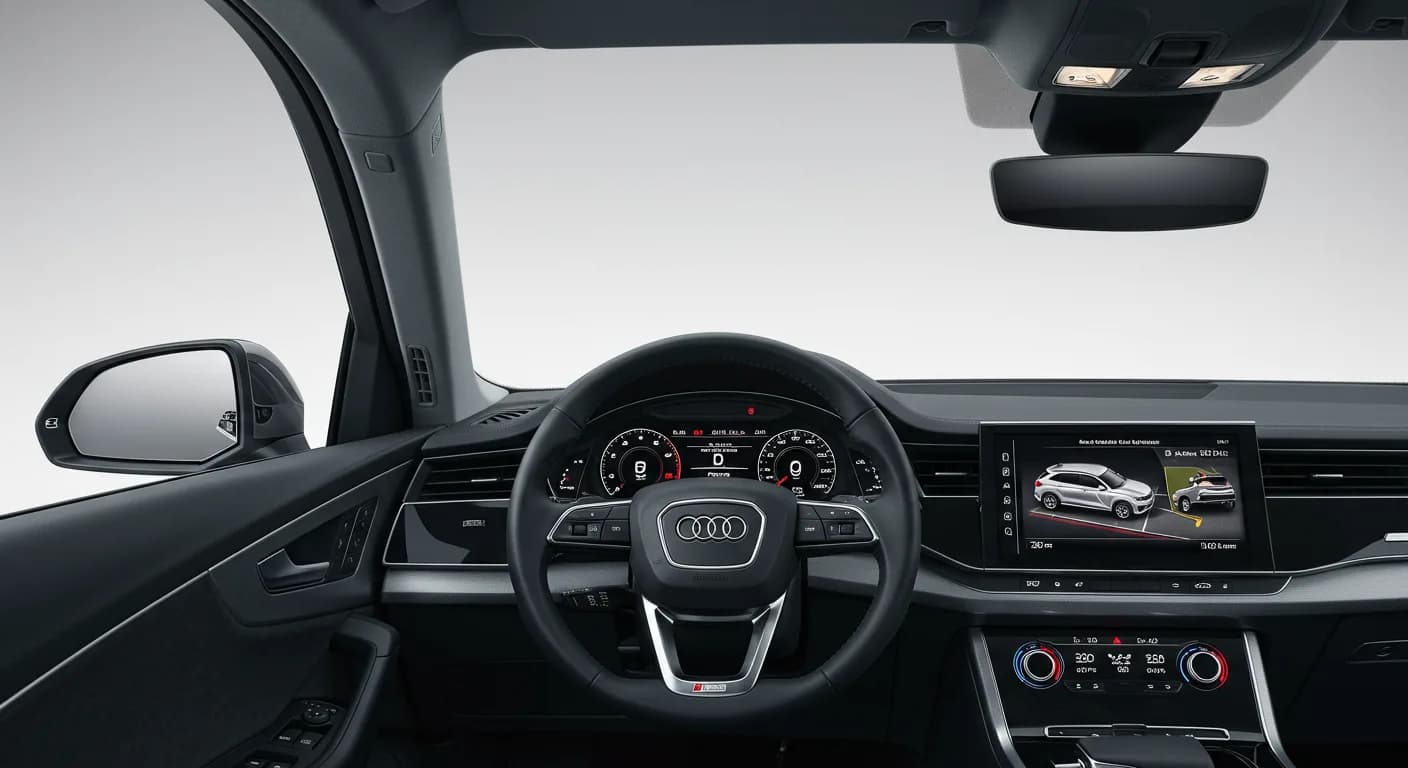
Also applies to
- Audi A7
- 2021–2023
- Audi A7 e
- 2021–2022
- Audi A8 L e
- 2021
- Audi Q7
- 2021–2023
- Audi Q8
- 2021, 2023
- Audi RS 7
- 2021–2023
- Audi RS Q8
- 2021–2023
- Audi S7
- 2021–2023
- Audi S8
- 2021–2023
- Audi SQ7
- 2021–2023
- Audi SQ8
- 2021–2023
▸ Show 5 more▾ Show fewer
Owners of certain 2021-2023 Audi Q8 vehicles and other Audi models may encounter instrument cluster warnings such as "Electrical system: fault. Please contact workshop" or "Drive system: fault. Please contact workshop." These messages are often accompanied by the diagnostic trouble code (DTC) P0AA100, indicating a Hybrid/EV Battery Positive Contactor Circuit Stuck Closed fault. This bulletin, Audi TSB 2070813/1, addresses this specific Audi Q8 electrical system fault P0AA100.
Symptoms
If your vehicle is affected by this issue, you may observe the following messages displayed on the instrument cluster:
- "Electrical system: fault. Please contact workshop"
- "Drive system: fault. Please contact workshop"
These warnings indicate a problem within the vehicle's electrical or drive system, specifically related to the 48V battery.
Fault Codes / DTCs
When diagnosing this condition, a technician may find the following diagnostic trouble code stored in the battery management 2 (48V battery) control module (address word 0021):
- DTC P0AA100: Hybrid/EV Battery Positive Contactor Circuit Stuck Closed
Diagnosis / Trigger Conditions
This Audi Q8 electrical system fault P0AA100 is a software-related issue affecting the 48V battery in conjunction with the active roll stabilization system (PR number 2MQ). The DTC P0AA100 can be stored when the engine is turned on after the 48V system has been deactivated for more than 16 minutes. In vehicles with active roll stabilization, the 48V system remains active even when the engine is not running, causing capacitors on the 48V system to charge when the ignition is on.
The fault can be reproduced under specific conditions:
- The vehicle is switched off and remains off for over 16 minutes.
- The vehicle is then unlocked and entered, which activates the roll stabilization and the 48V system.
- The customer subsequently leaves the vehicle again.
- The customer returns within 16 minutes and switches on the ignition.
- At this point, DTC P0AA100 is set.
Even if voltage is present before and after an open relay during diagnosis (due to charged capacitors), this condition is logged as an event memory entry for P0AA100.
Repair Procedure Summary
Audi's solution for this condition is a software update for the battery management 2 (48V battery) control module. This update resolves the underlying software issue that causes the Audi Q8 electrical system fault P0AA100.
Technicians will perform the following steps:
- Preparation: Ensure the diagnostic system is configured correctly. It is crucial to use DoIP (Diagnostic over Internet Protocol) when flashing control modules via ODIS in supported vehicles. To activate DoIP, technicians must navigate to
Administration>>General>>GFF Process>>DoIP communication>>Only allow DoIP communication. This setting will automatically reset once the diagnostic session concludes. A red LED on the VAS 6154(A) interface indicates that DoIP is active. - Software Version Management (SVM): Follow the instructions detailed in TSB 2011732: 00 Software Version Management (SVM), operating instructions.
- Module Update: Update the battery management 2 (48V Battery) control module (address word 0021) using the SVM action code 21A003. This will install the latest software version to correct the fault.
Required Software/Parts
The software update involves replacing older software versions with newer ones. The relevant software part numbers are:
| Model | Old Software Part Number | Old Software Version | New Software Part Number | New Software Version |
|---|---|---|---|---|
| A6/A7/A8/Q7/Q8 | 4N0.915.105.B | 0108, 0109 | 4N0.915.105.E | 0113 |
| A6/A7/A8/Q7/Q8 | 4N0.915.105.D | 0206, 0207 | 4N0.915.105.F | 0211 |
Important Warnings
- DoIP Activation: When flashing a control module via ODIS, always use DoIP in supported vehicles. Ensure DoIP is activated by following the specific menu path:
Administration>>General>>GFF Process>>DoIP communication>>Only allow DoIP communication. This setting will reset after the diagnostic session ends. A red LED on the VAS 6154(A) indicates active DoIP. - Warranty: This Technical Service Bulletin is informational only if your vehicle is outside of its warranty period. Warranty claims are subject to review by Audi Warranty and must adhere to the Audi Warranty Policies and Procedures Manual.
Owner Action
If your 2021-2023 Audi Q8 or other affected Audi model is displaying the
Frequently Asked Questions
- What does the DTC P0AA100 mean for my Audi?
- DTC P0AA100, 'Hybrid/EV Battery Positive Contactor Circuit Stuck Closed,' indicates a software-related issue within your Audi's 48V battery management system, particularly if your vehicle has active roll stabilization.
- How is the 'Electrical system: fault' message resolved in my Audi?
- The 'Electrical system: fault' message, when associated with DTC P0AA100, is resolved by performing a software update on the battery management 2 (48V battery) control module, as detailed in Audi TSB 2070813/1.
- Will I be charged for the repair of the Audi Q8 electrical system fault P0AA100?
- If your vehicle is within the warranty period (up to 48 months/50,000 miles or CPO coverage), the software update described in TSB 2070813/1 should be covered under warranty. If your vehicle is outside of warranty, the bulletin is informational, and charges may apply.
- What is 'Active Roll Stabilization' and how does it relate to this fault?
- Active Roll Stabilization is a vehicle feature (identified by PR number 2MQ) that uses the 48V system. In affected vehicles, the 48V system remains active even when the engine is off, leading to capacitor charging and potentially triggering the P0AA100 fault under specific conditions.
Other revisions of this TSB
- 2021-2025 Audi Q5 e / A7 e Electrical System Fault TSBP0AA100
- 2021-2024 Audi Q5 e / A7 e Red Electrical System Fault P0AC000P0AA100
- 2021-2023 Audi e-tron Electrical System Fault P0AC000P0AA100
- 2021-2023 Audi e-tron Red Electrical System Fault TSB 93 24 07 2074900/1P0AA100
- 2021-2023 Audi e-tron Electrical System Fault P0AC000P0AA100
Related Articles
2021-2024 Audi Coolant Pump Leak & DTC P0299 TSB
This Audi Technical Service Bulletin 2070349/6 addresses coolant loss, warning lights, and DTC P0299 related to the mechanical coolant pump in 2021-2024 Audi models with 2.9L or 3.0L V6 TFSI engines. Learn about symptoms, diagnosis, and repair procedures.
2021-2026 Audi Q8 Rear Compartment Noise TSB 2067759/4
Audi has issued Technical Service Bulletin (TSB) 2067759/4 for 2021-2026 Audi Q8 vehicles experiencing a ticking or thumping noise in the rear passenger compartment, especially at idle. The noise is caused by vibrations from the activated charcoal filter solenoid valve (N80) against the EVAP line.
2021-2026 Audi Tensioner Part Number Update SM 63-2025
Audi Special Notice SM 63-2025 informs dealers about an updated tensioner part number. Old part 059-109-467-BB must be returned by December 16, 2025, and replaced with new part 059-109-467-BD to ensure proper inventory.
2022-2024 Audi MLBevo Emergency Call System Warning TSB
Audi Technical Service Bulletin 2079649/1 details a software issue causing an 'Emergency call function: fault' warning in the instrument cluster of 2022-2024 MLBevo vehicles. This TSB provides a software update solution for intermittent communication errors.
2022-2025 Audi Q7/Q8 Third Row Seat Malfunction TSB
Owners of 2022-2025 Audi Q7, SQ7, Q8, SQ8, and RS Q8 vehicles may experience a third row seat malfunction where seats do not fold or lock. Audi TSB 2079211/1 explains this is often due to external blockages and is not covered under warranty.
Leave a comment
Comments are moderated and may take a moment to appear. Only your first name and the initial of your last name are shown publicly.
Comments
Be the first to comment.