2021-2024 Audi Coolant Leak from Coolant Pump TSB 2071515/1
Audi has issued Technical Service Bulletin 2071515/1 to address coolant leaks originating from the coolant pump in various 2021-2024 models with 2.0L TFSI engines. Owners may notice coolant loss or an illuminated coolant warning lamp.
 Ahmet Topcu2024 Audi Q7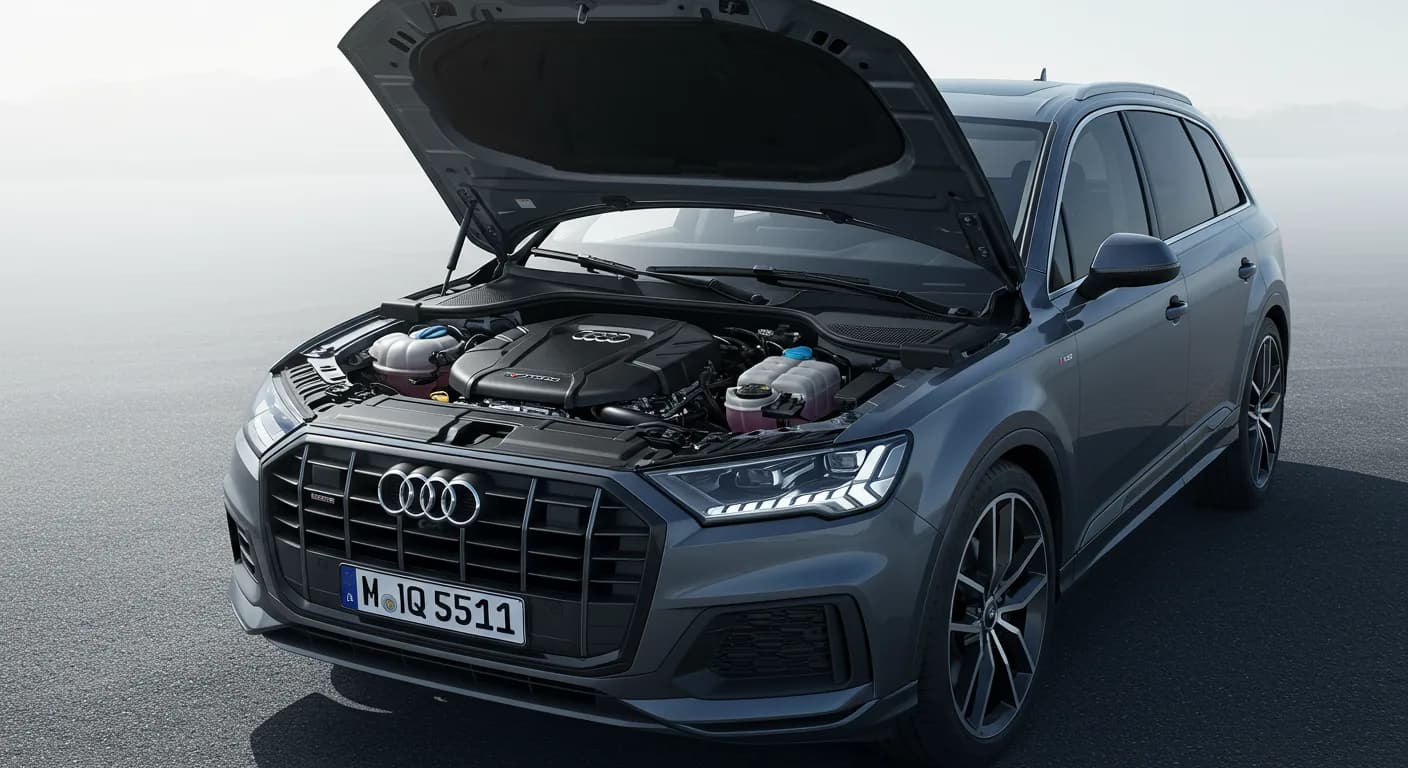
Also applies to
- Audi A3
- 2022–2024
- Audi A4
- 2021–2024
- Audi A4 allroad
- 2021–2024
- Audi A5
- 2021–2024
- Audi A6
- 2021–2024
- Audi A7 e
- 2021–2022
- Audi Q3
- 2021–2024
- Audi Q5
- 2021–2024
- Audi Q5 e
- 2024
- Audi Q7
- 2021–2023
- Audi S3
- 2022–2024
- Audi TT
- 2021–2023
- Audi TTS
- 2021–2023
▸ Show 7 more▾ Show fewer
Audi has released Technical Service Bulletin (TSB) 2071515/1 to address instances of coolant leaks originating from the coolant pump in various 2021-2024 models equipped with the 2.0L TFSI engine. This bulletin provides guidance for technicians on accurately diagnosing and resolving an Audi 2.0 TFSI coolant leak.
Symptoms of an Audi 2.0 TFSI Coolant Leak
Owners of affected Audi vehicles may experience one or more of the following issues:
- The customer notes "coolant loss", or a visible "coolant leak".
- The "coolant warning lamp is illuminated" on the dashboard.
Workshop findings indicate that these symptoms are typically traceable to a leak originating from the coolant pump.
Diagnosis and Trigger Conditions
To accurately diagnose an Audi 2.0 TFSI coolant leak and ensure proper repair, technicians are instructed to follow a specific procedure. This involves first taking a clear photo of the leak, including the VIN and date, and uploading it to the DOC-IT system. The photo should be in focus, well-lit, and, if possible, mark the exact location of the problem without showing personal information like faces or license plates.
After documentation, the area around the leak and any traces of coolant must be thoroughly cleaned and dried. The cooling system is then filled to its maximum level. The vehicle should be driven for a few miles to allow the system to pressurize and the leak to potentially reappear. If no further coolant leak is detected after this reassessment, no parts should be replaced, and the vehicle should continue to be observed. However, if a coolant leak is detected again, the component causing the damage, typically the coolant pump, should be replaced.
Important Warnings for Owners
Audi emphasizes that repairs related to TSB 2071515/1 must only be carried out if all specified criteria, including model/type, chassis number, engine/motor code, PR numbers, part numbers, and software versions, precisely match the vehicle. Failure to adhere to these criteria may result in the problem not being resolved, necessitating repeat repairs, and potentially leading to the rejection of warranty claims and re-debiting of parts.
Repair Procedure Summary
The repair process for an Audi 2.0 TFSI coolant leak involves several key steps:
- Documentation: Before any repair, a photograph of the leak must be taken and uploaded to DOC-IT. This photo needs to clearly show the VIN and date, be in focus, and indicate the precise location of the leak without capturing any personal data.
- Preparation: The area around the leak and any coolant traces must be thoroughly cleaned and dried.
- System Fill: The cooling system is then filled to its maximum capacity.
- Reassessment: After driving the vehicle for a few miles, the suspected leak area is reassessed. If no further leak is observed, no parts are replaced, and the vehicle is monitored.
- Component Replacement: If the leak reappears, the component identified as the source of the leak, which is typically the coolant pump, is replaced.
Warranty Information
Warranty claims for this issue fall under Claim Type 110 for vehicles up to 48 months or 50,000 miles. For Certified Pre-Owned (CPO) vehicles, Claim Type G10 applies, requiring owner verification. If the vehicle is outside of any warranty period, this Technical Service Bulletin 2071515/1 serves as informational guidance only. The Service Number for this procedure is 1950, with a Damage Code of 0050. Labor operations include checking the cooling system (code 1901 0199) with an allowance of 20 Time Units (TU). Road tests before and after the service procedure have no allowance.
All warranty claims must comply with the Audi Warranty Policies and Procedures Manual and are subject to review by Audi Warranty.
Owner Action
If you experience coolant loss, a visible coolant leak, or if your "coolant warning lamp is illuminated" in your 2021-2024 Audi with a 2.0L TFSI engine, it is recommended to contact your authorized Audi dealership. Inform them about the symptoms you are observing. The dealership will follow the diagnostic and repair procedures outlined in TSB 2071515/1 to address the Audi 2.0 TFSI coolant leak.
Source: NHTSA ID: 10242918
Frequently Asked Questions
- What are the common signs of an Audi 2.0 TFSI coolant leak?
- Owners may notice visible "coolant loss", a general "coolant leak", or see the "coolant warning lamp is illuminated" on their dashboard. These symptoms often point to a leak from the coolant pump.
- Which Audi models and years are affected by TSB 2071515/1?
- This TSB applies to various 2021-2024 Audi models equipped with the 2.0L TFSI engine, including the TT, A3, A4, A5, A6, A7 e quattro, Q3, Q5, and Q7.
- What is the repair procedure for an Audi 2.0 TFSI coolant leak according to TSB 2071515/1?
- The repair involves documenting the leak with photos, thoroughly cleaning the area, refilling the cooling system, and then re-evaluating after a test drive. If the leak persists, the component causing the damage, typically the coolant pump, is replaced.
- Will Audi cover the cost of this repair?
- For vehicles within the 48 months/50,000 miles warranty period or Certified Pre-Owned (CPO) vehicles (G10 claim type), the repair may be covered. If the vehicle is outside warranty, the TSB serves as informational guidance, and costs may apply.
Related Articles
2022-2025 Audi On-Car Analysis List for Various Faults
Audi has released an On-Car Analysis List for 2022-2025 models, addressing various issues including engine oil leaks, ECM DTC P060600, engine oil pressure switch problems, airbag warning lights (DTC B12251B), noisy belt tensioners, dislocated steering column switches, and binding sunroof shades.
2023-2024 Audi Thermostat Oil Seal Leak TSB 19PP
Audi Technical Service Bulletin 19PP addresses potential oil seal leaks in the thermostat of certain 2023-2024 Audi models. This proactively released update aims to prevent leaks caused by wear or deformation of the thermostat's internal oil seal, requiring replacement of the engine temperature…
2023-2024 Audi Thermostat Leak Update 19PP
Audi has issued UPDATE 19PP for certain 2023-2024 models, including the 2024 Audi Q7, to address potential oil seal wear or deformation within the thermostat, which can lead to leaks. This update requires the replacement of the engine temperature regulation actuator.
2021-2025 Audi Q7/SQ7 Second Row Seat Noise TSB
Audi has released Technical Service Bulletin (TSB) 72 24 60 2060719/3 to address customer complaints of creaking and rattling noises from the second row seats in 2021-2025 Audi Q7 and SQ7 models. The TSB outlines a repair procedure to adjust the seat locking mechanism.
2023-2024 Audi Q7 Airbag Light B12251B Issue
This Audi On-car analysis list from August 22, 2024, details various issues affecting 2023-2024 Audi models, including the 'Airbag light B12251B' for the Q7, 'ECM DTC P016900' for the Q5, and MIB3 system problems for A3/Q3.
Leave a comment
Comments are moderated and may take a moment to appear. Only your first name and the initial of your last name are shown publicly.
Comments
Be the first to comment.