2024 Audi Q5 e Instrument Cluster Warning TSB
Audi has released Technical Service Bulletin 93 24 16 2075301/2 for 2024 Audi Q5 e quattro vehicles experiencing a "warning message in instrument cluster" and logging DTC B200000. This TSB outlines a software update for the high-voltage battery charging unit control module (J1050) to resolve the…
 David Chen2024 Audi Q5 e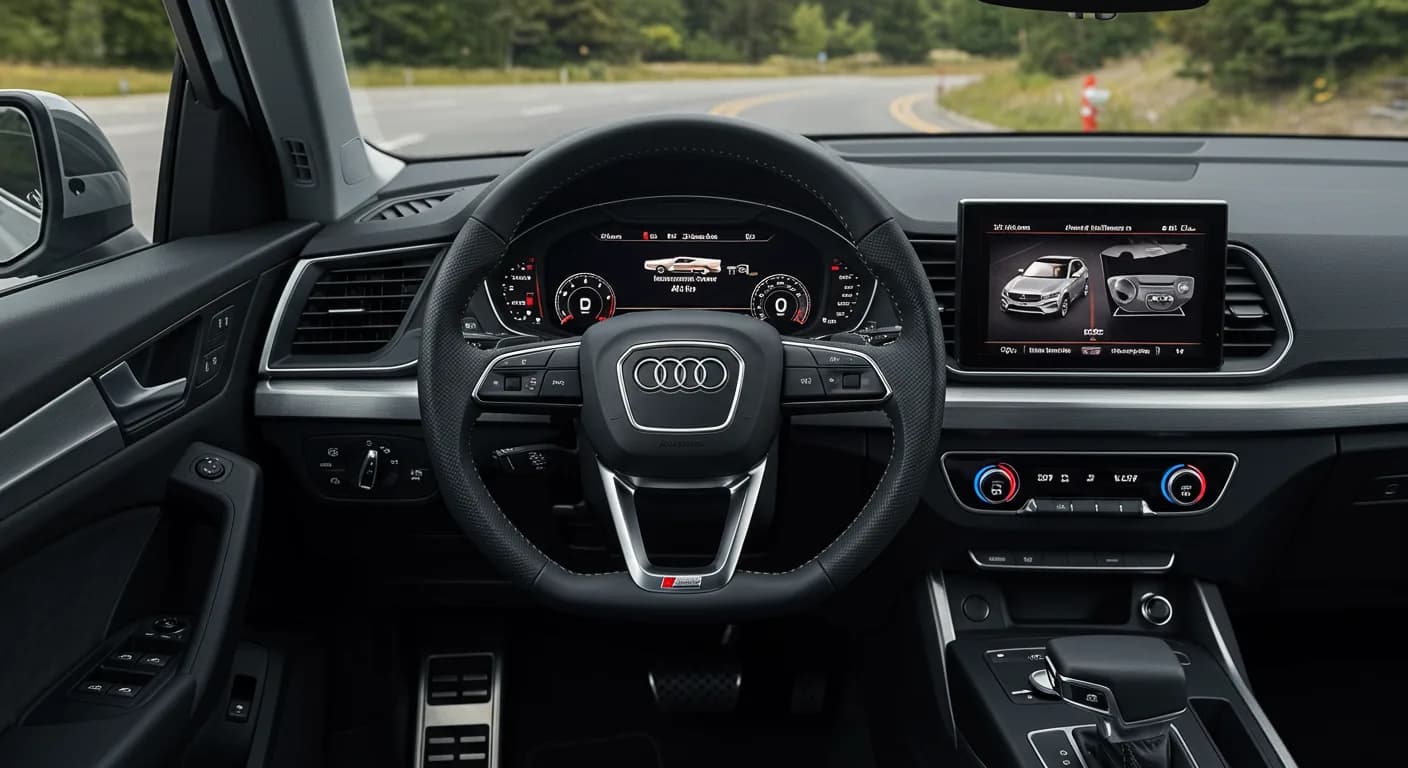
Owners of certain 2024 Audi Q5 e quattro vehicles may observe a "warning message in instrument cluster" appearing on their dashboard. This condition is often accompanied by a Diagnostic Trouble Code (DTC) B200000, indicating a fault within the control module. Audi has issued Technical Service Bulletin (TSB) 93 24 16 2075301/2 to address this specific concern, providing a software-based solution.
This TSB, dated September 23, 2024, supersedes previous guidance, including Technical Service Bulletin Group 93 number 24-12 dated September 17, 2024, and Pending Service Solution (PSS) TSB 2074344. The update applies to 2024 Audi Q5 e quattro models within the VIN range 000001-015509.
Symptoms
The primary symptom reported by owners is a generic "warning message in instrument cluster." This visual alert indicates an underlying issue that requires attention from a qualified technician.
Fault Codes / DTCs
When diagnosing the Audi Q5 e instrument cluster warning, technicians will typically find the following event memory entry logged in the control unit for the high-voltage battery charging unit (diagnostic address 00C6):
- DTC B200000: Control module faulty (symptom 1049088) active/static.
Diagnosis / Trigger Conditions
The root cause of the Audi Q5 e instrument cluster warning and DTC B200000 is identified as a software issue within the high-voltage battery charging unit control module, J1050. This software defect causes the On-Board Diagnostics (OBD) system to be overly sensitive, leading to the erroneous fault code and warning message.
Important Warnings
Audi has provided critical instructions for technicians performing this update:
- High-Voltage Battery Safety: To prevent charging of the high-voltage battery during the software update, the high-voltage cable must be removed BEFORE entering the SVM code on vehicles with high-voltage components. Charging the high-voltage battery during a software update can damage the high-voltage components.
- DoIP Communication: Always use DoIP (Diagnostics over Internet Protocol) when flashing a control module via ODIS in supported vehicles. To activate DoIP, technicians must select
Administration>>General>>GFF Process>>DoIP communication>>Only allow DoIP communication. This setting will automatically reset after the diagnostic session. A red LED on the VAS 6154(A) diagnostic tool indicates active DoIP.
Repair Procedure Summary
The repair involves updating the software of the high-voltage battery charging unit control module, J1050 (address word 00C6). Technicians must follow the instructions detailed in TSB 2011732: 00 Software Version Management (SVM), operating instructions.
The update is performed using SVM action code C6A014. The software will be updated from an older version (e.g., Part Number 9Y0915681D, Version 3310) to a newer version (e.g., Part Number 9Y0915681Q, Version 3323 or higher).
Required Tools or Parts
Technicians will utilize the ODIS diagnostic system and a VAS 6154(A) interface for the software update. The specific new software part number required for the J1050 control module is 9Y0915681Q, or a later version.
Owner Action
If your 2024 Audi Q5 e quattro displays a "warning message in instrument cluster" or if you suspect your vehicle is affected by DTC B200000, it is recommended to contact an authorized Audi dealership. They can diagnose the issue and perform the necessary software update as outlined in TSB 93 24 16 2075301/2. This software update is typically covered under warranty for eligible vehicles.
Source: NHTSA ID 11009402
Other revisions of this TSB
- 2021-2025 Audi Emergency Call System Fault TSBB200000
- 2022-2025 Audi e-tron Emergency Call System Fault TSBB200000
- 2023-2026 Audi Emergency Call System Fault B200000 TSBB200000
- 2020-2026 Audi Emergency Call Fault B200000B200000
- 2022-2026 Audi Emergency Call System Fault TSBB200000
- 2021-2026 Audi Emergency Call System Fault B200000B200000
- 2021-2026 Audi Emergency Call System Fault TSB 2059528/14B200000
- 2024-2025 Audi A5 Steering Warning Lamp TSBB200000
Related Articles
2024-2025 Audi Q5 e 12V Battery Discharge TSB 2074126/5
Audi has issued Technical Service Bulletin 2074126/5 for 2024-2025 Q5 e models, addressing 12V battery discharge caused by high-voltage charging unit bus wake-ups. This bulletin describes symptoms and a temporary workaround while a permanent solution is developed.
2024-2025 Audi Q5 e Engine Warning Lamp TSB 2080142/1
Audi has issued Technical Service Bulletin 2080142/1 for 2024-2025 Audi Q5 e PHEV vehicles, addressing an engine warning lamp (MIL) illumination caused by a software issue affecting the refrigerant pressure sensor. This can lead to various diagnostic trouble codes (DTCs), including P2CD400…
2021-2025 Audi Q5/A7 e Gearbox Malfunction TSB 2070965/5
Owners of 2021-2025 Audi Q5 e and A7 e vehicles may experience a "Gearbox malfunction message" and DTC P288200. Audi Technical Service Bulletin 2070965/5 outlines a software update for the transmission control module to resolve excessive engine disconnect clutch slippage.
2024-2025 Audi Q5 e 12V Battery Discharge TSB 2074126/4
Audi has released Technical Service Bulletin (TSB) 2074126/4 for 2024-2025 Q5 e models addressing a 12V battery discharge issue. This occurs due to bus wake-ups by the high-voltage charging unit. Owners may experience a discharged battery after the vehicle has been stationary or during…
2021-2025 Audi PHEV Exhaust Emissions Warning Lamp TSB
Audi TSB 2079117/1 addresses the exhaust emissions warning lamp (MIL) activating in 2021-2025 Audi A7, A8, and Q5 PHEV models. This can be triggered by specific refrigerant pressure sensor fault codes (P053100, P0EBF00, P251600, P0EC400, P1C5E00) due to a software issue, often without an actual…
Leave a comment
Comments are moderated and may take a moment to appear. Only your first name and the initial of your last name are shown publicly.
Comments
Be the first to comment.