2020-2022 Audi e-tron A/C Sensor Service Action 87H9
Audi has issued Service Action 87H9 for certain 2020-2022 e-tron vehicles to address potential failures of the air conditioning system's pressure and temperature sensors. This issue can lead to a non-functional A/C system. Owners are advised to schedule a free inspection and repair.
 Ahmet Topcu2022 Audi e-tron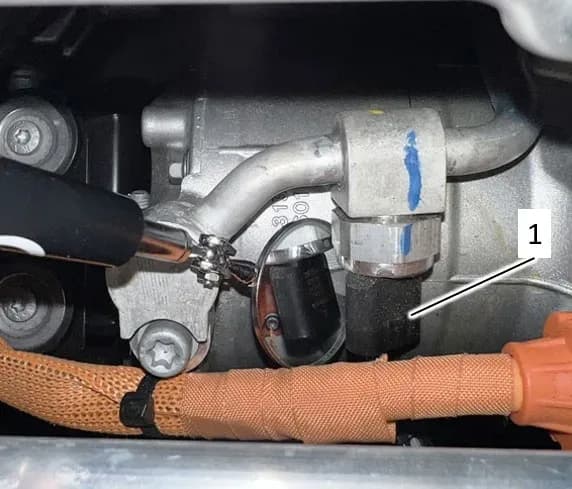
Si applica anche a
- Audi e-tron
- 2021
Audi has launched Service Action 87H9 to address a potential issue with the air conditioning system in certain 2020-2022 e-tron vehicles. This service action focuses on the pressure and temperature sensors, specifically the G395 and G826 sensors, which, if faulty, can cause the entire A/C system to stop functioning. Owners of affected vehicles should schedule an appointment with an authorized Audi dealer for inspection and repair.
This proactive measure aims to ensure customer satisfaction and maintain the expected performance of your Audi e-tron. The repair will be performed free of charge, but it is important to have the work completed before the campaign expiration date of September 01, 2028.
Symptoms of A/C Sensor Failure
Owners of affected 2020-2022 Audi e-tron vehicles may experience a complete failure of the air conditioning system. If the pressure and temperature sensors in the A/C system fail, the primary symptom will be that the "air conditioning system will no longer function." This means the vehicle's climate control will be unable to cool the cabin effectively.
What Owners Should Know
Owners should be aware of the following critical information regarding Service Action 87H9:
- Campaign Expiration: "This service action will be available for you free of charge only until September 01, 2028." If you wish to have this service performed after this date, "your dealerships normal costs associated with this work will apply."
- Inventory Vehicles: Dealers are required to ensure that every affected inventory vehicle has this campaign completed before delivery to consumers.
- Professional Service Required: The repair information in this document is intended for use only by skilled technicians. These procedures are not intended to be attempted by "do-it-yourselfers." Contact an authorized Audi dealer to determine if this information applies to your vehicle.
- Improper Repair: "Damages resulting from improper repair or failure to follow these work instructions are the dealer's responsibility and are not eligible for reimbursement under this action."
- Pre-existing Conditions: "Diagnosis and repair of pre-existing conditions in the vehicle are not covered under this action."
- Loaner/Wash Services: Dealers are instructed, "Do not claim wash/loaner under this action."
Diagnosis and Inspection Process
To diagnose the Audi e-tron A/C sensor failure, technicians will first verify the vehicle's eligibility for Service Action 87H9 using the Campaigns/Actions screen in the Audi Elsa system. Elsa is the only valid source for campaign inquiry and verification. The campaign status must show "open" for the vehicle to qualify for the repair.
If other open actions are present in Elsa, the customer will be informed so that all necessary work can be completed during the same workshop visit. Before proceeding, technicians must confirm the campaign is open and note the Applicable Criteria ID to determine the correct work and associated parts.
Critical Repair Step: If multiple software update Campaign/Actions are open, they must be performed in order of their start date, with the oldest being performed first. All Safety Recalls must be completed prior to completing this campaign.
The inspection involves visually checking the G395 and G826 pressure/temperature sensors. The first step is to remove the front luggage compartment liner, following the instructions in the ELSA repair manual under "Body > Body Interior > Interior Trim > Luggage Compartment Trim Panels > Front Luggage Compartment Liner, Removing and Installing." The sensors are located in the under-hood compartment. Technicians will label the sensors and connectors as needed, ensure the ignition is turned off, and then disconnect the sensors.
Technicians will look for a green dot on the connector housing of both the G395 and G826 sensors. If both sensors have this green dot, they do not require replacement, and the technician will proceed with reassembly. If a green dot is not present on one or both sensors, the production date of the affected sensor is checked. Sensors produced between calendar week 23 of 2020 and calendar week 30 of 2021 must be replaced. If the production information is not easily visible, a mirror can be used for inspection. Sensors produced outside this range, such as calendar week 31 of 2022, do not require replacement. The date format for production is week/year.
Detailed Repair Procedure
If a sensor requires replacement, the repair proceeds to Section C of the service action. This critical step involves careful handling of the high-voltage system and refrigerant. Technicians must observe strict safety precautions due to the "Danger of frostbite due to refrigerant coming out under pressure." This includes wearing safety gloves and protective eyewear.
The repair process requires evacuating or draining the refrigerant and immediately opening the refrigerant circuit. If more than 10 minutes pass after extraction or draining without opening the circuit, the refrigerant must be extracted or drained again due to pressure buildup from evaporation. The power-activated valves in the refrigerant circuit must be opened via ODIS (Offboard Diagnostic Information System) per ELSA prior to refrigerant recovery.
Specific instructions for replacing the G395 and G826 sensors are found in the ELSA repair manual under "Heating, Ventilation & Air Conditioning > Heating Ventilation and Air conditioning > 87 Air Conditioning > Refrigerant Circuit > A/C Pressure/Temperature Sensor G395, Removing and Installing" and "A/C Pressure/Temperature Sensor 2 G826, Removing and Installing," respectively. After sensor replacement, any additional basic settings recommended by the test plan must be completed.
Vehicle reassembly involves reversing the removal process. The A/C system must be recharged with the amount of refrigerant that was recovered. Crucially, the front luggage compartment liner and the foam insert for tool storage (Part Numbers 4KE-012-113-A and 4KE-863-362-B) must be replaced with new parts after removal.
Required Tools and Parts
Performing Service Action 87H9 requires specialized tools and specific parts to ensure a correct and safe repair:
- Sensors:
- SENSOR (Part Number: 4M0-959-603-E or 4M0959603E) - Up to 2 units
- Bins/Inserts:
- BIN (Part Number: 4KE-012-113-A) - 1 unit, VIN to Order
- BIN (Part Number: 4KE-863-362-B) - 1 unit, VIN to Order
- Tool storage insert (Part Number: 4KE-012-113-A)
- Storage Bin (Part Number: 4KE-863-362-B)
- Refrigerant and Oil:
- OIL REFRIG (Part Number: G-052-535-1M-DSP) - Up to 1.2 ml, Free Order
- R1234yf refrigerant (Locally sourced) - Up to 74g (2.61 oz), Free Order
- OIL FOR REFRIGERANT COMPRESSOR (Part Number: G 052535M2) - Up to 0.01 unit
- Fasteners:
- RIVET (Part Number: N 90558401) - Up to 4.00 units
- Specialized Equipment:
- R1234yf Air Conditioning Service Unit (ROB1234YFX- or VAS581005-)
- Engine Bung Set (VAS6122- or equivalent)
- Socket - 24mm (T40284- or equivalent)
- Diagnostic Tester (VAS6150X/6160X- or equivalent)
- Battery Tester/Charger capable of minimum 90 Amp continuous supply
- Safety Gear:
- Safety Gloves
- Safety Goggles
Parts ordered for this campaign should always follow the information in the circular, as the ordering system will supersede parts if applicable. For US dealers, VIN-to-order parts use AVA, while Canadian dealers contact Parts Specialists via phone (800-767-6552), email ([email protected]), or chat/text with the VIN.
Warranty Claim Information
For dealers, the claim entry instructions for Service Action 87H9 specify:
- Service Number: 87H9
- Damage Code: 0099
- Parts Vendor Code: 002
- Claim Type: Sold vehicle: 7 10; Unsold vehicle: 7 90
- Causal Indicator: Mark labor as causal if SENSOR is OK; Mark SENSOR* as causal if a sensor(s) is NOT OK
- Criteria I.D.: GE (Pressure/temperature sensor inspection)
Labor Operations and Time Units:
| Labor Op | Time Units | Description |
|---|---|---|
| 8711 01 99 | 10 | Check sensor production dates |
| 7007 19 00 | SEE ELSA | Storage compartment remove+reinstall |
| 8709 20 51 | SEE ELSA | 2 Pressure switch remove+reinstall (if both sensors replaced) |
| 8757 19 50 | SEE ELSA | High pressure switch remove+reinstall (Only if G395 sensor replaced) |
| 8764 19 50 | SEE ELSA | Low pressure switch remove+reinstall (Only if G826 sensor replaced) |
| 8703 17 00 | SEE ELSA | Refrigerant drain+fill |
| 2706 89 50 | SEE ELSA | Connect battery charge |
| 0150 00 00 | Time stated on diagnostic protocol | GFF/Guided functions |
Owner Action
If you own a 2020-2022 Audi e-tron, and you experience an Audi e-tron A/C sensor failure or simply want to ensure your vehicle is not affected, you should contact your authorized Audi dealer as soon as possible to schedule an appointment. The inspection and any necessary repairs will be performed free of charge. Audi estimates the work will take approximately four hours, though additional time may be needed for scheduling and preparation.
To check your vehicle's eligibility for this or any other service campaign, you can visit the Recall/Service Campaign Lookup tool on www.audiusa.com and enter your Vehicle Identification Number (VIN).
Source: NHTSA ID: 10250344
Galleria
11 immagini
Frequently Asked Questions
- What is Service Action 87H9 for Audi e-tron vehicles?
- Service Action 87H9 is an Audi campaign to address potential failures of the pressure and temperature sensors (G395 and G826) in the air conditioning system of certain 2020-2022 e-tron models. If these sensors fail, the A/C system will stop functioning.
- What are the symptoms of the A/C sensor failure in an Audi e-tron?
- The primary symptom of an Audi e-tron A/C sensor failure is that the "air conditioning system will no longer function." This means your vehicle's climate control will not be able to cool the cabin.
- Will I have to pay for the repair under Service Action 87H9?
- No, the inspection and any necessary repairs under Service Action 87H9 will be performed free of charge by an authorized Audi dealer. However, this free service is only available until September 01, 2028.
- How long will the repair take for Service Action 87H9?
- Audi estimates that the inspection and repair process for Service Action 87H9 will take approximately four hours. However, dealers may require additional time for scheduling and preparing for the work.
- How can I check if my Audi e-tron is affected by Service Action 87H9?
- You can check if your 2020-2022 Audi e-tron is affected by visiting the Recall/Service Campaign Lookup tool on www.audiusa.com and entering your Vehicle Identification Number (VIN). You can also contact your authorized Audi dealer.
Related Articles
2022 Audi e-tron Problems: Electrical System & Braking Concerns
The 2022 Audi e-tron has faced significant owner complaints regarding its electrical system, including sudden power loss and charging hazards, as well as various braking malfunctions. This profile details these issues and relevant service bulletins.
2022-2026 Audi Guided Fault Finding Reporting Obligation
Audi has issued Technical Service Bulletin TPI 2033392, also known as Transaction No. 2081531/1, regarding a reporting obligation for technicians when Guided Fault Finding produces an unexpected result. This TSB outlines the process for contacting Audi Product Support for diagnostic assistance.
2022-2026 Audi Infotainment System Complaints
Audi has released Technical Service Bulletin (TSB) 2081405/1 to address various customer complaints regarding infotainment systems in 2022-2026 Audi vehicles. This TSB helps technicians diagnose issues often caused by external media or mobile devices, rather than vehicle technology.
2018-2026 Audi Models Cracking Noise TSB 2061464/11
Audi Technical Service Bulletin 2061464/11 describes a cracking noise from the front or rear axle when changing direction in various 2018-2026 Audi models. The issue is due to stub axle movement and is resolved by bonding the stub axle to the wheel bearing with locking fluid.
2022-2026 Audi Parking Aid False Warnings TSB 2024323/13
Audi has released Technical Service Bulletin 2024323/13 to address customer complaints of false parking aid warnings. This bulletin details various environmental and vehicle-specific conditions that can cause the parking aid system to issue alerts even when no obstacles are present. It provides…
Leave a comment
Comments are moderated and may take a moment to appear. Only your first name and the initial of your last name are shown publicly.
Comments
Be the first to comment.