2019-2025 Audi Self-Leveling Suspension Leans to One Side
Audi has issued Technical Service Bulletin 43 25 02 2061907/3 to clarify updated tolerance specifications for self-leveling suspension systems in various 2019-2025 models. This bulletin addresses customer concerns where the vehicle leans to one side when parked on a level surface.
 David Chen2023 Audi A6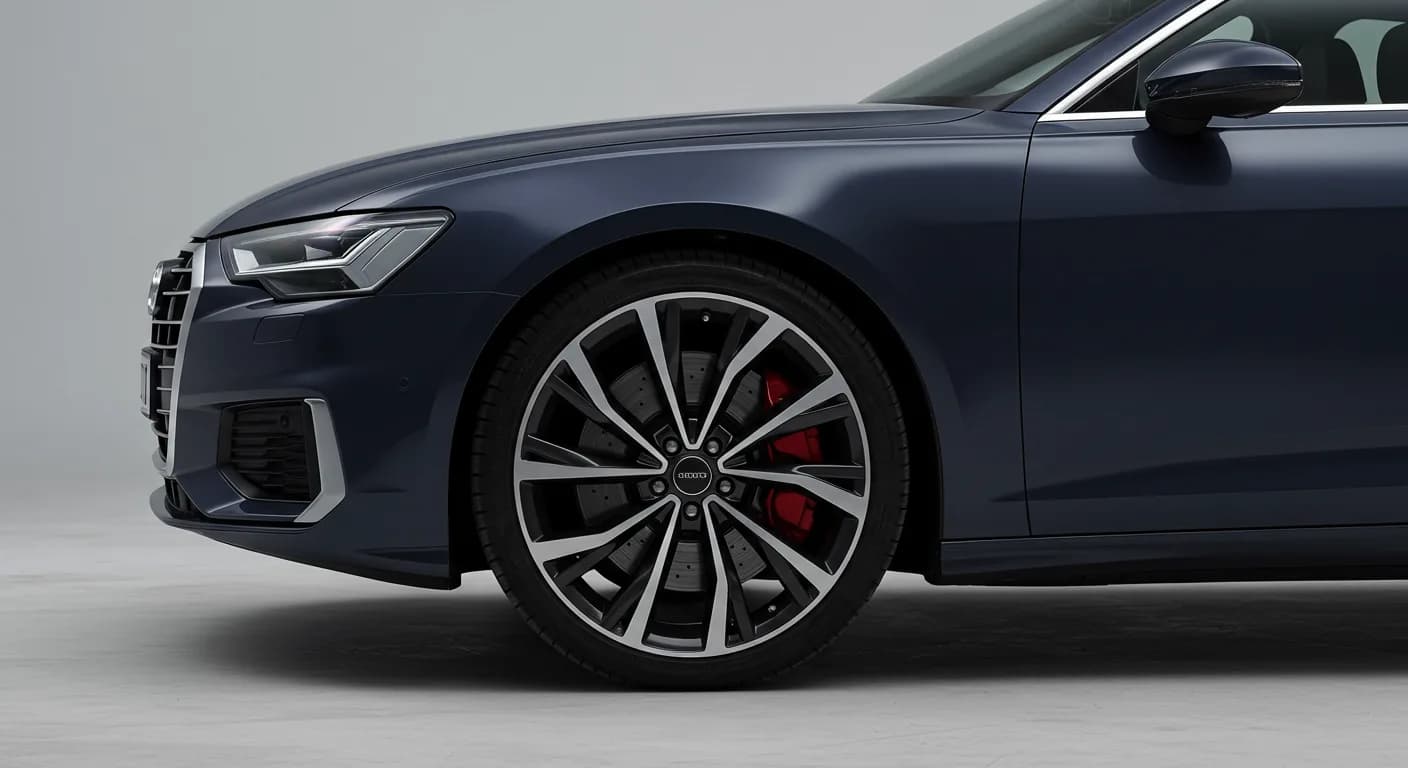
Gilt auch für
- Audi A6
- 2021, 2022, 2024, 2025
- Audi A6 allroad
- 2021–2025
- Audi A7
- 2021–2025
- Audi A7 e
- 2021–2022
- Audi RS 6 Avant
- 2021–2025
- Audi RS 7
- 2021–2025
- Audi S6
- 2021–2025
- Audi S7
- 2021–2025
▸ 2 weitere anzeigen▾ Weniger anzeigen
TSB Revision History and Supersession
The Technical Service Bulletin (TSB) 43 25 02 2061907/3, issued on January 15, 2025, supersedes an earlier bulletin, Group 43 number 22-66, which was dated July 12, 2022. This latest revision, marked as Revision 3, primarily updates the header to include additional model years. Previous revisions include Revision 2 on July 12, 2024, also for header updates and model year additions, and the initial publication (Revision 1) on January 12, 2021.
Symptoms
Owners of certain Audi vehicles equipped with self-leveling suspension may notice that their vehicle appears to lean to one side when parked on a level surface. This observation, described as "the vehicle leans to one side when it is parked on a level surface," is the primary customer concern addressed by this bulletin. While the self-leveling suspension system is designed to maintain a consistent ride height, slight deviations might be observed.
Technical Background and Updated Specifications
Audi has issued this TSB to clarify and update the permissible tolerance for the self-leveling suspension system. The key change is an increase in the acceptable difference between the right and left sides of the vehicle, from the previous 10mm to a new maximum of 13mm. This adjustment means that what might have previously been considered a deviation from specifications in systems like ElsaPro is now within the manufacturer's updated guidelines.
The bulletin emphasizes precise measurement techniques. To accurately assess the vehicle's stance, the distance between the center of the wheel and the bottom edge of the wing/wheel housing must be calculated as an average. Critical conditions for accurate measurement include ensuring that there are no persons or objects inside the vehicle and that the fuel tank and all other fluid levels are filled to their maximum capacity. These steps are crucial to obtain a true reading of the vehicle's resting height and determine if the Audi self-leveling suspension leans beyond the new 13mm tolerance.
Suspension System Tolerances
The following table details the updated permissible tolerances for various self-leveling suspension types:
| Suspension Type | Front Axle Tolerance | Rear Axle Tolerance | Tolerance between Right and Left |
|---|---|---|---|
| 1BA | ± 10 mm | ± 10 mm | <= 13 mm |
| 1BE | ± 10 mm | ± 10 mm | <= 13 mm |
| 1BL | ± 10 mm | ± 10 mm | <= 13 mm |
| 1BR | ± 10 mm | ± 10 mm | <= 13 mm |
| 1BQ | ± 10 mm | ± 10 mm | <= 13 mm |
Important Warnings for Owners
Audi explicitly states that this Technical Service Bulletin 43 25 02 2061907/3 is "informational only and not applicable to any Audi Warranty." This is a crucial point for owners to understand. If your vehicle's self-leveling suspension exhibits a lean that falls within the newly defined 13mm tolerance, it is not considered a defect eligible for warranty repair. This TSB serves to provide updated technical specifications to service centers, not to initiate a repair campaign.
Furthermore, the bulletin notes that there is "Not applicable." for both production solutions and service procedures outlined within this document. This reinforces that the TSB is a clarification of acceptable parameters rather than a guide for a specific repair or modification. Owners should be aware that any diagnostic work or potential repairs for a lean outside this 13mm tolerance would be handled separately and may not be covered under this specific bulletin.
What This Means for Owners
If you own a 2019-2025 Audi A6, A7, RS 6, RS 7, S6, S7, A6 allroad, or A7 e quattro with self-leveling suspension and observe that your vehicle leans to one side, it's important to understand the updated specifications. A lean within the 13mm tolerance is now considered normal.
While this TSB does not outline a repair, it is still advisable to have your vehicle inspected by an authorized Audi service center if you have concerns. They can perform the necessary measurements according to the guidelines provided in TSB 43 25 02 2061907/3 to confirm whether the observed lean falls within the revised acceptable limits. This will help determine if any further investigation or action is warranted, though it's important to remember that a lean within the 13mm specification will not be covered by warranty under this bulletin.
Source: NHTSA ID 11013721
Frequently Asked Questions
- What does it mean if my Audi's self-leveling suspension leans to one side?
- Audi Technical Service Bulletin 43 25 02 2061907/3 indicates that a lean of up to 13mm between the right and left sides is now considered within the acceptable operating tolerance for self-leveling suspension systems in certain models. This means that a slight lean might be normal according to the updated specifications.
- Which Audi models are affected by this self-leveling suspension clarification?
- This TSB applies to 2019-2025 Audi A6, A7, RS 6, RS 7, S6, S7, A6 allroad, and A7 e quattro models equipped with self-leveling suspension. The bulletin specifically addresses the condition where "the vehicle leans to one side when it is parked on a level surface."
- Will Audi cover repairs for a leaning self-leveling suspension under warranty?
- According to TSB 43 25 02 2061907/3, this bulletin is informational only and "not applicable to any Audi Warranty." This implies that if the lean is within the newly defined 13mm tolerance, it may not be considered a warrantable repair.
- How should measurements be taken to check for a lean?
- The TSB specifies that measurements should be taken between the center of the wheel and the bottom edge of the wing/wheel housing, calculated as an average. It's important to ensure no persons or objects are in the vehicle and that all fluids (including fuel) are at maximum level for accurate assessment of the Audi self-leveling suspension leans.
Related Articles
2021-2023 Audi A6/A7 TPMS Warning Light DTC U012700
Audi has released Technical Service Bulletin 2065474/5 to address instances where a Tire Pressure Monitoring System (TPMS) warning light appears in the instrument cluster, or a "TPMS message" is displayed, accompanied by diagnostic trouble code U012700.
2021-2025 Audi DL382 Transmission Noises TSB 2074806/3
Audi has released Technical Service Bulletin (TSB) 2074806/3 to address various noises and vibrations originating from the DL382 transmission and engine in 2021-2025 A4, A5, A6, A7, and Q5 models. This TSB provides detailed diagnostic and repair procedures for technicians.
2022-2025 Audi Steering Lock for Active Steering Failed Warning
Audi has issued Manufacturer Communication 11018963 to address instances where the warning message "Steering lock for active steering failed" appears in various 2022-2025 Audi A4, A5, A6, A7, S, and RS models. This technical service bulletin provides critical information for diagnosing and…
2022-2024 Audi A4-A8 Steering Lock Failure TSB 2061904/6
Audi has issued Technical Service Bulletin 2061904/6 for 2022-2024 A4, A5, A6, A7, and A8 models. It addresses a 'Steering lock for active steering failed' warning, often accompanied by DTC C110DF0, indicating a hardware issue with the steering column lock magnet.
2017-2025 Audi Quattro Droning Noises in Corners TSB
Audi has issued Technical Service Bulletin 2075681/2 to address customer complaints of droning noises and vibrations from the drivetrain when pulling away or turning sharply in various 2017-2025 Audi models equipped with quattro with ultra technology (PR number GH4).
Leave a comment
Comments are moderated and may take a moment to appear. Only your first name and the initial of your last name are shown publicly.
Comments
Be the first to comment.