2021-2022 Audi A6 Jerking/Hesitation with DTC P023600
Audi has released Technical Service Bulletin 2062323/3 for 2021-2022 A6 models experiencing jerking, bucking, or hesitation while driving, often accompanied by DTCs P023600 or P010600. The issue stems from damaged wiring at the G31 boost pressure sensor.
 Ahmet Topcu2022 Audi A6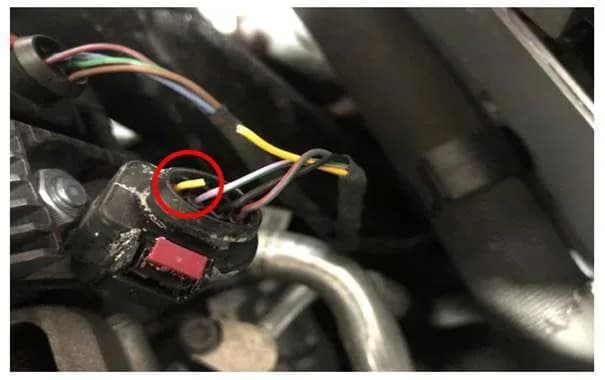
Also applies to
- Audi A6
- 2021
Symptoms
Owners of 2021-2022 Audi A6 models equipped with the 2.0l engine may experience their vehicle feeling as if it is hesitating, is low on power, or is bucking/jerking while driving. Additionally, the Malfunction Indicator Lamp (MIL) may be illuminated on the dashboard.
Fault Codes / DTCs
When diagnosing the Audi A6 jerking hesitation P023600 issue, technicians may find one or more of the following Diagnostic Trouble Codes (DTCs) stored in the Engine Control Module (ECM), specifically J623 (address word 0001):
| Code | Description |
|---|---|
| P010600 | Manifold Abs.Pressure or Bar.Pressure Range/Performance |
| P023600 | Turbocharger Boost Sensor (A) Circ. Range/Performance |
Diagnosis / Trigger Conditions
The root cause of the Audi A6 jerking hesitation P023600 and P010600 DTCs is often traced to damage in the yellow wire on the electrical connector of the G31 charge pressure sender. This damage is attributed to the routing and uncovered length of the wiring, making it susceptible to vibrations over time.
Important Warnings
Audi explicitly states that "Parts replacement does not solve this issue. Claims for replaced parts (e.g., G31 sensor or turbocharger) will be subject to review." This means simply replacing the G31 sensor or turbocharger will not resolve the underlying wiring problem and may not be covered under warranty. Furthermore, if your vehicle is outside any applicable warranty, this Technical Service Bulletin 2062323/3 is for informational purposes only, implying potential out-of-pocket costs for repairs.
Repair Procedure Summary
The repair detailed in Technical Service Bulletin 2062323/3 involves inspecting and repairing the wiring at the G31 boost pressure sensor. If damage is found at the pins or wire of the G31 boost pressure sensor, the harness must be repaired using a VAS 1978B wire harness repair set. This includes using gold-plated contacts (part number 000 979 025 EA) for the damaged wires and ensuring sufficient slack in the harness to prevent future issues. Following the repair, the harness must be wrapped with textile tape (part number N 105 920 02), starting below the connector and extending to cover the connector base, ensuring wires are kept flat and overlapping existing tape.
Required Tools or Parts
To perform the repair outlined in TSB 2062323/3, the following parts and tools are specified:
Parts
- Fasteners, Bolts, Nuts, and Screws: As needed (refer to ETKA/ELSA)
- N 10592002: Textile Tape (quantity: 0.10)
- 000979025EA: Gold-plated contact (quantity: 01)
- 000979940: Butt connector (quantity: 01)
Tools
- VAS 1978B: Wire harness repair set
- VAS 6160/VAS 6150: VAS tester with the current version of ODIS (Windows 10)
Warranty Information
Warranty claims for this repair are typically covered under the following conditions:
- Claim Type 110: Up to 48 Months/50,000 Miles.
- Claim Type G10: For Certified Pre-Owned (CPO) vehicles, verification of owner status is required.
The Service Number for this operation is 9709, and the Damage Code is 0015. All warranty claims must adhere to the Audi Warranty Policies and Procedures Manual and are subject to review.
Owner Action
If your 2021-2022 Audi A6 is exhibiting symptoms such as jerking, hesitation, or low power, especially with an illuminated MIL, and you suspect the Audi A6 jerking hesitation P023600 issue, it is recommended to schedule an appointment with an authorized Audi dealership. They can perform a diagnostic scan to confirm the presence of DTCs P023600 or P010600 and apply the appropriate repair as per Technical Service Bulletin 2062323/3.
Source: NHTSA ID: 10251498
Gallery
5 images
Frequently Asked Questions
- What causes my 2021-2022 Audi A6 to jerk or hesitate while driving?
- Your 2021-2022 Audi A6 may be jerking or hesitating due to damaged wiring at the G31 boost pressure sensor. This issue is detailed in Audi Technical Service Bulletin 2062323/3, which attributes the damage to vibrations affecting the wiring harness.
- What DTCs are associated with the Audi A6 jerking hesitation P023600 issue?
- The primary DTCs associated with the Audi A6 jerking hesitation P023600 issue are P023600 (Turbocharger Boost Sensor (A) Circ. Range/Performance) and P010600 (Manifold Abs.Pressure or Bar.Pressure Range/Performance), both stored in the ECM (J623).
- Can I fix the jerking/hesitation by replacing the G31 sensor or turbocharger?
- No, Audi explicitly states that "Parts replacement does not solve this issue." The problem is with the wiring itself, not necessarily the sensor or turbocharger. Attempting to replace these parts will not resolve the underlying cause and may not be covered under warranty.
- What is Audi Technical Service Bulletin 2062323/3 about?
- Audi TSB 2062323/3 addresses jerking, bucking, or hesitation while driving in 2021-2022 Audi A6 models, often accompanied by DTCs P023600 and P010600. It provides a repair procedure for damaged wiring at the G31 boost pressure sensor, which is caused by vibrations.
- Is the repair for the Audi A6 jerking hesitation P023600 issue covered under warranty?
- The repair is typically covered under Audi's New Vehicle Limited Warranty (up to 48 months/50,000 miles) or for Certified Pre-Owned (CPO) vehicles (Claim Type G10). However, if your vehicle is outside of these warranty periods, the TSB is for informational purposes only, meaning the repair might not be free of charge.
Other revisions of this TSB
- 2021-2024 Audi e-tron Door Panel Noise and Other Common Issues TSBP023600, P010600
- 2022-2024 Audi e-tron U046900 Belt Starter Generator DTCP023600, P010600
- 2021-2024 Audi USB Trim Detached and Other IssuesP023600, P010600
- 2021-2023 Audi Q3 Boost Pressure Sensor DTCsP023600, P010600
- 2020-2023 Audi Common Issues: Coolant, Noise, Airbag DTCsP023600, P010600
- 2021-2023 Audi Multi-Topic TSB: Noise, Warnings & DTCsP023600, P010600
- 2021-2022 Audi e-tron PDC Sensor Loose & Other FaultsP023600, P010600
- 2021-2022 Audi e-tron Door Panel Noise TSBP023600, P010600
Related Articles
2021-2024 Audi Gearbox P17EF00 Hydraulic Pump Adaptation
Audi Technical Service Bulletin 2074823/2 details a condition where the auxiliary hydraulic pump adaptation routine in the DL-382 gearbox control unit may not start automatically, logging DTC P17EF00. This TSB applies to various 2021-2024 Audi A4, A5, A6, A7, and Q5 models and requires a software…
2017-2025 Audi Models Droning/Vibrations TSB 2059057/13
Audi has released Technical Service Bulletin 2059057/13 to address customer complaints of droning, humming, and vibrations in various 2017-2025 Audi models equipped with Quattro Ultra. This TSB outlines a specific ATF drain and fill procedure for the all-wheel drive coupling 1.
2021-2025 Audi Starter/Generator Belt Noise P2BA300
Audi has released Technical Service Bulletin 2061461/13 to address grinding, squeaking, or tweeting noises from the engine compartment, or an "Electrical system: Malfunction!" warning, potentially linked to Diagnostic Trouble Code P2BA300 in 2021-2025 A4, A5, A6, and Q5 models.
2022-2023 Audi A6 / A7 Abrupt Shifting TSB
Audi has issued Technical Service Bulletin (TSB) 37 24 26 2075033/1 to address customer complaints of "rough" or "abrupt" shifting behavior in 2022-2023 Audi A6, A6 allroad, and A7 vehicles. This issue is caused by a software problem in the Transmission Electronics control module (J217) and is…
2021-2023 Audi Gearbox Malfunction DTC P17F900
Audi has released Technical Service Bulletin 2064312/6 to address a 'Gearbox Malfunction' warning and DTC P17F900 in 2021-2023 A4, A5, A6, A7, and Q5 models with DL382 transmissions. The issue often stems from loose bolts on the high-pressure filter cover, leading to a loss of drive.
Leave a comment
Comments are moderated and may take a moment to appear. Only your first name and the initial of your last name are shown publicly.
Comments
Be the first to comment.