2025 Audi A5 Instrument Cluster Messages TSB 2079930/2
Audi has released Technical Service Bulletin 2079930/2 for 2025 A5, S5, Q5, and SQ5 models addressing various instrument cluster warning messages, including 'Drive system: fault' and 'Loose wheel warning.' This TSB outlines a software update to resolve communication DTCs U02AB00 and U042200.
 David Chen2025 Audi A5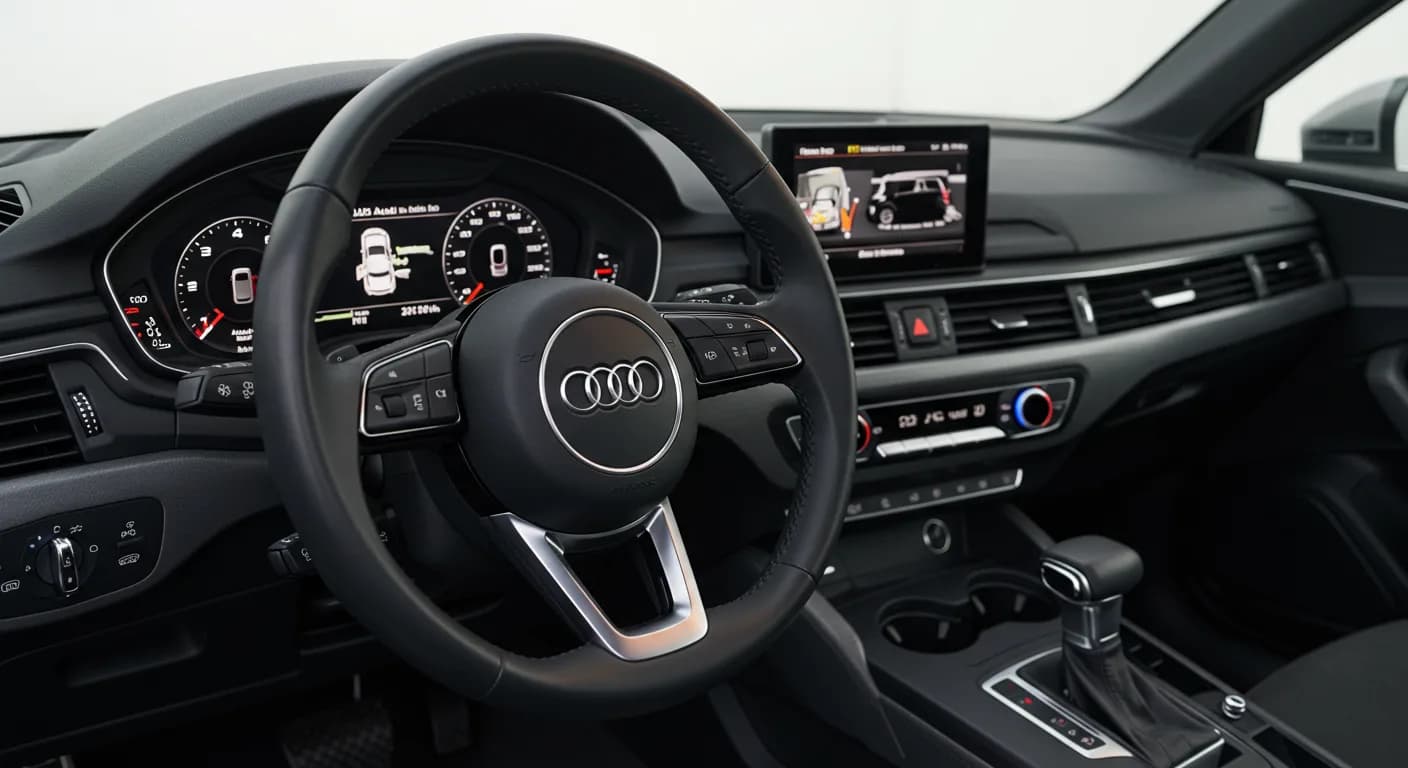
Also applies to
- Audi Q5
- 2025
- Audi S5
- 2025
- Audi SQ5
- 2025
Revision History
Technical Service Bulletin 2079930/2, released on December 16, 2025, is the second revision of this document. The initial publication (Revision 1) was issued on November 10, 2025. Revision 2 primarily involved a revised header that added a software version filter, refining the applicability of the bulletin.
Symptoms: Various Instrument Cluster Messages
Owners of 2025 Audi A5, S5 (FU), Q5, Q5 Sportback, SQ5, and SQ5 Sportback (GU) models may observe a range of warning messages appearing in their instrument cluster. These messages indicate potential issues with various vehicle systems and can be concerning. The presence of these 2025 Audi A5 instrument cluster messages is the primary symptom addressed by Technical Service Bulletin (TSB) 2079930/2.
Examples of the verbatim warning messages that owners might see include:
- "Drive system: fault. Limited performance. Please contact workshop"
- "Loose wheel warning: fault. See owner's manual."
- "Tire pressure: fault. See owner's manual."
- "Initializing active front assist. Please wait..."
- "Brakes: function restricted. You can continue driving cautiously. Please contact workshop."
- "Fault in cooling system"
Fault Codes (DTCs)
Upon diagnosis, technicians may find that certain diagnostic addresses are unreachable, specifically 00C5 and potentially 8132. The underlying cause for the 2025 Audi A5 instrument cluster messages is often linked to specific Diagnostic Trouble Codes (DTCs) stored in the vehicle's control units. These codes indicate communication issues or invalid data reception.
The following DTCs may be stored in the Engine electronics, J623 (address word 0001):
| Code | Description | Condition |
|---|---|---|
| U02AB00 | Thermal management control unit – no communication | Active/Static |
| U042200 | Invalid data received from body control module | Active/Static |
Additionally, for vehicles equipped with 2.0L TFSI engines (engine codes DWZA, DWZB, or DXCA), the following DTC may also be logged:
| Code | Description | Condition |
|---|---|---|
| P021700 | Engine Coolant Over Temperature Condition – symptom 47156 | Active/Static |
Technical Background
Audi has identified the root cause of these various instrument cluster warnings and associated DTCs as a software issue within the onboard supply control unit, designated as J519. This software anomaly can lead to communication failures between critical vehicle modules, resulting in the display of erroneous or critical warning messages to the driver. This issue can prevent diagnostic addresses 00C5 and 8132 from being reached, further complicating diagnosis without the proper procedure.
Repair Procedure Summary
Technical Service Bulletin 2079930/2 outlines a two-step repair process to address the software issue and resolve the 2025 Audi A5 instrument cluster messages. This TSB replaces previous bulletins, specifically Pending Service Solution TSB 2078345 and 97 PSS, which also dealt with instrument cluster messages and unreachable diagnostic addresses.
Perform a Terminal 30 Reset: The first step involves performing a terminal 30 reset for a minimum of 15 minutes. This procedure helps to clear temporary electrical states and can restore communication with diagnostic addresses 00C5 and 8132. This step is crucial before proceeding with any software updates.
Check for and Apply Software Update: After the terminal 30 reset, technicians must check if TSB 2079690, titled "00 Combined software update 03.10.00/C (28.13.01) KD2," is applicable and visible for the specific vehicle. If this TSB is applicable, the software update detailed within TSB 2079690 must be performed. This update is crucial for correcting the underlying software fault in the J519 onboard supply control unit, which is the root cause of the communication errors and subsequent instrument cluster warnings.
Warranty Information
This Technical Service Bulletin 2079930/2 provides guidance for repairs. If the vehicle is outside of any warranty, this bulletin serves as informational guidance only, meaning the repair costs may not be covered by Audi. For vehicles under warranty, specific labor operations and time units (TU) are provided for claiming the repair.
- Service Number: 9710
- Damage Code: KD02
Labor Operations for Terminal 30 Reset Only (for vehicles where TSB 2079690 is not yet visible):
| Operation | Code | Time Units (TU) | Notes |
|---|---|---|---|
| GFF / Guided Functions | 0150 0010 | See SRT | With associated operations |
| GFF / Guided Functions | 0150 0060 | Time stated on diagnostic protocol | |
| Loosen and secure ground cable | 9785 0999 | 20 |
Labor Operations for Terminal 30 Reset AND Software Update (for vehicles where TSB 2079690 is already visible):
| Operation | Code | Time Units (TU) | Notes |
|---|---|---|---|
| Software update, including connecting battery charger | 0151 0010 | See SRT | With associated operations |
| Fixed rate for software update | 0151 0040 | 130 | Includes all required preliminary and follow-up work (bus sleep cycle, calibration drive, additional work, and restarting software update if flashing is aborted) |
| Loosen and secure ground cable | 9785 0999 | 20 |
Important Notes for Owners and Technicians
When performing the combined software update described in TSB 2079930/2, Audi specifies that time stamps are not required for billing under warranty. Furthermore, technicians are permitted to work on other vehicles at the same time, and the combined software update can also be performed by non-productive personnel. This flexibility aims to streamline the repair process for dealerships.
Source: NHTSA ID 11027380
Frequently Asked Questions
- What are the common instrument cluster messages addressed by TSB 2079930/2 for 2025 Audi models?
- Technical Service Bulletin 2079930/2 addresses various instrument cluster messages, including "Drive system: fault. Limited performance. Please contact workshop," "Loose wheel warning: fault. See owner's manual.," "Tire pressure: fault. See owner's manual.," "Initializing active front assist. Please wait...," "Brakes: function restricted. You can continue driving cautiously. Please contact workshop.," and "Fault in cooling system."
- What diagnostic trouble codes (DTCs) are associated with these instrument cluster warnings?
- The instrument cluster warnings are typically associated with DTCs U02AB00 (Thermal management control unit – no communication) and U042200 (Invalid data received from body control module), both stored in the Engine electronics (J623). For 2.0L TFSI engines, P021700 (Engine Coolant Over Temperature Condition) may also be present.
- How does Audi recommend fixing the instrument cluster warning messages?
- Audi recommends performing a terminal 30 reset for at least 15 minutes. Following this, technicians must check for and apply a software update detailed in TSB 2079690 if it is applicable to the vehicle. This process, outlined in TSB 2079930/2, aims to resolve the underlying software issue in the onboard supply control unit J519.
- Is the repair for these 2025 Audi A5 instrument cluster messages covered under warranty?
- If your 2025 Audi A5 is still under warranty, the repair outlined in TSB 2079930/2 is typically covered. However, if the vehicle is outside of its warranty period, the Technical Service Bulletin serves as informational guidance only, and repair costs may not be covered by Audi.
- What is the purpose of the Terminal 30 reset in the repair procedure?
- The Terminal 30 reset, which involves disconnecting and reconnecting the battery for at least 15 minutes, is the initial step in the repair process. Its purpose is to clear temporary electrical states and restore communication with diagnostic addresses 00C5 and 8132, which are often unreachable due to the software issue.
Other revisions of this TSB
- 2025-2026 Audi A5/Q5/S5 Instrument Cluster Messages TSBU02AB00, U042200, P021700
- 2025 Audi Q5 / SQ5 AC No Cooling TSB 2080332/1P021700
- 2025 Audi A5 Instrument Cluster Messages TSBU02AB00, U042200
- 2025 Audi A5/Q5/S5/SQ5 Instrument Cluster Messages TSBU02AB00, U042200
Related Articles
2024-2025 Audi On-Car Analysis: Check Engine Light & DTCs
Audi's March 2025 On-Car Analysis list provides guidance for technicians on several issues affecting 2024-2025 Audi A3, Q5, and A5 models. These include check engine lights, vehicle sound malfunction warnings, and specific diagnostic trouble codes (DTCs) such as POE5E00 and P219500. The document…
2025-2026 Audi A5/Q5 Coolant Pump V188 Blocked P2BC100 TSB
Audi TSB 2080825/2 addresses the 'Coolant pump for charge air cooler, blocked' issue (DTC P2BC100) and 'Drive system: fault' message in 2025-2026 Audi A5 and Q5 models, often after extended stationary periods. It outlines diagnosis and repair steps.
2025 Audi A5/Q5/S5/SQ5: 'Position P Cannot Be Selected'
A Technical Service Bulletin (TSB 2080044/4) has been issued for certain 2025 Audi A5, Q5, S5, and SQ5 vehicles regarding an issue where 'Position P cannot be selected' and the vehicle cannot be locked. This condition is resolved with a software update.
2025 Audi A5/S5/Q5/SQ5 Software Update Flashing Issues
This technical service bulletin (TSB 2079692/5) from Audi addresses various issues encountered during the combined software update 03.10.00/C (28.13.01) KD2 for 2025 Audi A5, S5, Q5, and SQ5 models. It covers diagnostic errors, control module communication problems, and solutions for successful…
2025 Audi A5/Q5/S5/SQ5 Software Update TSB 2079690/8
Audi has released Technical Service Bulletin 2079690/8 for 2025 A5, Q5, S5, and SQ5 models. This TSB details a combined software update (00 Combined software update 03.10.00/C (28.13.01) KD2) that resolves various issues including navigation, connectivity, digital key functionality, and driving…
Leave a comment
Comments are moderated and may take a moment to appear. Only your first name and the initial of your last name are shown publicly.
Comments
Be the first to comment.