Audi Explores Humanoid Robotics for Ingolstadt Plant Logistics
Audi, in collaboration with Agile Robots, Dassault Systèmes, and NVIDIA, has launched a proof-of-concept to integrate mobile humanoid robots into its Ingolstadt plant's logistics. The project focuses on automating intricate parts sequencing, a critical step in vehicle assembly, to enhance…

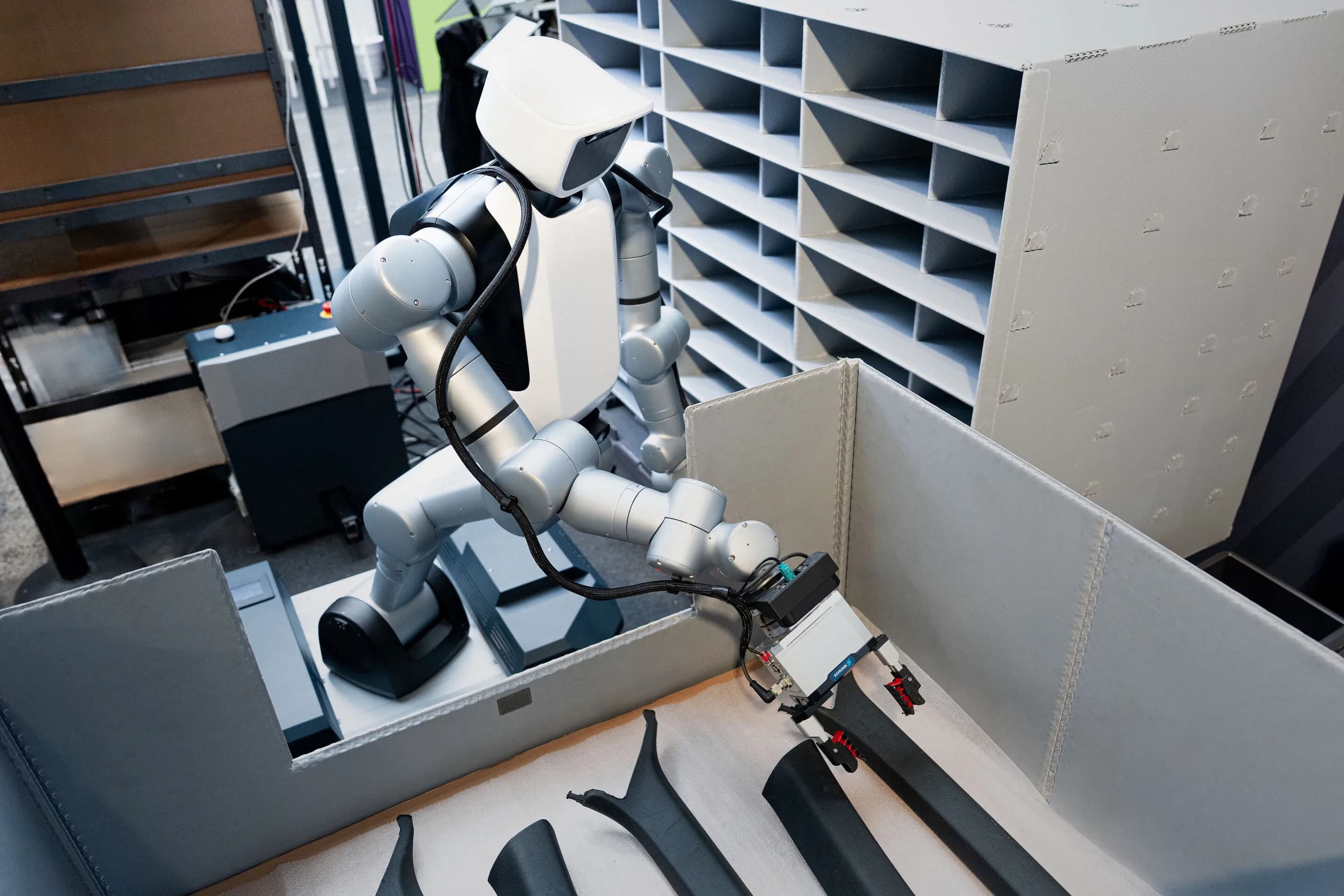
Audi has initiated a proof-of-concept to integrate mobile humanoid robots into its Ingolstadt manufacturing plant, aiming to automate complex parts sequencing in automotive logistics. This project, announced on October 21, 2026, involves collaborations with robotics firm Agile Robots, software provider Dassault Systèmes, and AI computing leader NVIDIA.
Automating Complex Logistics
Audi's Ingolstadt plant relies on highly complex sequencing operations to ensure that approximately one million parts daily reach assembly workstations in the correct order. Traditionally, handling high-variant or semi-rigid components, as well as picking unsorted parts from containers, has presented significant challenges for automation.
The mobile humanoid robots developed by Agile Robots are designed to address these difficulties. These robots feature dual-arm manipulation capabilities for handling large and flexible parts, combined with AI-powered perception to identify and precisely grasp various components, even when mixed or presented in different packaging.
Operating at human height, these robots can seamlessly integrate into Audi's existing production environment. The proof-of-concept is being tested within Audi's Production Lab, a dedicated innovation space for future manufacturing and logistics technologies.
Virtual Simulation and Efficiency Gains
Before the physical deployment of the Audi humanoid robots, a virtual twin of Audi's logistics environment is being created using Dassault Systèmes' DELMIA application. This virtual model, leveraging Dassault Systèmes' 3DEXPERIENCE platform and NVIDIA Omniverse libraries, allows engineers to simulate and validate robot tasks.
This approach enables rapid testing of feasibility, timings, ergonomics, and safety within a virtual environment, significantly reducing the time required for robot commissioning from months to days. Dassault Systèmes' AI-powered Virtual Companion, LEO, will further assist engineers in this accelerated process.
The overall goal is to reduce manual workload, increase operational efficiency, and allow human employees to focus on more complex, higher-value tasks within Audi's 'thinking factory' concept, where AI and robotics support human workers.
The Future of Automotive Manufacturing
This collaboration represents a step towards highly automated in-house logistics, pushing the boundaries of automated kitting. The partners aim to demonstrate how Physical AI-powered humanoid robots can transform future logistics by automating tasks previously considered beyond the scope of traditional robotics.
Audi's Board Member for Production and Logistics, Gerd Walker, emphasized that the future of manufacturing will be shaped by the successful integration of industrial expertise with artificial intelligence. He noted that parts picking in sequencing has long been a difficult automation challenge in automotive logistics.
Dr. Zhaopeng Chen, CEO of Agile Robots, highlighted that their mobile humanoids are performing critical tasks previously impossible to automate, showcasing the practical application of Physical AI for industrial productivity. Deepu Talla of NVIDIA added that humanoid robots are extending automation beyond repetitive tasks to the complex work central to modern manufacturing.
While this initiative focuses on internal factory logistics, it signals Audi's ongoing investment in advanced manufacturing technologies. This could lead to more efficient production processes, potentially impacting vehicle availability and the overall quality of future Audi models for consumers.
Yorum bırakın
Yorumlar moderasyondan geçer ve görünmesi biraz zaman alabilir. Sadece adınız ve soyadınızın baş harfi herkese açık olarak gösterilir.
Yorumlar
İlk yorum sizden olsun.