2021-2025 Audi Engine Temperature Too High TSB P00B700
Audi has issued Technical Service Bulletin 2077593/2 to address instances of the 'engine temperature too high' warning and related diagnostic trouble codes P00B700, P011600, and P268100 in various 2021-2025 models. The solution involves a software update for the engine control module.
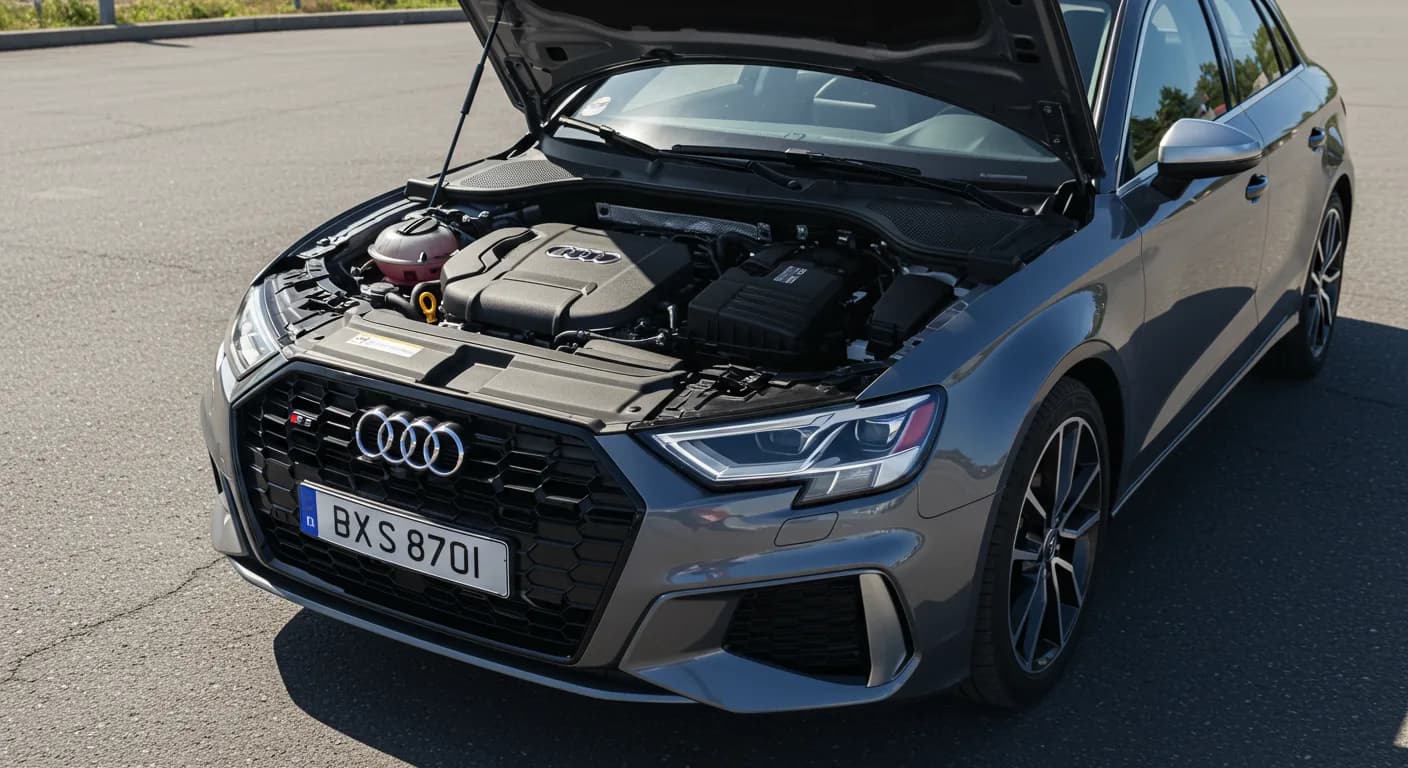
 David Chen2022 Audi S3
Şu araçlar için de geçerli
- Audi A3
- 2022–2024
- Audi Q5
- 2021–2025
- Audi Q5 e
- 2021, 2023, 2025
- Audi RS 3
- 2022–2024
- Audi S3
- 2023–2024
- Audi SQ5
- 2021–2025
Audi has released Technical Service Bulletin (TSB) 2077593/2 to address concerns regarding the engine temperature being too high in certain 2021-2025 Audi vehicles equipped with the 4-cylinder 2.0 TFSI engine. This issue can manifest with specific diagnostic trouble codes (DTCs) and warning messages appearing on the instrument cluster. The TSB outlines a software update for the engine control module as the primary solution to rectify these conditions.
Symptoms
Owners of affected Audi vehicles may notice several indicators that point to this issue. The most common symptom reported by customers is the illumination of the coolant level warning lamp. This light signals a potential problem with the vehicle's cooling system, prompting concern from the driver.
Additionally, the vehicle's information, navigation, communication, or entertainment system may display warning symbols related to low coolant or coolant temperature. These messages, such as a "low coolant/coolant temperature warning display," serve as critical alerts to the driver about the engine's thermal management system. Workshop findings also indicate that the coolant thermostat might exhibit "no function" errors, further contributing to the Audi engine temperature too high P00B700 condition.
Fault Codes / DTCs
When diagnosing the Audi engine temperature too high P00B700 issue, technicians may find one or more of the following diagnostic trouble codes (DTCs) stored in the engine control module (J623), which is identified by address word 0001. These codes provide specific details about the nature of the cooling system malfunction:
| Diagnostic address | Diagnostic trouble code | Fault symptom | Storage state |
|---|---|---|---|
| 0001 - Engine electronics | P011600: Engine Coolant Temperature Sensor 1 Circuit Range/Performance | Intermittent | Intermittent |
| 0001 - Engine electronics | P268100: Engine Coolant Bypass Valve Control Circuit/Open | Intermittent | Intermittent |
| 0001 - Engine electronics | P00B700: Engine Coolant Flow Low/Performance | Intermittent | Intermittent |
These DTCs indicate problems ranging from an intermittent coolant temperature sensor reading to issues with the coolant bypass valve control circuit and low coolant flow. All these conditions can contribute to the engine running at an elevated temperature.
Technical Background
The root cause of the Audi engine temperature too high P00B700 and related symptoms is identified as a software anomaly within the engine control module (J623). The engine control module is responsible for managing various engine functions, including the cooling system. An outdated or faulty software version can lead to incorrect readings, improper control of cooling components, and ultimately, the illumination of warning lights and the storage of DTCs.
To resolve these issues, the software for the engine control module, J623 (address word 0001), requires an update. This update will recalibrate the module's logic, ensuring accurate monitoring of engine temperature and proper operation of the cooling system components, thereby preventing the Audi engine temperature too high P00B700 condition.
Important Warnings for Owners and Technicians
Audi has issued specific warnings within TSB 2077593/2 that are crucial for both technicians performing the repair and owners to understand, especially concerning vehicles equipped with high-voltage components:
- High-Voltage Battery Precaution: "To prevent charging of the high-voltage battery during the software update, the high-voltage cable is to be removed BEFORE entry of the SVM code on vehicles with high-voltage components." This step is critical because "Charging the high-voltage battery during a software update can damage the high-voltage components." This emphasizes the importance of following precise procedures to protect sensitive electrical systems during service.
- DoIP Communication: "Always use DoIP when flashing a control module via ODIS in supported vehicles." DoIP (Diagnostics over Internet Protocol) is a modern communication standard used for diagnostics and flashing control modules. Activating DoIP ensures reliable and efficient data transfer during the software update process. Technicians must navigate to Administration >> General >> GFF Process >> DoIP communication and select "Only allow DoIP communication" to enable this feature.
- Chip Tuning Advisory: The TSB also contains a significant warning regarding aftermarket engine modifications. If the engine control unit has been altered by chip tuning, updating the software will render the chip tuning ineffective. In some cases, the software update could even damage an engine control unit that has been chip-tuned. Audi states that damage resulting from chip tuning cannot be billed under warranty. Owners who have had their vehicle chip-tuned should clarify with the tuning company whether a software update is possible before proceeding. This protects both the owner from potential damage and the dealership from warranty disputes.
Repair Procedure Summary
The repair for the Audi engine temperature too high P00B700 and associated DTCs involves updating the software of the engine control module (J623). This procedure is performed using Audi's Software Version Management (SVM) system, following instructions outlined in TSB 2011732: 00 Software Version Management (SVM), operating instructions.
- Preparation: Before initiating the software update, especially on vehicles with high-voltage components, the high-voltage cable must be removed. This prevents unintended charging of the high-voltage battery, which could lead to damage during the update process. Technicians must also ensure DoIP communication is enabled in ODIS for supported vehicles.
- Software Update: The engine control module (J623) is updated using the SVM action code 01A267. This code directs the diagnostic system to download and install the correct software version for the specific vehicle model. For FY* models, the software part number 80A 906 259 M is updated from version 0005 to 0006. For 8Y* models, the software part number 8Y0 906 259 J is updated from version 0004 to 0005.
- Completion: After the software update is successfully completed, the diagnostic session will automatically reset. Technicians can verify DoIP activity by observing a red LED on the VAS 6154(A) diagnostic tool.
This software update ensures that the engine control module operates with the latest calibrations and logic, effectively resolving the issues leading to the Audi engine temperature too high P00B700 fault.
Warranty Information
For vehicles still under warranty, this software update is typically covered. The TSB specifies the following details for warranty claims:
- Claim Type: If the vehicle is outside of any warranty, this Technical Service Bulletin is informational only.
- Service Number: 1958
- Damage Code: 0017
- Labor Operations: Software update (0151 0010) and Software update (0151 0060), with time stated on the diagnostic protocol.
- Claim Comment: As per TSB 2077593/2
All warranty claims must adhere to the Audi Warranty Policies and Procedures Manual. Claims are subject to review and audit by Audi Warranty. Owners should note that damage resulting from aftermarket chip tuning is not covered under warranty.
Owner Action
If you own a 2021-2025 Audi model listed above and are experiencing an "engine temperature too high" warning, a "low coolant/coolant temperature warning display," or if your vehicle has been diagnosed with DTCs P00B700, P011600, or P268100, it is recommended to contact your authorized Audi dealership. Inform them about the symptoms and the specific diagnostic trouble codes if you have them. Reference Audi Technical Service Bulletin 2077593/2 when discussing the issue with your service advisor.
The dealership will be able to perform the necessary software update on your engine control module (J623) to resolve the underlying issue. If your vehicle has high-voltage components or has undergone aftermarket chip tuning, be sure to discuss these details with your service center to ensure the correct procedure is followed and to understand any potential warranty implications.
Source: NHTSA ID 11018986
Frequently Asked Questions
- What does the 'Audi engine temperature too high P00B700' warning mean?
- The 'Audi engine temperature too high P00B700' warning, often accompanied by DTC P00B700, P011600, or P268100, indicates a software issue within the engine control module (J623) that affects the cooling system's performance or monitoring. This can lead to inaccurate temperature readings or improper coolant flow.
- Which Audi models are affected by TSB 2077593/2?
- Technical Service Bulletin 2077593/2 applies to various Audi models from model years 2021 to 2025, including the A3, S3, RS 3, Q5, Q5 e, and SQ5, specifically those equipped with the 4-cylinder 2.0 TFSI engine. A full list of affected vehicles is provided in the TSB.
- What is the fix for the Audi engine temperature too high issue?
- The resolution involves a software update for the engine control module (J623). This update, performed by an authorized Audi dealership using SVM action code 01A267, recalibrates the module to correctly manage the engine's cooling system and prevent the 'Audi engine temperature too high P00B700' condition.
- Are there any special precautions for the software update?
- Yes, for vehicles with high-voltage components, the high-voltage cable must be removed before the software update to prevent damage to the battery. Additionally, the update must be performed using DoIP (Diagnostics over Internet Protocol) via ODIS. Owners with aftermarket 'chip tuning' should be aware that the update may render the tuning ineffective or potentially cause damage, which would not be covered under warranty.
- Is the software update covered under warranty?
- If your vehicle is still within its warranty period, the software update described in TSB 2077593/2 is typically covered. However, if the vehicle is outside of warranty, the bulletin is informational only, and costs may apply. Damage caused by aftermarket chip tuning is explicitly not covered by Audi's warranty.
Bu TSB'nin diğer revizyonları
- 2021-2025 Audi Engine Temperature TSB 2077593/1P00B700, P011600, P268100
Related Articles
2022-2023 Audi MIB3 MMI Software Update for Emergency Call Fault
Audi has issued Technical Service Bulletin (TSB) 2079134/4 for 2022-2023 A3, S3, RS 3, e-tron GT, and RS e-tron GT vehicles equipped with MIB3 infotainment systems. This TSB addresses various MMI function problems and the 'Emergency call fault' message by providing a critical software update.
2021-2024 Audi A3/S3/TT Whining Noises TSB 2074764/2
Audi Technical Service Bulletin 2074764/2 describes whining noises from the rear end of 2021-2024 Audi A3, S3, and TT models during acceleration or deceleration. This TSB clarifies that these noises are comfort-related and replacing parts will not resolve the issue.
2022-2025 Audi MIB3 Volume Control Not Working TSB U11B900
Audi has released Technical Service Bulletin 2072873/6 to address issues with the MIB3 infotainment system's volume control and skip buttons not working in 2022-2025 A3, S3, RS 3, e-tron GT, and RS e-tron GT models. The problem is linked to DTC U11B900, indicating a software issue requiring an…
2022-2023 Audi MIB3 Conbox Software Update
Audi has released a software update for the conbox component within the MIB3 infotainment system. This update, detailed in manufacturer communication NHTSA ID 11027377, applies to various 2022-2023 Audi A3, S3, RS 3, e-tron GT, and RS e-tron GT models.
2022-2024 Audi A3/S3/RS3 Exterior Lighting Warning TSB 2074786/3
Audi Technical Service Bulletin 2074786/3 details a 'Warning lamp for exterior lighting' issue in 2022-2024 A3, S3, RS3, and Q4 e-tron vehicles. This TSB addresses DTCs U112100, U110B00, and B126A29, often resolved by light switch replacement.
Yorum bırakın
Yorumlar moderasyondan geçer ve görünmesi biraz zaman alabilir. Sadece adınız ve soyadınızın baş harfi herkese açık olarak gösterilir.
Yorumlar
İlk yorum sizden olsun.