2021-2023 Audi e-tron High-Voltage Charger Module Address Issue
This Technical Service Bulletin (TSB) addresses an issue in 2021-2023 Audi e-tron models where the high-voltage battery charger control module (J1050) reports an incorrect diagnostic address (8113 instead of 00C6) after being replaced. This can prevent the high-voltage system from activating…
 Sarah Mitchell2022 Audi e-tron
Şu araçlar için de geçerli
- Audi e-tron
- 2021, 2023
- Audi e-tron Sportback
- 2021–2022
Symptoms
Owners might notice that after the high-voltage battery charger control module, identified as J1050 (address word 00C6), has been replaced due to a fault, the new unit no longer reports its diagnostic data under the expected address word 00C6. Instead, it incorrectly reports under address word 8113 in the diagnostic scan tool. This incorrect reporting can lead to the high-voltage system failing to activate properly.
Diagnosis / Trigger Conditions
This issue specifically arises after the J1050 module has been replaced. The core problem is that the replacement part requires its diagnostic address or address word to be changed to function correctly within the vehicle's system. Technicians will use the ODIS diagnostic system to identify the incorrect address reporting and follow specific test plans, particularly if the high-voltage system cannot be activated.
Repair Procedure Summary
Audi Technical Service Bulletin 93 24 54 2063427/6 outlines the steps for technicians to resolve the incorrect diagnostic address reporting for the Audi e-tron charger module address issue. The procedure varies slightly depending on the vehicle's software version.
For vehicles with software versions 3112 or 3115 (=UNECE):
- A new charging unit for the high-voltage battery must be ordered.
- Before installing the new battery charger, technicians must check the resistance of the charging socket(s). This involves using a VAS 1594 tool to measure specific pins (24-60 and 4-61) on the 60-pin plug of the battery charger to the electrical system. The expected resistance values are approximately 2.7k Ohm or 4.7k Ohm, with a tolerance of +/- 5%.
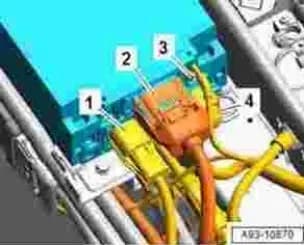
- The battery charger is then installed, ensuring the correct connection sequence is followed. Electrical connectors -1- and -2- must be connected first, with connector -4- connected last.
- After installation, the battery charger must be activated using the workshop manual's Guided Functions, specifically
Galeri
2 görsel
Frequently Asked Questions
- What is the Audi e-tron charger module address issue?
- The Audi e-tron charger module address issue, detailed in TSB 93 24 54 2063427/6, occurs when the high-voltage battery charger control module (J1050) is replaced, and the new unit incorrectly reports its diagnostic address as 8113 instead of the expected 00C6. This can prevent the high-voltage system from activating.
- Which Audi e-tron models are affected by this TSB?
- This Technical Service Bulletin applies to 2021-2023 Audi e-tron, e-tron Sportback, and certain 2024-2025 Q8 e-tron and SQ8 e-tron models. The issue specifically arises after the J1050 module has been replaced.
- What is the repair for the incorrect diagnostic address 8113?
- The repair involves ordering a new charging unit, checking charging socket resistance, carefully installing the new battery charger following a specific connection sequence, and then activating it through Guided Functions. If the module still reports address 8113, the electrical system configuration must be updated using ODIS, following the steps outlined in TSB 93 24 54 2063427/6.
- Are there any special tools required for this repair?
- Yes, technicians will need specialized tools such as the VAS 1594 wire harness repair set for resistance measurements and a VAS tester (VAS 6160/VAS 6150) with the current version of ODIS diagnostic software to perform the necessary diagnostic and configuration updates.
Related Articles
2022 Audi e-tron Electrical System Problems: Complaints & TSBs
Owners of the 2022 Audi e-tron frequently report significant electrical system malfunctions, ranging from sudden power loss and charging hazards to software crashes. Braking issues and unexpected automatic emergency braking are also common concerns, alongside numerous technical service bulletins…
2022-2026 Audi Guided Fault Finding Reporting Obligation
Audi has issued Technical Service Bulletin TPI 2033392, also known as Transaction No. 2081531/1, regarding a reporting obligation for technicians when Guided Fault Finding produces an unexpected result. This TSB outlines the process for contacting Audi Product Support for diagnostic assistance.
2022-2026 Audi Infotainment System Complaints
Audi has released Technical Service Bulletin (TSB) 2081405/1 to address various customer complaints regarding infotainment systems in 2022-2026 Audi vehicles. This TSB helps technicians diagnose issues often caused by external media or mobile devices, rather than vehicle technology.
2018-2026 Audi Models Cracking Noise TSB 2061464/11
Audi Technical Service Bulletin 2061464/11 describes a cracking noise from the front or rear axle when changing direction in various 2018-2026 Audi models. The issue is due to stub axle movement and is resolved by bonding the stub axle to the wheel bearing with locking fluid.
2022-2026 Audi Parking Aid False Warnings TSB 2024323/13
Audi has released Technical Service Bulletin 2024323/13 to address customer complaints of false parking aid warnings. This bulletin details various environmental and vehicle-specific conditions that can cause the parking aid system to issue alerts even when no obstacles are present. It provides…
Yorum bırakın
Yorumlar moderasyondan geçer ve görünmesi biraz zaman alabilir. Sadece adınız ve soyadınızın baş harfi herkese açık olarak gösterilir.
Yorumlar
İlk yorum sizden olsun.