2023 Hyundai Elantra Kona P250C Oil Level Sensor Warning
Hyundai Technical Service Bulletin 23-EM-004H addresses a warning lamp illumination for DTC P250C, 'Engine Oil Level Sensor Circuit Low,' in certain 2023 Hyundai Elantra (CN7) and Kona (OS) vehicles with the 2.0L Nu Atkinson engine. An ECU update is required to resolve the issue.
 Sarah Mitchell2023 Hyundai Elantra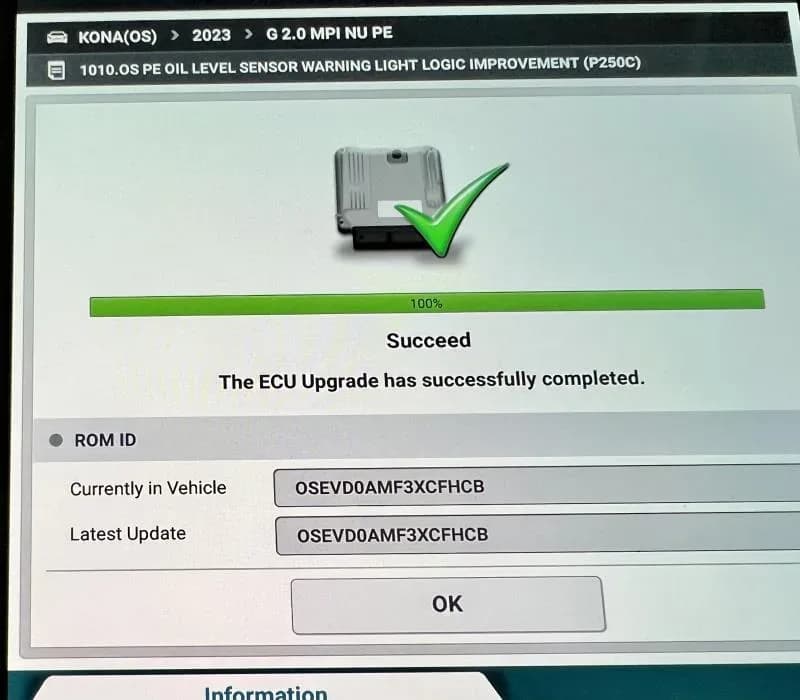
Também se aplica a
- Hyundai Kona
- 2023
Certain 2023 Hyundai Elantra (CN7) and Kona (OS) vehicles equipped with the 2.0L Nu Atkinson engine may experience a warning lamp illumination related to the oil level sensor circuit. This issue is addressed by Hyundai Technical Service Bulletin (TSB) 23-EM-004H, which outlines a procedure to update the Powertrain Control Module (PCM) software.
Symptoms
Owners of affected 2023 Hyundai Elantra or Kona vehicles may notice a warning lamp illuminating on the dashboard. This light indicates a potential issue with the engine oil level sensor system.
Fault Codes / DTCs
The primary diagnostic trouble code (DTC) associated with this issue is P250C. This code specifically points to a problem within the oil level sensor circuit.
| Code | Description |
|---|---|
| P250C | "Engine Oil Level Sensor Circuit Low" |
Diagnosis / Trigger Conditions
The warning lamp and DTC P250C are triggered by a software logic issue within the Powertrain Control Module (PCM) concerning the oil level sensor circuit. This is not necessarily due to a faulty sensor or low oil level, but rather how the PCM interprets the sensor's readings.
Repair Procedure Summary
The resolution for the 2023 Hyundai Elantra P250C issue involves reprogramming the Powertrain Control Module (PCM) with updated software. This process is typically performed using the Global Diagnostic System (GDS) and involves several key steps:
- The ECU update must initially be performed in Auto Mode via the GDS. Technicians verify the ECU ROM ID before proceeding with the software update.
- If the update fails in Auto Mode, it should then be attempted in Manual Mode.
- After the update reaches 100% completion, the ignition key must be cycled to the OFF position for at least 10 seconds to reset the control unit.
- Following the reset, an All Systems Fault Code search is performed, and any historical DTCs that may have occurred during the update process are cleared.
- Finally, the vehicle is started to confirm proper operation and ensure the warning lamp does not reappear.
Hyundai TSB 23-EM-004H also includes requirements for repair validation photos, which technicians must take and upload to the STUI system.
Required Tools or Parts
Technicians will utilize the Global Diagnostic System (GDS) for the ECU update. For additional information regarding tablet-based Mobile GDS ECU updates, TSB 15-GI-001 is referenced. The bulletin also specifies various ECU part numbers and corresponding old and new ROM IDs for both Elantra (Event #1009) and Kona (Event #1010) models, which are used to ensure the correct software is applied.
Important Warnings
Owners should be aware of specific conditions during the ECU update process:
- Low Battery Voltage: If the GDS displays a
Galeria
3 imagens
Frequently Asked Questions
- What does the P250C code mean for my 2023 Hyundai Elantra or Kona?
- The P250C code, or "Engine Oil Level Sensor Circuit Low," indicates a software-related issue within your vehicle's Powertrain Control Module (PCM) that affects how it interprets the oil level sensor. It typically triggers a warning light on your dashboard.
- How is the Hyundai Elantra P250C issue resolved?
- The issue is resolved by an ECU (Engine Control Unit) software update to the Powertrain Control Module (PCM). This update, outlined in Hyundai TSB 23-EM-004H, corrects the logic for the oil level sensor warning light.
- Is TSB 23-EM-004H a recall?
- No, TSB 23-EM-004H is a Technical Service Bulletin, not a recall. It provides guidance to dealerships on how to address a known issue (DTC P250C) that may arise in certain vehicles. While it addresses a potential problem, it is not a safety recall initiated by NHTSA.
- What should I do if my 2023 Hyundai Elantra or Kona shows an oil level sensor warning light?
- If your 2023 Hyundai Elantra or Kona displays a warning light related to the oil level sensor, especially with a DTC P250C, you should contact your authorized Hyundai dealership. They can perform the necessary ECU update as described in TSB 23-EM-004H to resolve the issue.
Related Articles
2021-2025 Hyundai Elantra Inoperable Horn Warranty Extension
Hyundai has announced a warranty extension for the Horn Assembly on certain 2021-2025 Elantra, Elantra N, and Elantra Hybrid vehicles. This extension covers the Horn Assembly for 10 years or 120,000 miles due to concerns about an inoperable horn.
2021-2025 Hyundai Elantra Fuel Tank Thudding Noise TSB
Hyundai has issued Technical Service Bulletin (TSB) 25-FL-003H for certain 2021-2025 Elantra, Elantra N, and Elantra N-Line vehicles. This TSB addresses a "thudding noise coming from the fuel tank assembly" that occurs when the Purge Control Solenoid Valve (PCSV) is operating and the fuel level is…
2021-2025 Hyundai Elantra Inoperable Horn TSB
Hyundai has released Technical Service Bulletin 25-BE-005H-2 addressing an inoperable horn condition in 2021-2025 Elantra models. This TSB extends warranty coverage for horn replacement to 10 years or 120,000 miles for affected vehicles.
2021-2025 Hyundai Elantra Inoperable Horn Warranty Extension
Hyundai has issued Warranty Extension Z03 for certain 2021-2025 Elantra, Elantra (CN7A), and Elantra Hybrid models experiencing an inoperable horn, extending coverage to 10 years or 120,000 miles.
2021-2024 Hyundai Elantra Ventilator Lever TSB
Hyundai has issued Technical Service Bulletin 25-HA-001H for 2021-2024 Elantra models to address issues with the ventilator lever. Owners may notice a lack of airflow from center vents, mode actuator problems, or popping/snap noises when switching HVAC modes.
Leave a comment
Comments are moderated and may take a moment to appear. Only your first name and the initial of your last name are shown publicly.
Comments
Be the first to comment.