2021-2025 Audi Q5 e / A7 e Electrical System Fault TSB
Audi has released Technical Service Bulletin 2076748/2 for 2021-2025 Audi Q5 e and A7 e models. This TSB addresses a red electrical system fault, often accompanied by the message "Electrical system: fault. Safely stop vehicle," and diagnostic trouble code P0AC000.
 Marcus Weber2025 Audi Q5 e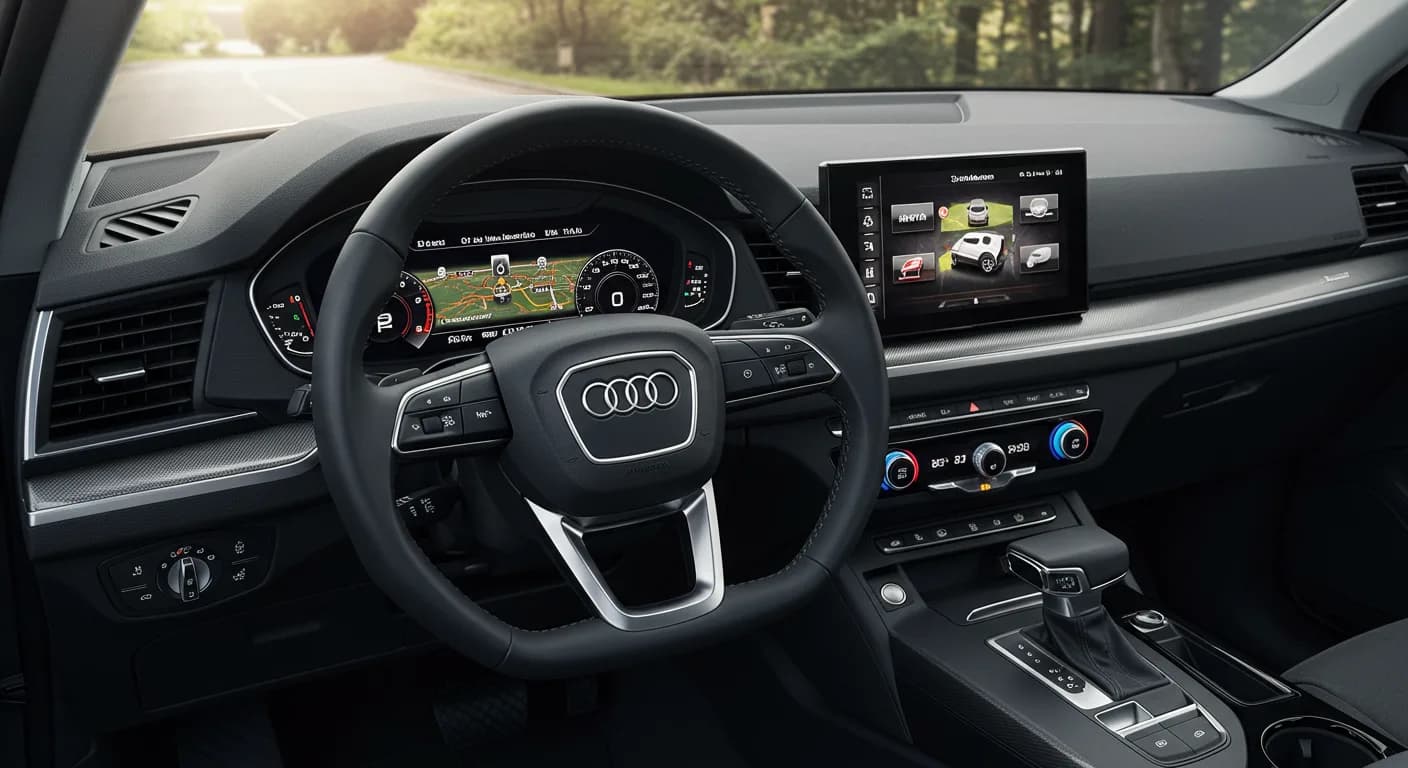
Também se aplica a
- Audi A7 e
- 2021–2022
- Audi Q5 e
- 2021, 2023, 2024
Symptoms
Owners of 2021-2025 Audi Q5 e and A7 e vehicles may experience a prominent red electrical system warning displayed in the instrument cluster. This warning is often accompanied by the specific message, "Electrical system: fault. Safely stop vehicle". In severe cases, the vehicle may also be unable to start.
Fault Codes / DTCs
When diagnosing this Audi Q5 e electrical system fault, technicians will typically find the following diagnostic trouble code (DTC) logged in the 008C - Hybrid battery management control unit:
- P0AC000: Hybrid/EV Battery Pack Current Sensor "A" Circuit Range/Performance (Symptom ID: 14340)
It is important to note that the following related DTCs are typically not logged when this specific issue occurs:
- P0AA700: Hybrid/EV Battery Voltage Isolation Sensor Circuit
- P0AA100: Hybrid Battery Positive Contact Circuit Stuck Closed
- P0AA200: Hybrid/EV Battery Positive Contactor Circuit Stuck Open
- P0AA400: Hybrid/EV Battery Negative Contact Circuit Stuck Closed
- P0AA500: Hybrid/EV Battery Negative Contact Circuit Stuck Open
Diagnosis
To properly diagnose the Audi Q5 e electrical system fault, technicians should first confirm the software version of the High-Voltage Battery Switch Box (diagnostic address 06D0). The relevant software versions for this issue are 0108 or 0208. This can be checked using the Guided Functions in ODIS by navigating to Diagnostic address 008C, then Guided Function, Read identification, and finally Read additional identification data. The results will be displayed in the diagnostic log.
Important Warnings
Audi Technical Service Bulletin 2076748/2 highlights critical information for both technicians and owners:
- Do not replace parts: "Replacing parts or attempting repairs will not fix the problem." This means that replacing components like the Hybrid/EV Battery Pack Current Sensor 'A' without following the TSB's procedure will not resolve the issue and could lead to unnecessary costs.
- Warranty implications: "Unjustified work/replacement parts will be charged back. Invoicing under warranty is not permitted." For vehicles outside of warranty, this TSB is for informational purposes only, and any repairs would be at the owner's expense if not covered by a separate policy.
Repair Procedure Summary
If your vehicle is experiencing this Audi Q5 e electrical system fault, the recommended procedure outlined in TSB 2076748/2 involves a specific sequence of steps:
- Activate bus sleep mode: This requires locking the vehicle, ensuring no electrical equipment is active (contactors must be open), and confirming the vehicle is not connected to a charger.
- Erase event memory entries: After the bus sleep cycle is complete, all stored event memory entries should be cleared.
- Re-assess: The vehicle should then be re-assessed to determine if the issue still occurs.
If the complaint persists after these steps, technicians are instructed to submit a TAC (Technical Assistance Center) ticket or TAC Web ticket. The TSB number (2076748/2) should be included in the field for additional information on workshop findings to help the internal department identify the connection to this TSB quickly. TAC will then provide further information.
Superseded Bulletin
This Technical Service Bulletin 2076748/2 supersedes Pending Service Solution (PSS) TSB 2074901, which also addressed the red electrical system fault in the instrument cluster with DTC P0AC000 for Q5/A7 PHEV models.
Warranty Information
All warranty claims submitted for payment must adhere to the Audi Warranty Policies and Procedures Manual. Claims are subject to review or audit by Audi Warranty. The TSB explicitly states that if the vehicle is outside of any warranty, the information provided in this bulletin is for informational purposes only.
NHTSA ID: 11017680
Outras revisões deste TSB
- 2021-2024 Audi Q5 e / A7 e Red Electrical System Fault P0AC000P0AC000, P0AA700, P0AA100
- 2021-2023 Audi e-tron Electrical System Fault P0AC000P0AC000, P0AA700, P0AA100
- 2021-2024 Audi Q5 e / A7 e Electrical System Fault P0AC000P0AC000
- 2021-2024 Audi Q5 e / A7 e Red Electrical System Fault P0AC000P0AC000
- 2021-2023 Audi e-tron Electrical System Fault P0AC000P0AC000, P0AA700, P0AA100
- 2021-2023 Audi e-tron Red Electrical System Fault TSB 93 24 07 2074900/1P0AC000, P0AA700, P0AA100
- 2021-2022 Audi Q5 e / A7 e No Start DTC P0AA200 P0AA500P0AA200, P0AA500
- 2021 Audi Q5 e / A7 e Electrical System Malfunction TSBP0AC000
Related Articles
2021-2025 Audi Q5 e Electrical System Malfunction TSB 2081028/2
Audi Q5 e owners might encounter an 'electrical system malfunction' warning light and the vehicle failing to go into drive. This TSB, 2081028/2, is an informational bulletin for technicians to report specific DTCs like P0AF800 and U01A000 to Audi's Technical Assistance Center.
2024-2025 Audi Q5 e Check Engine Light After Charging TSB
If your 2024-2025 Audi Q5 e displays a check engine light after charging, a technical service bulletin (TSB) addresses this concern. The issue is often linked to Diagnostic Trouble Code POE5E00, indicating a problem with the battery charger control module processor.
2024-2025 Audi Q5 e Gateway Software Update TSB 2079116/1
Audi Technical Service Bulletin 2079116/1 addresses a software issue in the diagnostic interface control unit (DA0019) of 2024-2025 Audi Q5 e PHEV vehicles. This update resolves problems with reading hybrid battery information and scan tool communication with the gateway, ensuring proper vehicle…
2024-2025 Audi Q5 e 12V Battery Discharge TSB 2074126/3
Audi has issued Technical Service Bulletin 2074126/3 for 2024-2025 Q5 e PHEV vehicles regarding a 12V battery discharge issue caused by bus wake-ups from the high-voltage charging unit. A software solution is under development, with a workaround available.
2024-2025 Audi Q5 e Battery Charger Software Update
Audi's Service Action 93SG addresses an erroneous warning message and a high-voltage battery charging fault in 2024-2025 Q5 e vehicles. A software update resolves the issue, preventing charging limitations with 110V cables.
Leave a comment
Comments are moderated and may take a moment to appear. Only your first name and the initial of your last name are shown publicly.
Comments
Be the first to comment.