2020-2022 Audi e-tron AC Sensor Failure Service Action
Audi has issued Service Action 87H9 for certain 2020-2022 Audi e-tron vehicles. This action addresses potential failures of the air conditioning system's pressure and temperature sensors, which can cause the AC to stop functioning.
 Marcus Weber2021 Audi e-tron
Também se aplica a
- Audi e-tron
- 2022
Audi has initiated Service Action 87H9 to address a potential issue with the air conditioning system in certain 2020-2022 Audi e-tron vehicles. This service action aims to resolve problems caused by faulty pressure and temperature sensors, which can lead to a complete loss of air conditioning function. The campaign code 87H9 was applied to affected vehicles on or about February 13, 2024.
This proactive measure from Audi ensures that affected vehicles receive the necessary inspection and repair to maintain optimal performance of the AC system. Owners of eligible vehicles are encouraged to schedule service at their authorized Audi dealer. This service action was originally published on February 13, 2024, with updated claiming instructions issued on February 23, 2024.
Why This Matters
The air conditioning system is crucial for comfort, especially in varying climates. When the pressure and temperature sensors fail, the entire system can cease to operate. This not only impacts passenger comfort but can also affect the vehicle's overall climate control functionality, making the Audi e-tron AC sensor failure a significant inconvenience.
Audi has identified that on vehicles manufactured within a specific period, the pressure and temperature sensors (G395 and G826) in the air conditioning system may fail. If this occurs, the primary symptom will be that the "air conditioning system will no longer function."
Symptoms
The primary symptom of this issue is a non-functional air conditioning system. Owners of affected 2020-2022 Audi e-tron vehicles may notice that their AC system simply does not produce cold air or operate at all. This is directly linked to the failure of the pressure and temperature sensors, which are vital for the system's operation. The result is a complete Audi e-tron AC sensor failure, leading to a lack of cooling.
Diagnosis and Trigger Conditions
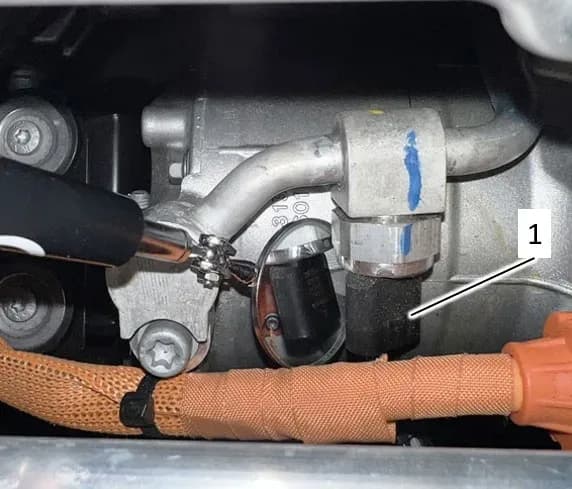
To diagnose the issue, technicians will perform a detailed inspection of the G395 and G826 pressure/temperature sensors located in the air conditioning system. The diagnostic process involves several key steps:
- Initial Check: Technicians will first check for a green dot on the connector housing of both the G395 and G826 sensors. If a green dot is present on both sensors, no replacement is required, and the sensors are considered to be functioning correctly.
- Production Date Verification: If a green dot is not present on one or both sensors, the technician will then check the production date of the affected sensor. This date is typically formatted as week/year.
- Replacement Criteria: A sensor must be replaced if it was produced between calendar week 23 of 2020 and calendar week 30 of 2021. Sensors manufactured outside this specific timeframe, even without a green dot, do not require replacement under this service action. For example, a sensor produced in calendar week 31 of 2022 would not require replacement.
This inspection process helps accurately identify which sensors are prone to failure and require corrective action to resolve the Audi e-tron AC sensor failure.
Repair Procedure Summary
The repair for the Audi e-tron AC sensor failure involves a precise inspection and, if necessary, replacement of the faulty pressure and temperature sensors. The general procedure, identified by Service Number 87H9, is as follows:
- Pre-Repair Check (Section A): The technician enters the vehicle's VIN into the Audi Elsa system to confirm the campaign status is "open." If multiple campaigns are open, all safety recalls must be completed first, and other campaigns performed in order of their start date. If a Campaign Completion Stamp is already present, no further work is required.
- Sensor Inspection (Section B): To access the G395 and G826 pressure/temperature sensors, the front luggage compartment liner must be removed according to the ELSA repair manual. The sensors are located in the under-hood compartment. Technicians label and disconnect the sensors after ensuring the ignition is off. A critical caution is noted: "The connectors for the G395 and G826 can be swapped! Ensure that the connectors are reinstalled in their correct locations if removed." The sensors are then inspected for a green dot. If no green dot is present, the production date is checked. Sensors produced between calendar week 23 of 2020 and calendar week 30 of 2021 are identified for replacement. If a sensor is positioned to obscure its production information, a mirror can be used for inspection.
- Sensor Replacement (Section C): If replacement is required, the air conditioning system's refrigerant must be evacuated or drained. Technicians must wear safety gloves and protective eyewear due to the "Danger of frostbite due to refrigerant coming out under pressure." The power-activated valves in the refrigerant circuit must be opened through the ODIS diagnostic system prior to refrigerant recovery. If more than 10 minutes elapse after extracting or draining, the refrigerant must be extracted or drained again to prevent pressure buildup. The faulty G395 and/or G826 sensors are then replaced following detailed instructions in the ELSA repair manual, which specifies procedures for "A/C Pressure/Temperature Sensor G395, Removing and Installing" and "A/C Pressure/Temperature Sensor 2 G826, Removing and Installing." Any additional basic settings recommended by the test plan are performed.
- Vehicle Reassembly: After sensor replacement, the vehicle is reassembled in the reverse order of removal. This includes reinstalling the front luggage compartment liner and replacing the foam insert for tool storage (part numbers 4KE-012-113-A and 4KE-863-362-B). The A/C system is then recharged with the appropriate amount of R1234yf refrigerant that was recovered.
- Campaign Completion (Section D): Once the campaign is completed, the technician stamps the repair order. Stamps are available through the Compliance Label Ordering Portal.
- Parts Return/Disposal (Section E): Removed parts must be stored, destroyed, or disposed of according to state/province/local requirements, unless otherwise specified by the Warranty Parts Portal (WPP) for the U.S. or the Part Destruction and Core Disposition Report for Canada.
Required Tools or Parts
Performing Service Action 87H9 requires specific tools and parts to ensure the repair is completed accurately and safely. These include:
- Sensor: 4M0-959-603-E (up to 2 units)
- BIN: 4KE-012-113-A (1 unit), 4KE-863-362-B (1 unit)
- Oil Refrigerant: G-052-535-1M-DSP (up to 1.2 ml), G 052535M2 (up to 0.01 units)
- Rivet: N 90558401 (up to 4 units)
- A/C Refrigerant: R1234yf (up to 74g or 2.61 oz)
- R1234yf Air Conditioning Service Unit: ROB1234YFX or VAS581005 (or equivalent)
- Engine Bung Set: VAS6122 (or equivalent)
- Socket - 24mm: T40284 (or equivalent)
- Battery Tester/Charger: Capable of minimum 90 Amp continuous supply
- Diagnostic Tester: VAS6150X or VAS6160X (or equivalent)
- Safety Equipment: Safety Gloves and Safety Goggles
Warranty Claim Information
For dealerships, the claim entry instructions for Service Action 87H9 specify:
- Service Number: 87H9
- Damage Code: 0099
- Parts Vendor Code: 002
- Claim Type: Sold vehicle: 7 10; Unsold vehicle: 7 90
- Causal Indicator: Mark labor as causal if SENSOR is OK; Mark SENSOR* as causal if a sensor(s) is NOT OK
- Labor Operations:
- 8711 01 99: Check sensor production dates (10 Time Units)
- 7007 19 00: Storage compartment remove+reinstall (SEE ELSA)
- 8709 20 51: 2 Pressure switch remove+reinstall (if both sensors replaced) (SEE ELSA)
- 8757 19 50: High pressure switch remove+reinstall (Only if G395 sensor replaced) (SEE ELSA)
- 8764 19 50: Low pressure switch remove+reinstall (Only if G826 sensor replaced) (SEE ELSA)
- 8703 17 00: Refrigerant drain+fill (SEE ELSA)
- 2706 89 50: Connect battery charge (SEE ELSA)
- 0150 00 00: GFF/Guided functions (Time stated on diagnostic protocol)
Important Warnings
Audi has issued critical advisories regarding Service Action 87H9 that owners and dealerships must heed:
- Dealer Delivery Hold: "Dealers must ensure that every affected inventory vehicle has this campaign completed before delivery to consumers." This means that any new or used 2020-2022 Audi e-tron vehicle in dealer inventory that is subject to this service action cannot be sold or delivered until the repair is performed.
- Campaign Expiration: "This service action will be available for you free of charge only until September 01, 2028. If you wish to have this service performed after that date, your dealer's normal costs associated with this repair will apply." Owners should schedule this service before the expiration date to avoid potential charges.
- No Wash/Loaner Claim: "Do not claim wash/loaner under this action."
- Improper Repair Responsibility: "Damages resulting from improper repair or failure to follow these work instructions are the dealer's responsibility and are not eligible for reimbursement under this action."
- Pre-existing Conditions: "Diagnosis and repair of pre-existing conditions in the vehicle are not covered under this action."
- High Voltage Safety: "Extremely dangerous due to high voltage. The voltage levels in the high-voltage system constitute a safety hazard. Danger of severe or fatal injuries from electric shock if high-voltage components or high-voltage wiring are damaged." Technicians must follow strict safety protocols.
- Refrigerant Handling: "Danger of frostbite due to refrigerant coming out under pressure. Frostbite on the skin and other parts of the body is possible." Technicians must wear safety gloves and protective eyewear. Also, "If more than 10 minutes elapse after extracting or draining the refrigerant and the refrigerant circuit has not been opened, extract or drain the refrigerant again. Pressure develops in the refrigerant circuit due to evaporation."
Owner Action
If you own a 2020-2022 Audi e-tron, it is recommended to take the following steps:
- Schedule Service: Contact your authorized Audi dealer as soon as possible to schedule an appointment for Service Action 87H9. The repair is expected to take approximately four hours, though additional time may be needed for dealer preparation and scheduling.
- Check Eligibility: You can verify if your specific vehicle is affected by this or any other open recall/service campaign by visiting the Recall/Service Campaign Lookup tool on www.audiusa.com and entering your Vehicle Identification Number (VIN).
- Cost and Reimbursement: This service action will be performed free of charge. If you have previously paid for repairs related to this specific condition, you may be eligible for reimbursement. Your dealer can provide details on how to submit a reimbursement request.
Audi began owner notifications in February 2024. This service action affects 10,694 vehicles in the U.S. and 814 vehicles in Canada, totaling 11,508 vehicles.
Source: NHTSA ID: 10250819
Galeria
12 imagens
Frequently Asked Questions
- What is Audi Service Action 87H9?
- Audi Service Action 87H9 is a campaign to inspect and, if necessary, replace faulty G395 and G826 pressure and temperature sensors in the air conditioning system of certain 2020-2022 Audi e-tron vehicles. The failure of these sensors can cause the AC system to stop functioning, leading to an Audi e-tron AC sensor failure.
- How do I know if my Audi e-tron is affected by the AC sensor failure?
- You can check if your 2020-2022 Audi e-tron is affected by visiting the Recall/Service Campaign Lookup tool on Audi's website (www.audiusa.com) and entering your Vehicle Identification Number (VIN). Audi also began notifying owners in February 2024.
- What are the symptoms of the Audi e-tron AC sensor failure?
- The primary symptom is that your vehicle's "air conditioning system will no longer function." This means the AC system will not produce cold air or operate at all due to the faulty G395 and G826 pressure and temperature sensors.
- Will I have to pay for the repair for Service Action 87H9?
- No, the inspection and replacement of the affected pressure and temperature sensors under Service Action 87H9 will be performed free of charge by an authorized Audi dealer. However, this free service is only available until September 01, 2028.
- What parts are involved in the repair for the Audi e-tron AC sensor failure?
- The repair involves replacing the pressure and temperature sensors (part number 4M0-959-603-E), along with associated components like BINs (4KE-012-113-A, 4KE-863-362-B), oil refrigerant (G-052-535-1M-DSP, G 052535M2), rivets (N 90558401), and R1234yf refrigerant.
Related Articles
2021 Audi e-tron Electrical Malfunction and Power Loss
A 2021 Audi e-tron owner reported a severe 'Electrical Malfunction' resulting in complete loss of power on the highway. The issue has persisted despite dealer attempts to fix it over five months, posing significant safety risks.
2021-2026 Audi UTR Troubleshooting & FAQs TSB 2081409/1
This Audi Technical Service Bulletin (TSB 2081409/1) provides comprehensive answers to frequently asked questions and troubleshooting steps for the Audi Universal Traffic Recorder (UTR) accessory, covering topics like SD card compatibility, video playback, Wi-Fi issues, and more.
2021-2025 Audi Emergency Call System Fault TSB
Audi has released Technical Service Bulletin 2059528/18 to address an "Emergency call function: malfunction! Function unavailable. Please contact service" warning, often accompanied by a red SOS LED and DTC B200000. This issue affects various 2021-2025 Audi models and is due to a software problem…
2021-2026 Audi Adaptive Light System Fault C12B3FA TSB
Audi has released Technical Service Bulletin 2054202/7 to address an intermittent 'Audi adaptive light: system fault' message and DTC C12B3FA in various 2021-2026 models. This TSB outlines diagnosis and resolution for driver assistance system malfunctions.
2021-2026 Audi Parking Aid False Warnings TSB 2024323/12
This Technical Service Bulletin (TSB 2024323/12) details diagnostic and repair procedures for 2021-2026 Audi vehicles experiencing false parking aid warnings. Learn about environmental factors, sensor checks, and proper installation to resolve issues like 'Parking aid does not work / warning is…
Leave a comment
Comments are moderated and may take a moment to appear. Only your first name and the initial of your last name are shown publicly.
Comments
Be the first to comment.