Toyota Unveils Scion Brand, Future Mobility & Manufacturing
Toyota has introduced its new Scion by Toyota brand, featuring the KEI-01 ultra-compact commercial truck and two off-road concepts. The company also detailed advancements in automated driving, the Arene software platform, next-generation electrification, and robotics in manufacturing.

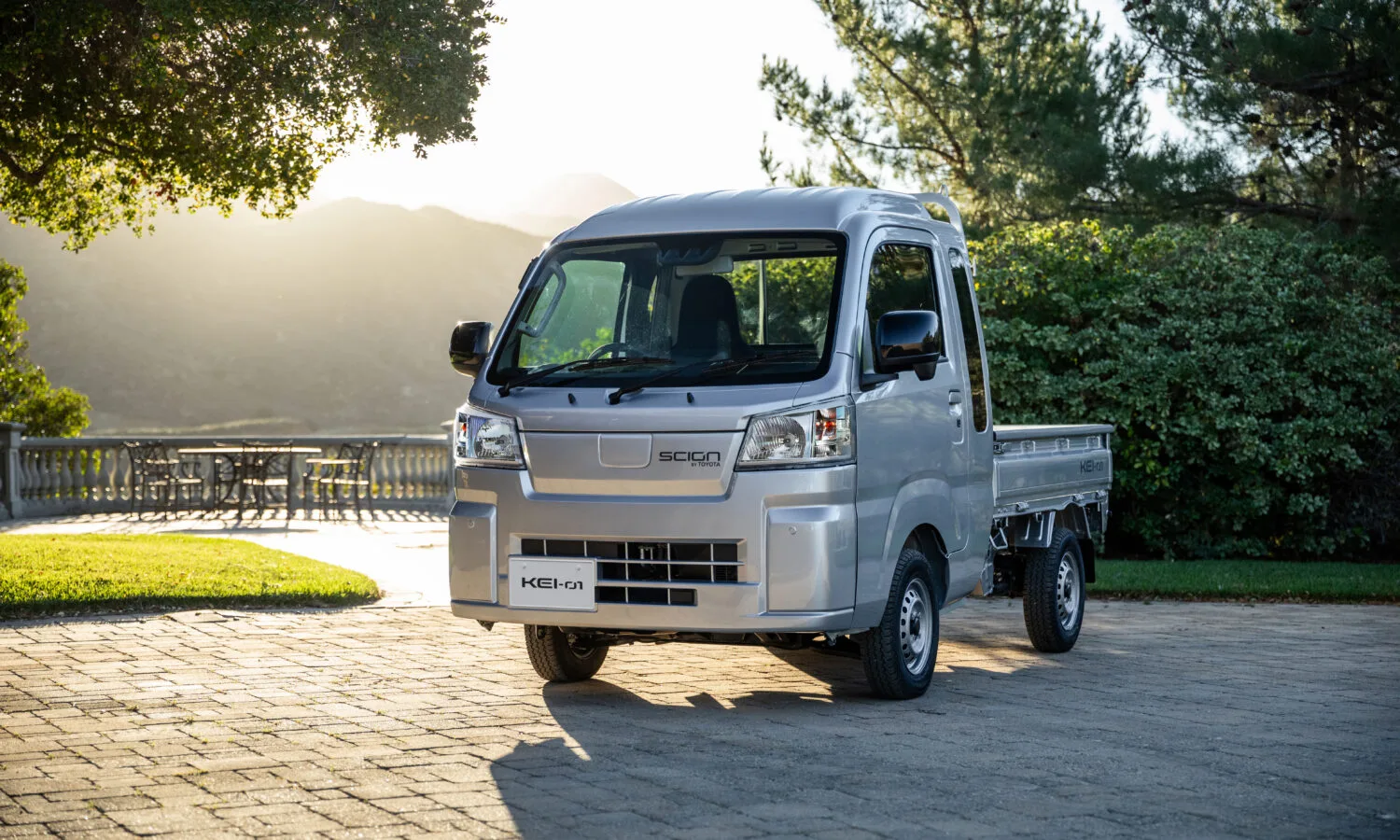
Toyota introduced a new brand, Scion by Toyota, alongside a preview of its upcoming mobility and manufacturing technologies at its North American R&D headquarters. The new Scion brand aims to explore novel mobility solutions with purpose-built vehicles for the American market, starting with an ultra-compact commercial truck. This announcement provides insight into Toyota's strategic direction for vehicle development and production.
Introduction of Scion by Toyota and New Concepts
Toyota's new Scion by Toyota brand debuted with the KEI-01, an ultra-compact, lightweight commercial truck designed for the American market. This vehicle, certified as a FMVSS 500 or Low-Speed Vehicle (LSV), will be assembled at Toyota Motor Manufacturing Indiana. The KEI-01 is positioned as an affordable, highly capable, and maneuverable utility vehicle.
In addition to the KEI-01, Scion by Toyota showcased two off-road concepts. The SXS Concept is a side-by-side vehicle developed by Toyota's North American engineering team, featuring a turbocharged four-cylinder hybrid powertrain producing over 300 horsepower. The BKE Concept is a foldable electric two-wheeler, addressing short-distance mobility challenges.
Advancements in Mobility Technology
Toyota outlined its progress in automated driving, aiming to introduce L2++ automated driving assistance technology in select retail vehicles by 2028, with broader availability across models within several years. The company is integrating real-world driving data, expert insights, and in-house AI to enhance these systems. Furthermore, Toyota is developing technology to connect vehicles, people, and infrastructure for improved efficiency.
The Arene software platform, designed to facilitate continuous improvement of vehicle software, is set to expand from the Toyota RAV4 and Lexus ES to approximately 50 models and 10 million vehicles worldwide by 2030. This platform supports applications across various semiconductor types, allowing software to adapt to evolving hardware. Toyota also anticipates applying Arene beyond vehicles, including in robotics, factories, and smart infrastructure.
Regarding electrification, Toyota presented advancements in hybrid and battery electric vehicle (BEV) systems, alongside new battery technologies. A new prismatic lithium-ion battery design, featuring horizontally placed terminals, achieves approximately 20% lower battery height and 20% higher efficiency. The company is also targeting the introduction of all-solid-state batteries in a future model by the end of 2028, which promise increased energy density and faster charging times.
Future of Manufacturing and North American R&D
Toyota is integrating physical AI and robotics into its factory floors to enhance the Toyota Production System and support its skilled workforce. This strategy involves three levels of factory automation: FA 1.0 for repetitive tasks, FA 2.0 for synchronized end-to-end production, and FA 3.0 for human-robot collaboration. This approach allows robots to learn from human experts and scale to support complex roles.
From 2028 onward, Toyota and its suppliers expect to invest approximately JPY ¥1 trillion (around $6.3 billion USD) annually to modernize production equipment. This investment will support the deployment of about 150,000 robots across Toyota and Toyota Group companies, and an additional 250,000 at suppliers. Toyota plans to expand its robotics business to other manufacturers and industries in the future.
The company's North American R&D facilities, including its safety center, benchmarking center, and the recently opened Toyota Battery Center, play a crucial role in advancing mobility within the region and contributing to global engineering efforts. These centers evaluate various powertrain technologies, from hybrid to full battery-electric.
Toyota's latest announcements signal a comprehensive strategy focused on diversified mobility solutions, advanced manufacturing, and a renewed emphasis on the American market through the Scion by Toyota brand. These developments indicate Toyota's ongoing efforts to integrate new technologies across its product lineup and production processes, offering a glimpse into its Toyota future mobility offerings for consumers and businesses.
Gallery
3 images
Leave a comment
Comments are moderated and may take a moment to appear. Only your first name and the initial of your last name are shown publicly.
Comments
Be the first to comment.