Honda Develops Robotics for Future Commercial Space Stations
Honda announced a collaboration with Redwire to develop advanced robotics solutions for upcoming commercial space stations. This initiative aims to automate in-orbit experiments and reduce the time astronauts spend on laboratory tasks, enhancing research capabilities and operational efficiency.

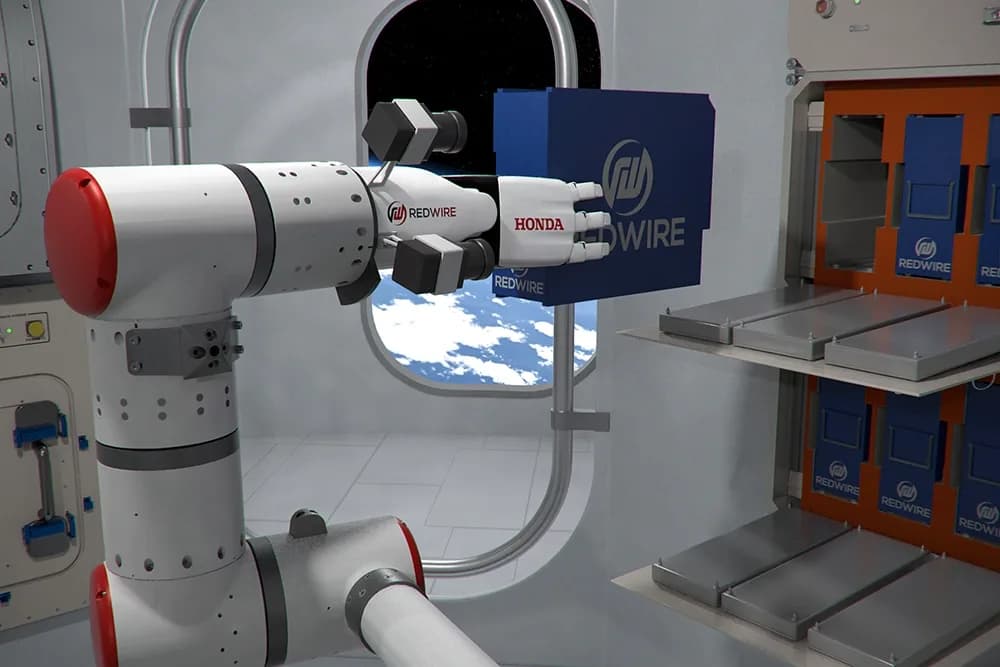
Honda announced its initiative to develop a robotics solution for upcoming commercial space stations, aiming to streamline research and reduce the time astronauts spend on laboratory tasks. This effort involves a collaboration with Redwire, a specialist in space and defense technology. The goal is to enhance research capabilities in orbit while minimizing demands on crew time through advanced Honda space robotics.
Advancing Space Station Automation
Honda's concept integrates its multi-fingered robotic hand with Redwire's STAARK robotic arm and experiment locker technology. This integrated system is designed to handle various research operations in orbit, from retrieving experiments and transferring samples to operating lab equipment and moving materials between workstations. The initiative responds to NASA's shift from the International Space Station (ISS) to commercially operated stations, which are expected to feature smaller crews and shorter astronaut stays.
The need for automation is increasing as future commercial stations will rely more on robotic assistance to support scientific investigations and daily operations. Automating routine tasks could significantly reduce operational costs and allow for greater utilization of research facilities, thereby supporting more scientific and commercial endeavors. Honda's long history in robotics, including its multi-fingered hand with active joints and tactile sensing, provides the dexterity needed for precise laboratory work.
Integrated Robotic Capabilities
The Honda multi-fingered robotic hand is engineered for delicate manipulation and precise contact detection, making it suitable for tasks such as handling research samples and operating small laboratory instruments. It has undergone extensive durability testing, demonstrating a balance of dexterity, power, and robustness. Tom Sladek, chief engineer for Honda's Space Development Division, noted that Honda's space initiatives are focused on practical in-orbit operations, with robotics offering human-like dexterity to support research in environments with fewer personnel.
Redwire contributes its STAARK robotic arm, a modular and customizable system with proven capabilities in space robotics. Redwire already operates eight facilities on the ISS and has extensive experience in developing hardware for in-space manufacturing. Recent tests have shown the STAARK arm can autonomously track and grasp dynamic objects, providing the necessary reach and positioning for moving equipment and accessing workspaces within a station. The combined system aims to support the entire experiment workflow, from sample handling to equipment operation and inventory management.
Future Collaborations and Outreach
Representatives from Honda and Redwire plan to attend the 2026 International Astronautical Congress (IAC) in Antalya, Türkiye, from October 5-9. During this event, they will engage with commercial space station developers and potential industry partners to discuss applications for their combined robotics solution. This outreach is part of an effort to explore how advanced Honda space robotics can unlock new value for customers in the evolving landscape of Low-Earth orbit.
Organizations interested in learning more about this robotics concept or scheduling a meeting at IAC 2026 can contact Honda's space development team directly via [email protected]. Honda's research and development operations in America, established in 1975, span 23 facilities and contribute to advanced products and technologies across its automotive, powersports, and power equipment divisions.
This collaboration between Honda and Redwire signifies a step towards increasing automation and efficiency aboard future commercial space stations. By leveraging advanced robotics, the initiative aims to free up astronaut time for more critical tasks, potentially expanding the scope and volume of scientific research conducted in orbit.
Galleria
3 immagini
Leave a comment
Comments are moderated and may take a moment to appear. Only your first name and the initial of your last name are shown publicly.
Comments
Be the first to comment.