2023 Jeep Wrangler CEL On, O2 Sensor DTCs S2408000094
Owners of 2023 Jeep Wrangler vehicles may experience the Check Engine Light (CEL) illuminating and the stop/start system becoming inoperative. This manufacturer communication, S2408000094, details diagnostic trouble codes (DTCs) related to O2 sensors and outlines a repair procedure.
 Marcus Weber2023 Jeep Wrangler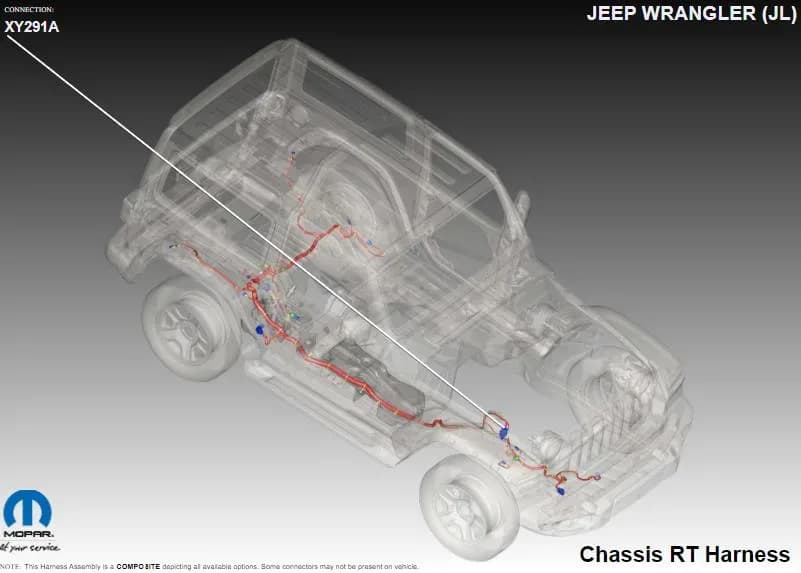
Owners of the 2023 Jeep Wrangler (JL platform) equipped with the 3.6L engine may encounter an illuminated Check Engine Lamp (CEL) and an inoperative stop/start system. This issue, described in manufacturer communication S2408000094, often correlates with the Powertrain Control Module (PCM) logging various O2 sensor-related diagnostic trouble codes (DTCs). If you're experiencing a "Jeep Wrangler CEL P0152" or similar O2 sensor fault, this information outlines the diagnostic and repair steps for technicians.
Symptoms
Vehicle owners may observe the following symptoms:
- The "Check Engine Lamp (CEL) On" indicator illuminates on the dashboard.
- The engine's stop/start function is "Stop Start Inoperative".
- The engine may be running rough.
Fault Codes / DTCs
Technicians may find one or more of the following Diagnostic Trouble Codes (DTCs) stored in the Powertrain Control Module (PCM):
| Code | Description |
|---|---|
| P0152 | O2 Sensor 2/1 Circuit High |
| P1129 | Closed Loop Fueling Not Achieved - Bank 2 Upstream |
| P0563 | System Voltage High |
| P2504 | Charging System Output High |
| P0158 | O2 Sensor 2/2 Circuit High |
| P0058 | O2 - Sensor 2/2 Heater Circuit High |
| P0052 | O2 - Sensor 2/1 Heater Circuit High |
| P0038 | O2 - Sensor 1/2 Heater Circuit High |
| P0032 | O2 - Sensor 1/1 Heater Circuit High |
| P0171 | O2 - Sensor 1/1 Fuel System Lean |
Diagnosis and Repair Procedure Summary
For a Jeep Wrangler CEL P0152 or any of the related O2 sensor DTCs, the repair procedure outlined in S2408000094 involves a thorough inspection of the O2 sensor system. This process aims to identify and correct issues with electrical connections that could lead to these fault codes.
- Inspect O2 Component Sensor Connectors: Technicians should begin by inspecting the O2 component sensor connectors for any DTCs that have been set. This involves using a "push, pull, push" method at the O2 sensor component to ensure the connector is securely seated.
- Check Inline Connectors and Circuits: Further inspection should extend to any inline connectors and their associated circuits. Technicians must look for Terminals Pushed Out (TPOs), which can cause intermittent or complete loss of electrical connection.
- Review TSB 18-050-24 Rev. A and PCM Update: If all connectors are found to be clean and secure, and no TPOs are identified, the next step is to review TSB 18-050-24 Rev. A. This bulletin provides guidance on updating the Powertrain Control Module (PCM) as necessary to resolve the issue.
Visual Aids for Technicians
The manufacturer communication S2408000094 includes several diagrams to assist technicians with diagnosis and repair:
- Catalyst Monitor System - 3.6L: This diagram provides an overview of the O2 sensor wiring, including connections for O2 sensors 1/1, 1/2, 2/1, and 2/2, their heater controls, and their interface with the PCM.
- XY291A 34 way black connector: This diagram illustrates the location and pinout of a 34-way black connector, crucial for O2 sensor wiring.
- XY200A 28 way black connector: This diagram shows the details of a 28-way black connector, which is part of the PCM module's harness.
- O2 Sensor Locations: Dedicated diagrams depict the physical locations of O2 Sensor 1/1 (on the Chassis RT Harness), O2 Sensor 1/2 (on the Powertrain Harness), O2 Sensor 2/1 (on the Powertrain Harness), and O2 Sensor 2/2 (also on the Powertrain Harness) within the Jeep Wrangler (JL) vehicle.
Owner Action
If your 2023 Jeep Wrangler is displaying a "Check Engine Lamp (CEL) On" and has an inoperative stop/start system, especially if you suspect a "Jeep Wrangler CEL P0152" or other O2 sensor-related fault, it is recommended to have your vehicle inspected by a qualified technician. They can diagnose the specific DTCs stored in the Powertrain Control Module (PCM) and perform the necessary connector inspections and PCM updates as outlined in manufacturer communication S2408000094.
Important Note for Technicians
This document, S2408000094, serves as a record of past experiences and does not authorize warranty repairs. It is intended to capture similar or related vehicle symptoms and conditions. Technicians are responsible for their own expert judgment in deciding the appropriate course of action. STAR Online does not provide definitive conclusions about vehicle malfunctions.
NHTSA ID: S2408000094
Galleria
7 immagini
Frequently Asked Questions
- What does the Check Engine Light on my 2023 Jeep Wrangler mean if my stop/start isn't working?
- If your 2023 Jeep Wrangler's Check Engine Light is on and the stop/start system is inoperative, it often indicates an issue with the O2 sensors, as detailed in manufacturer communication S2408000094. Diagnostic Trouble Codes (DTCs) like P0152 or P0171 are commonly associated with these symptoms.
- What are common O2 sensor DTCs for the 2023 Jeep Wrangler?
- Common O2 sensor-related DTCs for the 2023 Jeep Wrangler include P0152 (O2 Sensor 2/1 Circuit High), P0171 (O2 - Sensor 1/1 Fuel System Lean), P1129 (Closed Loop Fueling Not Achieved), and various O2 sensor heater circuit high codes like P0058 and P0032.
- How is the O2 sensor issue typically resolved for the 2023 Jeep Wrangler?
- The repair procedure for O2 sensor issues on the 2023 Jeep Wrangler involves inspecting the O2 sensor connectors for security and checking for Terminals Pushed Out (TPOs). If these checks are satisfactory, technicians are directed to review TSB 18-050-24 Rev. A and update the Powertrain Control Module (PCM) as needed.
Related Articles
2023 Jeep Wrangler Problems: Recalls & Service Bulletins
The 2023 Jeep Wrangler faces a significant recall for its defrost system, potentially reducing driver visibility. Owners may also encounter engine misfire DTCs, heated steering wheel issues, and various other concerns addressed by numerous service bulletins. This guide details known problems and…
2023 Jeep Wrangler Misfire DTCs PCM Software Update
A Technical Service Bulletin (TSB 18-048-26) addresses Malfunction Indicator Lamp (MIL) illumination and various misfire Diagnostic Trouble Codes (DTCs) in 2023 Jeep Wrangler vehicles. Symptoms include rough idle, engine miss, and noisy valvetrain, all caused by PCM software. The fix involves…
2023 Jeep Wrangler PCM Update for MIL & Misfire DTCs
Jeep has released TSB 18-046-26 for 2023 Wrangler models experiencing Malfunction Indicator Lamp (MIL) illumination, various misfire DTCs (P0300-P0306), rough idle, or a "Service Transmission" message. The fix involves a Powertrain Control Module (PCM) software update to improve engine performance…
2023 Jeep Wrangler Heated Steering Wheel Not Working TSB 08-120-26
Owners of 2023 Jeep Wrangler vehicles may experience a heated steering wheel that does not get hot enough or fails to work. Technical Service Bulletin (TSB) 08-120-26 provides a software update for the Comfort Seat Wheel Module (CSWM) to resolve this issue.
2023 Jeep Wrangler Heated Steering Wheel Not Working TSB
Owners of 2023 Jeep Wrangler vehicles with heated steering wheels may experience the steering wheel not heating up sufficiently or not working at all. Technical Service Bulletin (TSB) 08-120-26 provides a software update for the Comfort Seat Wheel Module (CSWM) to resolve this issue.
Leave a comment
Comments are moderated and may take a moment to appear. Only your first name and the initial of your last name are shown publicly.
Comments
Be the first to comment.