2026 Audi MQBevo Active Front Assist Intervention TSB
Audi Technical Service Bulletin 2081074/1 details instances where the active front assist system intervenes in 2026 Audi A3, S3, RS 3, and Q3 MQBevo vehicles. This TSB provides guidance for workshops on diagnosing and understanding these system interventions.
 Marcus Weber2026 Audi S3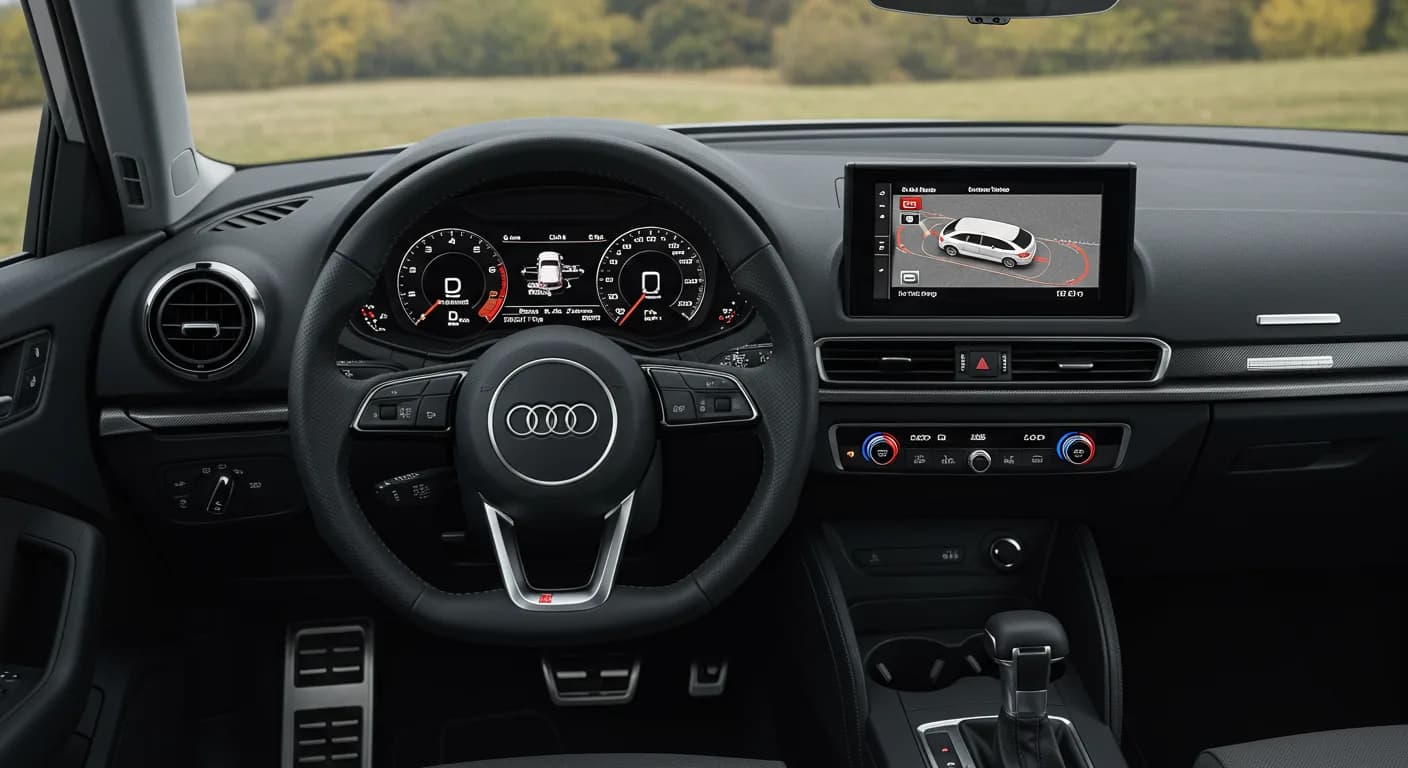
Si applica anche a
- Audi A3
- 2026
- Audi Q3
- 2026
- Audi RS 3
- 2026
Important Workshop Information
Audi has issued Technical Service Bulletin (TSB) 2081074/1, titled "96 Driver assist systems: active front assist intervenes - MQBevo," to provide guidance for workshops. This bulletin is particularly relevant for vehicles still within their new model launch repair authorization period. For vehicles in this launch phase, workshops must create a case with the Technical Assistance Center (TAC) to obtain repair authorization, referencing TSB 2081074/1 in the first line of the TAC case.
Symptoms of Active Front Assist Intervening
Owners of 2026 Audi A3, S3, RS 3, and Q3 models may report the active front assist intervening during driving. This intervention is often accompanied by specific visual symbols on the instrument cluster. One symbol, depicting a car with a starburst in front, appears when actions such as a collision warning, brake jolt, automatic brake pressure increase, or automatic brake intervention are initiated. Another symbol, showing a car with an arrow swerving, appears when swerve support is active. It's important to note that workshop findings indicate no relevant diagnostic trouble codes (DTCs) are typically stored when the active front assist intervening occurs under these conditions.
Understanding Active Front Assist Interventions
The "Active front assist" system in your 2026 Audi MQBevo vehicle is designed with several intervention stages to enhance safety. Technicians use the ODIS-S diagnostic system to review the history of these interventions. Here’s a breakdown of what each intervention means:
- Preliminary Warning: If the system detects a possible collision risk, the driver receives a visual and acoustic warning to prompt a reaction.
- Main Warning: In situations with an immediate collision risk, the system issues an acute warning, often in the form of a short brake jolt. This prompts the driver to take evasive action or brake sharply.
- Reaction Time-Increasing Automatic Braking (RAB): This function initiates partial braking early to increase the time available before an impending collision. This gives the driver more time to react and reduces the speed of impact if a collision is unavoidable.
- Deescalating Automatic Braking (DAB): When a collision can only be avoided by immediate braking, the system performs automatic braking. This helps to prevent accidents or reduce their severity.
- Automatic Braking to a Stop (AFB): In critical situations, such as at intersections or when driving away from a standstill at low speeds, the vehicle is automatically braked to a complete stop. This prevents collisions with oncoming vehicles or pedestrians/cyclists.
- Driver-Triggered Controlled Braking (FZB): If the driver is braking but not sufficiently, the system increases the braking force to help avoid a collision. This assists drivers who may not brake hard enough in critical situations.
- Swerve Support (AWU): This corrective steering function assists the driver for a limited time when there is a risk of a frontal collision. If the driver initiates a clear steering movement, the system checks for sufficient space to swerve and provides steering assistance, potentially including targeted braking of individual wheels, to help avoid the collision. The driver can always override this assistance.
Diagnosis and Service Procedure
For technicians, the "Active front assist" test program within ODIS-S is used to access and display the intervention history. This program can be found by navigating through "Test plan > Select own test... > Diagnostic capable system > 0013 - Adaptive cruise control – J428 > 0013 - Technical Product Information > Active front assist."
When using the test program, technicians input the date of a suspected intervention. The system then checks for active front assist interventions that occurred three days before and three days after the entered date. The program generates a list of all interventions within this period, providing valuable diagnostic information for understanding why the 2026 Audi active front assist intervening.
Warranty Information
For warranty claims related to this issue, the following codes and operations apply:
- Service Number: 9163
- Damage Code: 0039
- Labor Operations:
- GFF / Guided Functions: 0150 0010 (See SRT with associated operations)
- GFF / Guided Functions: 0150 0060 (Time stated on the diagnostic protocol)
The claim comment should reference TSB 2081074/1. If the vehicle is outside of warranty, this Technical Service Bulletin is for informational purposes only. All warranty claims must adhere to the Audi Warranty Policies and Procedures Manual.
Source: NHTSA ID: 11029437
Frequently Asked Questions
- What does Audi TSB 2081074/1 address?
- Audi Technical Service Bulletin 2081074/1 provides information to workshops regarding instances where the active front assist system intervenes in 2026 Audi A3, S3, RS 3, and Q3 MQBevo models. It helps technicians understand the various types of system interventions.
- What are the common symptoms when the active front assist intervening?
- When the active front assist intervening, owners may notice specific symbols on the instrument cluster. These symbols appear during events like collision warnings, brake jolts, automatic brake pressure increases, automatic brake interventions, or when swerve support is active.
- Are there any DTCs associated with the active front assist intervening?
- According to TSB 2081074/1, workshop findings typically indicate that no relevant Diagnostic Trouble Codes (DTCs) are stored when the active front assist intervening as described.
- How do technicians diagnose active front assist interventions?
- Technicians use the "Active front assist" test program within the ODIS-S diagnostic system. This program allows them to review the intervention history for a specified period, helping them understand the system's behavior.
- What are the different types of active front assist interventions?
- The active front assist system includes several intervention types: Preliminary warning, Main warning, Reaction time-increasing automatic braking (RAB), Deescalating automatic braking (DAB), Automatic braking to a stop (AFB), Driver-triggered controlled braking (FZB), and Swerve support (AWU).
Related Articles
2026 Audi S3 Emergency Assist Intervention TSB 2081476/1
Audi Technical Service Bulletin 2081476/1 details issues with the emergency assist system in 2026 Audi S3, A3, RS 3, and Q3 vehicles. Owners may experience unexpected system activation and various instrument cluster warnings related to lane departure, adaptive cruise, or driver inactivity.
2026 Audi A3/S3/RS 3 MMI Software Update for Emergency Call Fault
Audi has released Technical Service Bulletin 2081005/1 for 2026 A3, S3, and RS 3 models addressing MMI function problems and the 'Emergency call fault' message. This update targets the MIB3, AED2, and OCU3 control units to resolve software-related issues.
2025-2026 Audi A3/S3/RS3 Mirror Heating Issue
A Technical Service Bulletin (TSB 2076087/2) addresses concerns from 2025-2026 Audi A3, S3, and RS3 owners regarding the exterior mirror heating not working. This TSB clarifies that the mirror heating is intentionally disabled when Audi Drive Select is in efficiency mode due to efficiency…
2025-2026 Audi A3/S3/RS3 Seat Heater Button Flashes
Owners of 2025-2026 Audi A3, S3, and RS3 models may experience their seat heater button on the air conditioner control console flashing, indicating a software issue. Audi's TSB 2077639/2 explains that no repairs are currently needed, and component replacement will not resolve the problem.
2022-2026 Audi Remote Key Not Working TSB 2080521/1
Audi has issued Technical Service Bulletin 2080521/1 for 2022-2026 A3, S3, RS 3, Q4 e-tron, and Q4 Sportback e-tron models regarding remote control key malfunctions. Owners may find their key unable to lock/unlock the vehicle or its LED not flashing when pressed.
Leave a comment
Comments are moderated and may take a moment to appear. Only your first name and the initial of your last name are shown publicly.
Comments
Be the first to comment.