2021-2025 Audi Q5/A7 e Gearbox Malfunction TSB 2070965/5
Owners of 2021-2025 Audi Q5 e and A7 e vehicles may experience a "Gearbox malfunction message" and DTC P288200. Audi Technical Service Bulletin 2070965/5 outlines a software update for the transmission control module to resolve excessive engine disconnect clutch slippage.
 Ahmet Topcu2024 Audi Q5 e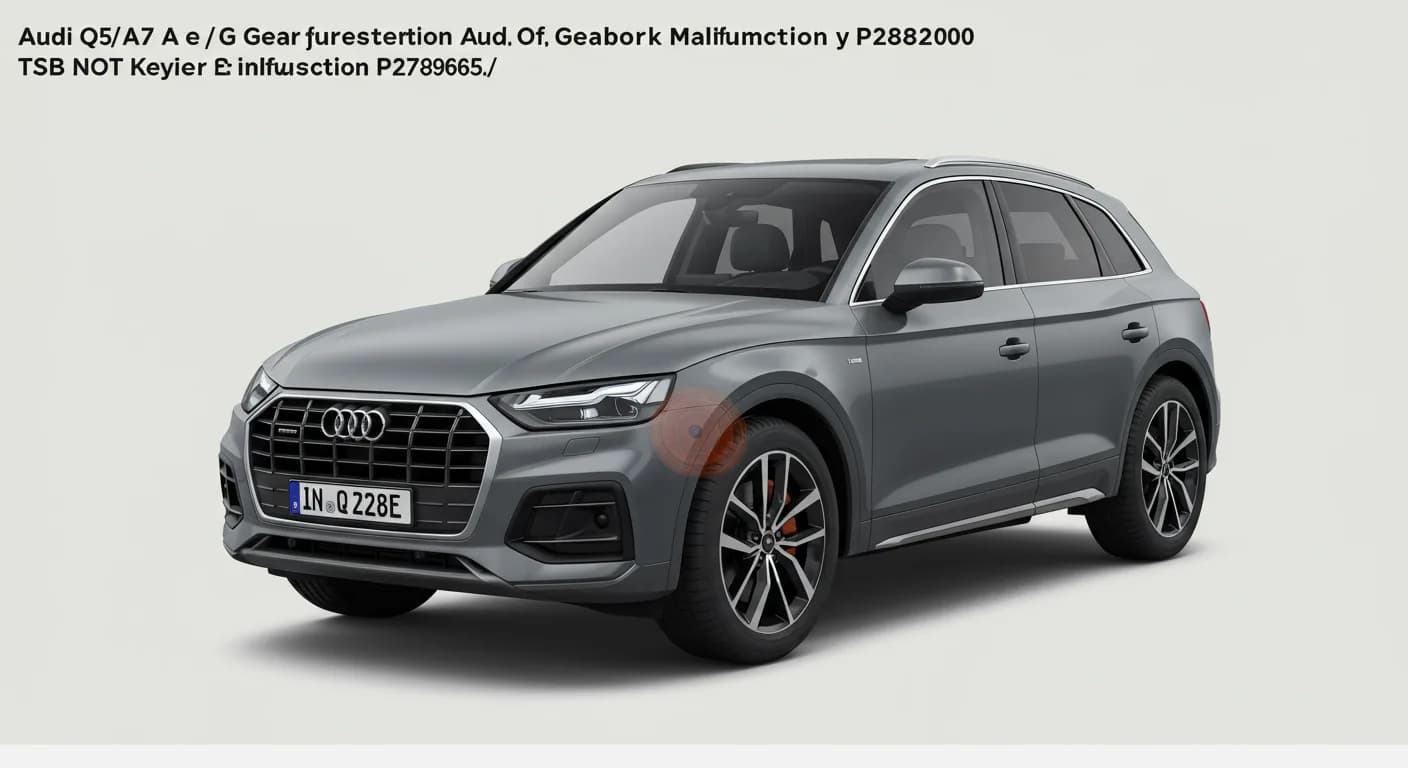
Si applica anche a
- Audi A7 e
- 2021–2022
- Audi Q5 e
- 2021, 2023, 2025
Owners of certain 2021-2025 Audi Q5 e and A7 e plug-in hybrid electric vehicles (PHEV) may encounter a "Gearbox malfunction message" displayed in the instrument cluster. This issue is often accompanied by the storage of diagnostic trouble code (DTC) P288200, which points to excessive slippage of the engine disconnect clutch. Audi Technical Service Bulletin 2070965/5 provides the necessary information and repair procedures to address this specific concern.
This TSB, identified as Transaction No. 2070965/5, was released for publishing on October 17, 2025, and applies to the United States market. It details a software-related solution for the powertrain system, specifically for models equipped with the DL382E Getriebe transmission.
Symptoms
Drivers may observe a "Gearbox malfunction message" appearing in the instrument cluster. This can be associated with various operational complaints related to the electro-drive mode, combined motor/electro-drive motor driving mode, or transmission control. The reported symptoms, which can trigger the Audi Q5 e P288200 fault, include:
- Engine operation in electro-drive mode: "functionality -> misfire", "functionality -> too slow", "functionality -> no function", "functionality -> switches on by itself", "functionality -> cannot be switched on/activated", or "functionality -> does not switch on/connect".
- Engine operation in combined motor/electro-drive motor driving mode: "functionality -> too slow", "functionality -> does not switch on/connect", "functionality -> switches on by itself", "functionality -> cannot be switched on/activated", or "functionality -> no function".
- Engine operation related to switching electro-drive motor on/off: "functionality -> too slow", "functionality -> misfire", "functionality -> switches on by itself", "functionality -> cannot be switched on/activated", or "functionality -> no function".
- General transmission control operation or power distribution: "functionality" issues.
Fault Codes / DTCs
When diagnosing this issue, technicians will find the following diagnostic trouble code (DTC) stored in the Transmission Control Module (TCM), specifically component -J217- (address word 0002):
- DTC P288200: Engine Disconnect Clutch Excessive Slippage with Symptom code 20954.
Diagnosis / Trigger Conditions
The root cause of the "Engine Disconnect Clutch Excessive Slippage" and the associated DTC P288200 is a software error within the transmission control module. This error affects the proper function of the gearbox, particularly in PHEV models utilizing the DL382E Getriebe transmission.
For vehicles from model year 2023 onwards, a modified software for the gearbox control unit has been implemented in series production. Therefore, these newer vehicles may already have the latest software version and might not require an update. The TSB notes that a software update is not necessary or possible for these vehicles as they already possess the latest software version.
Important Warnings
Audi has issued critical notices for technicians performing this repair to ensure safety and prevent damage:
- High-Voltage Battery Safety: "To prevent the high-voltage battery from charging during the software update, the high-voltage charging cable on vehicles with high-voltage components must be unplugged BEFORE the SVM code is entered. Charging the high-voltage battery during a software update can cause damage to the high-voltage components."
- Diagnostic Setup: "The parking brake must be released, and the diagnostic interface must be hardwired to the scan tool."
Repair Procedure Summary
The repair primarily involves updating the software of the Transmission Control Module (TCM) using the Software Version Management (SVM) system. The general steps are as follows:
- Initial Vehicle Check (Q5 models): For Audi Q5 models, the technician must first check if a software update for the gearbox control unit is possible. If the vehicle's current software part number is listed in the SVM table provided in the TSB, the technician proceeds with the software update using the SVM instructions. If the software is not in the table, or if the vehicle is an A7, the technician continues to Step 2 of the overall procedure.
- SVM Update Instructions: Technicians must follow all instructions detailed in TSB 2011732: "00 Software Version Management (SVM), operating instructions." This involves using a specific SVM action code to update the TCM (-J217-).
- For Q5 PHEV models, the update involves changing from Old Software Part Number
80A927156Dwith Old Software Version0002to New Software Part Number80A927156Dwith New Software Version0003. The SVM Code Input for this update is02A220.
- For Q5 PHEV models, the update involves changing from Old Software Part Number
- Software Verification: If the message "ER0203E" appears when attempting to run SVM code
02A220, it indicates that the gearbox control unit already has the necessary software version (0003 or higher), and no further update is required. - Pre-Update Checks (All vehicles): Before proceeding with any further diagnosis or repair, the charge level of the high-voltage battery must be checked. It needs to be within the range of 35% to 90%. If the charge is below 35%, it must be charged to a sufficient level. In such cases, technicians are instructed to use Guided Fault Finding (GFF) and precisely follow the test plan for the DTC memory entry.
- Guided Fault Finding (GFF) Outcome: If GFF does not detect any faults after the software update, it is not necessary to replace any components.
- Manual Checks (if GFF not possible): If GFF is not possible (e.g., because a passive entry in the event memory was erased), technicians should perform the following manual checks:
- Check the ATF (Automatic Transmission Fluid) level. If the gearbox ATF level is not correct, it must be adjusted as specified in the repair manual.
- Perform a hydraulic test.
- Execute the basic settings routine for "calibration of disengagement clutch K0" (also known as "Touch point adaptation of hydraulic clutch").
- Completion: If no malfunctions are indicated after these steps, the repair procedure is considered complete.
Required Parts and Tools
For this service, specific parts and tools may be required. Technicians are advised to always check with their Parts Department and/or ETKA for the latest information and parts bulletins.
- Fasteners, Bolts, Nuts and Screws: As needed per the repair manual, referenced via ETKA/ELSA.
- Dual Clutch Gearbox Oil ATF: Part number
G055529A2, only if needed for adjustment, as per the repair manual.
Warranty Information
Warranty claims for this service must be submitted in accordance with the Audi Warranty Policies and Procedures Manual. Claims are subject to review or audit by Audi Warranty.
- Claim Type: If the vehicle is outside any warranty, this Technical Service Bulletin is informational only.
- Service Number:
9350 - Damage Code:
0040
Labor Operations and Time Units:
| Labor Operation | Code | Time Unit / Reference |
|---|---|---|
| Software update (if required) | 0151 0060 |
Time stated on the diagnostic protocol |
| Charge high-voltage battery (if required) | 9303 8950 |
See SRT with associated operations |
| Check high-voltage battery | 9303 01xx |
See SRT with associated operations |
| Check and top up transmission oil (if required) | 3401 3550 |
See SRT with associated operations |
| Remove and install noise insulation (if required) | 1082 1900 |
See SRT with associated operations |
| GFF (if software update is not required) | 0150 0060 |
Time stated on the diagnostic protocol |
Owner Action
If you own a 2021-2025 Audi Q5 e or A7 e and experience a "Gearbox malfunction message" or suspect issues related to the engine disconnect clutch, it is recommended to contact your authorized Audi dealership. Mentioning the specific symptoms and the potential for DTC P288200 and TSB 2070965/5 can help expedite the diagnostic process. This service bulletin indicates that if your vehicle is outside of warranty, the TSB is informational only, suggesting potential costs for diagnosis and repair. However, for in-warranty vehicles, this software update should typically be covered under warranty.
TSB Revision History
This TSB has undergone several revisions to ensure accuracy and completeness:
- Revision 5: Updated model years in the header and revised the repair procedure within the service section.
- Revision 4 (August 30, 2024): Revised warranty information, specifically updating labor operations.
- Revision 3 (July 27, 2024): Revised the condition description and workshop findings, updated the repair procedure, and revised warranty details including labor operations.
NHTSA ID: 11025335
Altre revisioni di questo TSB
Related Articles
2024-2025 Audi Q5 e 12V Battery Discharge TSB 2074126/5
Audi has issued Technical Service Bulletin 2074126/5 for 2024-2025 Q5 e models, addressing 12V battery discharge caused by high-voltage charging unit bus wake-ups. This bulletin describes symptoms and a temporary workaround while a permanent solution is developed.
2024-2025 Audi Q5 e Engine Warning Lamp TSB 2080142/1
Audi has issued Technical Service Bulletin 2080142/1 for 2024-2025 Audi Q5 e PHEV vehicles, addressing an engine warning lamp (MIL) illumination caused by a software issue affecting the refrigerant pressure sensor. This can lead to various diagnostic trouble codes (DTCs), including P2CD400…
2024-2025 Audi Q5 e 12V Battery Discharge TSB 2074126/4
Audi has released Technical Service Bulletin (TSB) 2074126/4 for 2024-2025 Q5 e models addressing a 12V battery discharge issue. This occurs due to bus wake-ups by the high-voltage charging unit. Owners may experience a discharged battery after the vehicle has been stationary or during…
2021-2025 Audi PHEV Exhaust Emissions Warning Lamp TSB
Audi TSB 2079117/1 addresses the exhaust emissions warning lamp (MIL) activating in 2021-2025 Audi A7, A8, and Q5 PHEV models. This can be triggered by specific refrigerant pressure sensor fault codes (P053100, P0EBF00, P251600, P0EC400, P1C5E00) due to a software issue, often without an actual…
2024-2025 Audi Q5 e 12V Battery Discharged TSB 2074126/2
Audi has issued TSB 2074126/2 for 2024-2025 Q5 e PHEV vehicles regarding 12V battery discharge caused by bus wake-ups from the high-voltage charging unit. A software fix is pending, and a temporary workaround is available.
Leave a comment
Comments are moderated and may take a moment to appear. Only your first name and the initial of your last name are shown publicly.
Comments
Be the first to comment.