2018-2026 Audi Intersection/Lane Change Assist Fault TSB
Audi has released Technical Service Bulletin (TSB) 2063336/4 to address issues with the intersection assist and lane change assist systems in various 2018-2026 models. Owners may see warnings like "Intersection assist: fault. Please contact workshop." and diagnostic trouble code C12BFF0.
 Marcus Weber2021 Audi e-tron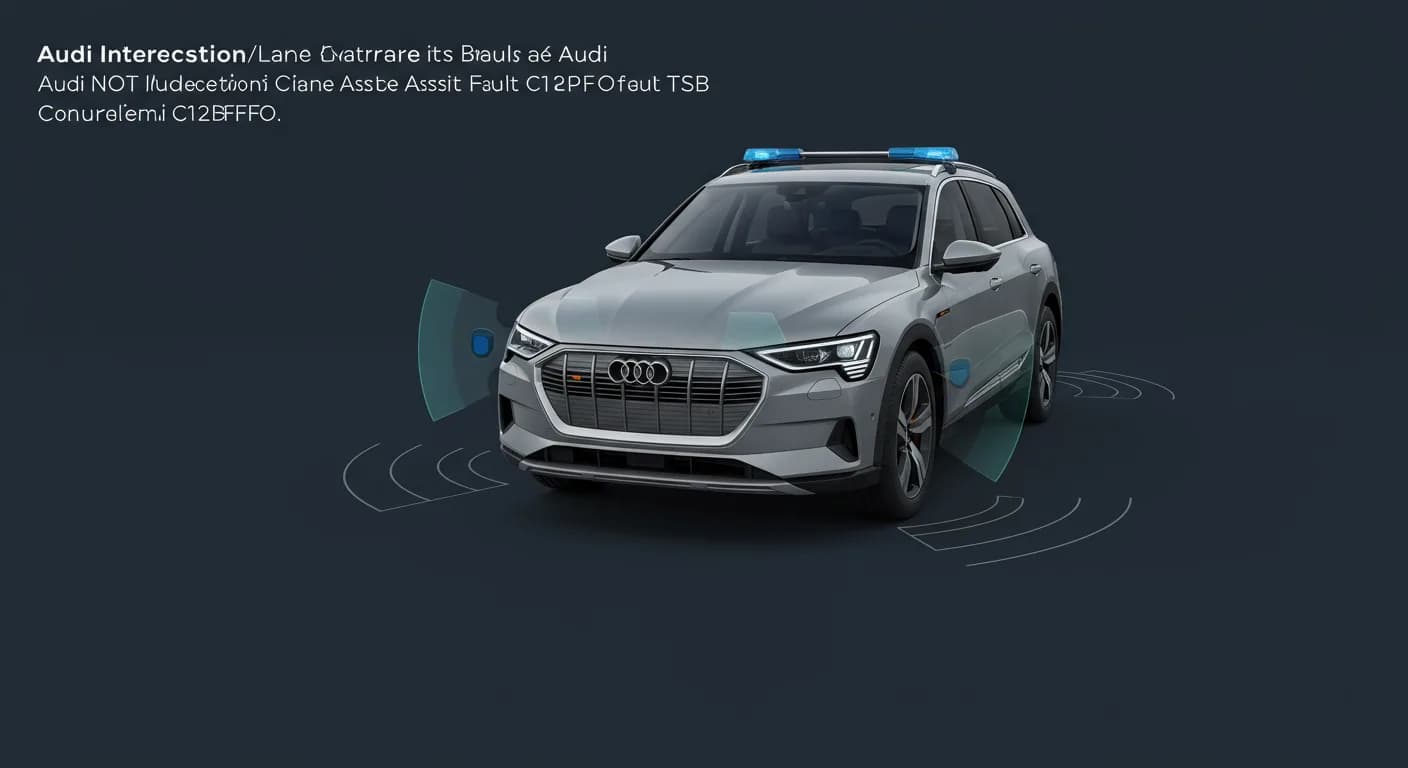
Si applica anche a
- Audi A6
- 2021–2025
- Audi A6 allroad
- 2021–2026
- Audi A7
- 2021–2025
- Audi A7 e
- 2021–2022
- Audi A8 L e
- 2021
- Audi e-tron
- 2022–2023
- Audi e-tron GT
- 2022–2026
- Audi e-tron Sportback
- 2021–2022
- Audi Q7
- 2021, 2022, 2023, 2024, 2026
- Audi Q8
- 2021, 2022, 2023, 2024, 2026
- Audi RS 6 Avant
- 2021–2026
- Audi RS 7
- 2021–2026
- Audi RS e-tron GT
- 2022, 2023, 2024, 2026
- Audi RS Q8
- 2021, 2022, 2023, 2024, 2026
- Audi S e-tron GT
- 2026
- Audi S6
- 2021–2025
- Audi S7
- 2021–2025
- Audi S8
- 2021–2026
- Audi SQ7
- 2021, 2022, 2023, 2024, 2026
- Audi SQ8
- 2021, 2022, 2023, 2024, 2026
▸ Mostra altri 14▾ Mostra meno
Owners of various 2018-2026 Audi models, including the A6, A7, A8, Q7, Q8, e-tron, e-tron GT, and their S/RS variants, may experience issues with their intersection assist and lane change assist systems becoming inoperative. This condition is often indicated by specific warning messages appearing in the instrument cluster and the storage of a diagnostic trouble code (DTC) C12BFF0. Technical Service Bulletin (TSB) 2063336/4 provides guidance for diagnosing and resolving this problem.
This TSB, identified as 2063336/4, outlines the symptoms, potential causes, and repair procedures for technicians to follow. The primary concern is the inability of the radar sensors to perform automatic calibration, leading to impaired functionality of critical driver assistance systems. Addressing the Audi intersection assist C12BFF0 is crucial for restoring these safety features.
Revision History
Audi TSB 2063336/4 has undergone several revisions to expand its scope and update information:
- Revision 4: The header was revised to include additional model years.
- Revision 3 (March 8, 2024): The header was revised to include additional model years.
- Revision 2 (November 24, 2021): The header was revised to include additional affected models.
Symptoms
If your Audi is affected by this issue, you will likely see one or more of the following warning messages displayed in your instrument cluster, indicating that the intersection assist and lane change assist systems are not functioning as intended:
- "Intersection assist: fault. Please contact workshop."
- "Side assist and exit warning system: fault. Please contact workshop."
- "Rear cross-traffic assist: fault. Please contact workshop."
- "Audi pre sense: fault. Please contact workshop."
Fault Codes / DTCs
The primary diagnostic trouble code associated with this issue is C12BFF0. This code specifically indicates "Radar sensors automatic calibration not possible." This DTC C12BFF0 may be stored as a 'static' fault in one of the following control modules:
| Diagnostic Address | Diagnostic Trouble Code | Fault Symptom | Storage State |
|---|---|---|---|
| 00CF - Lane change assistance 2 (J769/J770) | C12BFF0 | Radar sensors automatic calibration not possible | static |
| 00DB - front corner radar 1 (J1088/J1089) | C12BFF0 | Radar sensors automatic calibration not possible | static |
| 003C - Lane change assistance (J769/J770) | C12BFF0 | Radar sensors automatic calibration not possible | static |
| 00DC - front corner radar 2 (J1088/J1089) | C12BFF0 | Radar sensors automatic calibration not possible | static |
These codes are found in the lane change assist control modules (J769/J770) or the radar sensor control modules for object detection (J1088/J1089).
Technical Background
The radar sensors responsible for these advanced driver assistance systems continuously calibrate themselves in relation to the vehicle's surroundings while the vehicle is being driven above a defined speed threshold. This continuous calibration ensures accurate operation of features like intersection assist and lane change assist.
If the calculated dynamic angle offset of these sensors exceeds a threshold of +/-5° during this automatic calibration process, the DTC C12BFF0 is logged, and the corresponding warning messages appear in the instrument cluster. This indicates a problem with the sensor's ability to accurately perceive its environment, leading to the Audi intersection assist C12BFF0 fault.
Possible Causes
Several factors can lead to the radar sensors failing to calibrate correctly and triggering the Audi intersection assist C12BFF0 fault:
- Sensor Mounting Issues: Sensors that are loose or not fully seated in their mounts can disrupt their alignment and calibration, preventing proper functionality.
- Incomplete Calibration: If sensors were recently replaced, an incomplete or improper calibration procedure could be the root cause of the issue.
- Obstructions: The presence of decals, stickers, or NFC tags within the sensor's field of view, whether located on the inside or outside of the bumper cover, can interfere with radar signals.
- Environmental Contamination: Excessive dirt, mud, snow, or debris in the sensor's field of view on the bumper cover can block or distort radar readings.
- Bumper Damage: Physical damage to the bumper cover in the area where the sensor is located can affect its performance and alignment.
- Paintwork Issues: Inadequate or non-conforming paintwork, such as improper paint repairs, on the bumper cover within the sensor's field of view can also interfere with radar operation.
Important Warnings
Owners and technicians should be aware of a critical point regarding this issue: Replacing the corresponding radar sensor without clear findings will NOT resolve the issue. It is essential to first identify and remedy the underlying cause, such as obstructions or mounting problems, before considering sensor replacement. The dynamic calibration procedure should always be preferred when calibrating the sensors.
Repair Procedure Summary
Technicians are advised to first check for and remedy any of the possible causes listed above. If the cause cannot be clearly identified or if calibration continues to fail, the following procedure, as detailed in TSB 2063336/4, should be followed:
ITEM 1: Initial Sensor Check and Recalibration
- Remove and Reseat: The technician should remove the corresponding radar sensor from its mount. This allows for inspection of the mounting area and the sensor itself.
- Secure Seating: The sensor must then be securely reseated in its mount, ensuring proper alignment and stability.
- Perform Calibration: After reseating, a calibration of the sensor must be performed. This step attempts to re-establish proper sensor function.
ITEM 2: Sensor Swapping and Full Replacement Procedure (if Item 1 fails)
- Swap Sensors: If calibration still fails after performing ITEM 1, the technician should swap the problematic sensor with a sensor from the opposite side of the vehicle (e.g., left front radar with right front radar).
- Full Replacement Procedure with ODIS-S: After switching the sensors around, a full replacement procedure must be performed using the ODIS-S diagnostic system. This critical step ensures that the correct data set, which is required for subsequent calibration, is available on the sensors. ODIS-S is Audi's proprietary diagnostic and information system, essential for complex electronic component procedures.
- Perform Calibration Again: Following successful activation and data transfer via ODIS-S, another calibration must be performed.
To achieve optimal accuracy and functionality, the dynamic calibration procedure should preferably be used for all sensor calibrations. This method involves driving the vehicle under specific conditions to allow the sensors to self-calibrate against their environment.
Warranty Information
For vehicles still under the manufacturer's warranty, claims submitted for payment must adhere strictly to the Audi Warranty Policies and Procedures Manual. If the vehicle is outside of its warranty period, this Technical Service Bulletin is for informational purposes only, and repair costs would typically be borne by the owner. The claim comment for this TSB is specifically noted as "As per TSB 2063336/4."
Labor Operations
Technicians will use specific service and damage codes for warranty claims related to this TSB. These include service numbers 9635 and 9158, and damage code 0010. Labor operations are detailed based on the affected control module and whether ITEM 1 or ITEM 2 of the repair procedure is performed:
| Labor Operation | Code | Notes |
|---|---|---|
| ITEM 1: Remove and install lane change assist control unit | 9635 19XX | See SRT with associated operations |
| ITEM 1: Remove and install object detection control unit | 9158 19XX | See SRT with associated operations |
| ITEM 2: Remove and install 2 lane change assist control units | 9635 20XX | See SRT with associated operations |
| ITEM 2: Remove and install 2 object detection control units | 9158 20XX | See SRT with associated operations |
| GFF / Guided Functions | 0150 0000 | Time stated on the diagnostic protocol |
| Charge battery | 2706 8950 | See SRT with associated operations |
| Road test after the service procedure | 0121 0004 | 10 TU |
This TSB also references PR number ?:with 7Y1, which may indicate specific vehicle configurations or option codes related to the issue, such as vehicles equipped with certain driver assistance packages.
Owner Action
If your Audi is displaying any of the warning messages mentioned or you suspect an Audi intersection assist C12BFF0 fault, it is recommended to schedule an appointment with an authorized Audi service center. They have the necessary diagnostic tools, such as ODIS-S, and expertise to correctly diagnose the issue, perform the required calibration, and address any underlying causes. Attempting to resolve complex radar sensor issues without proper equipment and training may lead to further problems or incorrect repairs.
Source: NHTSA ID: 11025366
Frequently Asked Questions
- What does the Audi DTC C12BFF0 mean?
- DTC C12BFF0 in Audi vehicles indicates that the radar sensors are unable to perform automatic calibration. This often leads to the inoperability of driver assistance systems like intersection assist and lane change assist, and may trigger warning messages in the instrument cluster.
- What are the common symptoms of an Audi intersection assist fault?
- Common symptoms include warning messages in the instrument cluster such as "Intersection assist: fault. Please contact workshop.", "Side assist and exit warning system: fault. Please contact workshop.", "Rear cross-traffic assist: fault. Please contact workshop.", or "Audi pre sense: fault. Please contact workshop.". These indicate the systems are not functioning correctly.
- Can I fix the Audi intersection assist C12BFF0 fault myself?
- While some causes like dirt or stickers in the sensor's field of view can be checked by the owner, complex diagnostics and radar sensor calibration require specialized tools like ODIS-S and expertise. It is recommended to have an authorized Audi service center address this issue, as simply replacing the sensor without proper diagnosis and calibration will not resolve the problem.
- Which Audi models are affected by TSB 2063336/4?
- TSB 2063336/4 applies to various Audi models from 2018 to 2026, including the A6, A7, A8, Q7, Q8, e-tron, and e-tron GT. The specific models and years are detailed in the official TSB documentation.
- What is the repair process for the Audi radar sensor calibration issue?
- The repair process, as outlined in TSB 2063336/4, involves first checking for and remedying physical obstructions or loose sensors. If these steps don't resolve the issue, technicians may need to reseat the sensor, or in some cases, swap sensors between sides and perform a full replacement procedure using the ODIS-S diagnostic system, followed by dynamic recalibration.
Altre revisioni di questo TSB
Related Articles
2021 Audi e-tron Electrical Malfunction and Power Loss
A 2021 Audi e-tron owner reported a severe 'Electrical Malfunction' resulting in complete loss of power on the highway. The issue has persisted despite dealer attempts to fix it over five months, posing significant safety risks.
2021-2026 Audi UTR Troubleshooting & FAQs TSB 2081409/1
This Audi Technical Service Bulletin (TSB 2081409/1) provides comprehensive answers to frequently asked questions and troubleshooting steps for the Audi Universal Traffic Recorder (UTR) accessory, covering topics like SD card compatibility, video playback, Wi-Fi issues, and more.
2021-2025 Audi Emergency Call System Fault TSB
Audi has released Technical Service Bulletin 2059528/18 to address an "Emergency call function: malfunction! Function unavailable. Please contact service" warning, often accompanied by a red SOS LED and DTC B200000. This issue affects various 2021-2025 Audi models and is due to a software problem…
2021-2026 Audi Adaptive Light System Fault C12B3FA TSB
Audi has released Technical Service Bulletin 2054202/7 to address an intermittent 'Audi adaptive light: system fault' message and DTC C12B3FA in various 2021-2026 models. This TSB outlines diagnosis and resolution for driver assistance system malfunctions.
2021-2026 Audi Parking Aid False Warnings TSB 2024323/12
This Technical Service Bulletin (TSB 2024323/12) details diagnostic and repair procedures for 2021-2026 Audi vehicles experiencing false parking aid warnings. Learn about environmental factors, sensor checks, and proper installation to resolve issues like 'Parking aid does not work / warning is…
Leave a comment
Comments are moderated and may take a moment to appear. Only your first name and the initial of your last name are shown publicly.
Comments
Be the first to comment.