2021-2023 Audi A4, A5, Q5 Whistling Turbocharger TSB
Audi has released Technical Service Bulletin 2071243/2 for 2021-2023 A4, A5, and Q5 models experiencing a whistling noise from the turbocharger, particularly between 1500-2200 RPM at approximately 70% load. This TSB outlines the diagnostic and repair procedure.
 Sarah Mitchell2021 Audi A5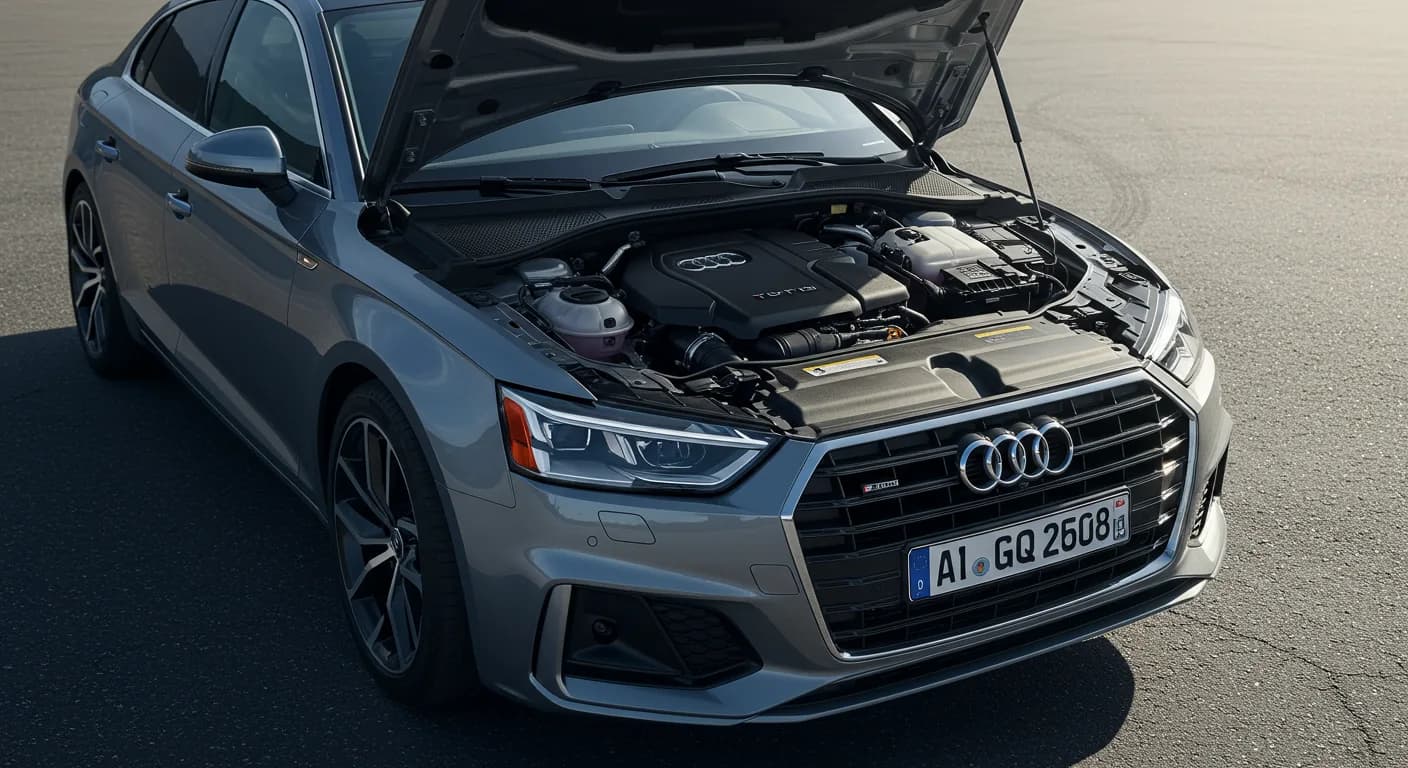
Si applica anche a
- Audi A4
- 2021–2023
- Audi A4 allroad
- 2021–2023
- Audi A5
- 2022–2023
- Audi Q5
- 2021–2023
Important Warning
Owners should be aware of a critical detail regarding this issue:
NOTICE: Replacing the turbocharger with one with an identical part number (part number 06N.145.702.D) will not fix the problem. Check ETKA for an alternative available part number.
This means that simply replacing the faulty turbocharger with another one of the same original part number (06N.145.702.D) will not resolve the whistling noise. Technicians must consult ETKA for an updated or alternative part number to ensure a successful repair.
Symptoms of Whistling Turbocharger
Owners of 2021-2023 Audi A4, A5, and Q5 models equipped with the 4-cylinder 2.0 TFSI engine may experience a distinct whistling noise emanating from the turbocharger. This noise is typically noticeable under specific driving conditions.
The whistling sound can be heard when accelerating or driving at a constant speed, particularly when the engine is operating in combustion mode. The issue often manifests between 1500 and 2200 RPM and at approximately 70% engine load. This Audi A5 whistling turbocharger issue can occur regardless of the selected transmission position.
Workshop findings indicate that the whistling noise has a frequency between 2.8 kHz and 3.2 kHz, which can be precisely measured using a PICO measurement tool.
Diagnosis and Trigger Conditions
To diagnose the whistling turbocharger, technicians will first attempt to duplicate the customer's concern. This involves test driving the vehicle under the reported conditions where the whistling noise is most prominent.
For accurate identification and analysis of the noise, the VAS tool 611015, also known as a PICO NVH tool, is recommended. This specialized tool allows for precise measurement of the noise frequency and helps confirm that the turbocharger is indeed the source of the whistling. Further details on using the PICO NVH tool for noise analysis can be found in TSB 2070568, which covers professional noise analysis for engine and gearbox issues.
Repair Procedure Summary
Audi Technical Service Bulletin 2071243/2 outlines the steps for addressing the whistling turbocharger. The process begins with a thorough noise analysis, ideally utilizing the VAS 611015 PICO NVH tool to confirm the turbocharger as the source of the noise.
Once confirmed, the primary repair involves replacing the turbocharger. It is crucial to note that the replacement turbocharger must not be of the identical part number (06N.145.702.D) that caused the original problem. Technicians are instructed to consult ETKA for an alternative, updated part number to ensure the issue is permanently resolved. After replacement, a road test is performed to verify the repair.
Required Tools and Parts
For the diagnosis and repair of the Audi A5 whistling turbocharger, specific tools and parts are necessary:
- VAS 611015 (PICO NVH tool): This specialized tool is essential for accurately identifying and measuring the whistling noise from the turbocharger.
- Turbocharger: A new turbocharger is required. It is critical that this replacement part is not the original part number 06N.145.702.D. Technicians must check ETKA for an alternative, updated part number.
- Fasteners, Bolts, Nuts, and Screws: These components may be needed as per the repair manual and should be sourced via ETKA/ELSA.
Always consult your Parts Department and/or ETKA for the latest information and parts bulletins to ensure the correct components are used.
Warranty Information
This Technical Service Bulletin 2071243/2 outlines warranty coverage for eligible vehicles. The claim type is generally covered for up to 48 months or 50,000 miles, whichever comes first.
For Certified Pre-Owned (CPO) vehicles, coverage falls under the G10 claim type, provided the owner is verified. If the vehicle is outside of any applicable warranty, this TSB serves as informational guidance only, and the repair costs would typically be borne by the owner. The service number associated with this TSB is 2130, and the damage code is 0020. Various labor operations are specified for diagnosis and replacement, including setup time for the PICO NVH tool and the actual turbocharger removal and installation.
Source: NHTSA ID 10251968
Frequently Asked Questions
- What is Audi Technical Service Bulletin 2071243/2 about?
- Audi TSB 2071243/2 addresses a whistling noise that can occur from the turbocharger in certain 2021-2023 Audi A4, A5, and Q5 models with the 2.0 TFSI engine, particularly between 1500-2200 RPM at approximately 70% load.
- What are the symptoms of the Audi A5 whistling turbocharger issue?
- Owners may hear a whistling noise from the turbocharger while accelerating or driving at a constant speed. This noise is most common between 1500-2200 RPM and around 70% engine load, and it can occur in any transmission gear.
- Can the turbocharger be replaced with the same part number to fix the whistling?
- No, the TSB specifically warns that replacing the turbocharger with an identical part number (06N.145.702.D) will not resolve the problem. An alternative, updated part number must be used, which technicians can find by checking ETKA.
- Is the repair for the whistling turbocharger covered under warranty?
- Yes, for eligible vehicles, the repair is typically covered under warranty for up to 48 months or 50,000 miles. Certified Pre-Owned vehicles also have coverage under the G10 claim type. If the vehicle is outside of warranty, the TSB is for informational purposes only.
Related Articles
2021-2026 Audi Cracking/Creaking Noises During Load Changes TSB
Audi has issued Technical Service Bulletin 2062633/6 to address cracking and creaking noises that may occur in 2021-2026 Audi models during vehicle load changes or severe body torsion. This TSB outlines a repair for a loose bonded joint in the subframe connection.
2020-2021 Audi MIB3 Favorites, Destinations Deleted TSB
This Technical Service Bulletin (TSB) 2079619/1 addresses a software issue in 2020-2021 Audi A4, A5, S4, S5, and RS5 models where the MIB3 system sporadically deletes last destinations, favorites, and home addresses. A software update is required to resolve this problem.
2021-2025 Audi Cracking/Creaking Noises TSB 2062633/4
Audi has issued TSB 2062633/4 to address cracking/creaking noises in 2021-2025 models. This noise, often heard during load changes or body torsion, originates from a loose bonded joint in the subframe. The TSB outlines a repair procedure involving a modified longitudinal member and cavity sealing.
2021-2025 Audi A4/A5 Engine Coolant Temperature Sensor TSB
This Technical Service Bulletin (2078939/1) from Audi addresses a specific diagnostic trouble code, P218500, related to the Engine Coolant Temperature Sensor 2 Circuit High. Owners may notice the exhaust emissions warning lamp (MIL) illuminating on the instrument cluster.
2021-2026 Audi Camera Part Return Notice SM 15-2025
Audi's Special Notice SM 15-2025 instructs dealers to return specific camera part numbers that are not "generation 03S" by March 18, 2025, to ensure customers receive correct parts.
Leave a comment
Comments are moderated and may take a moment to appear. Only your first name and the initial of your last name are shown publicly.
Comments
Be the first to comment.