2023-2025 Hyundai Tucson Inoperable Horn TSB 26-BE-003H
Hyundai has released Technical Service Bulletin 26-BE-003H for 2023-2025 Tucson (NX4A) vehicles experiencing an inoperable horn. This TSB outlines the diagnostic and repair steps to replace both the high and low-pitch horn assemblies due to internal oxidation.
 Sarah Mitchell2024 Hyundai Tucson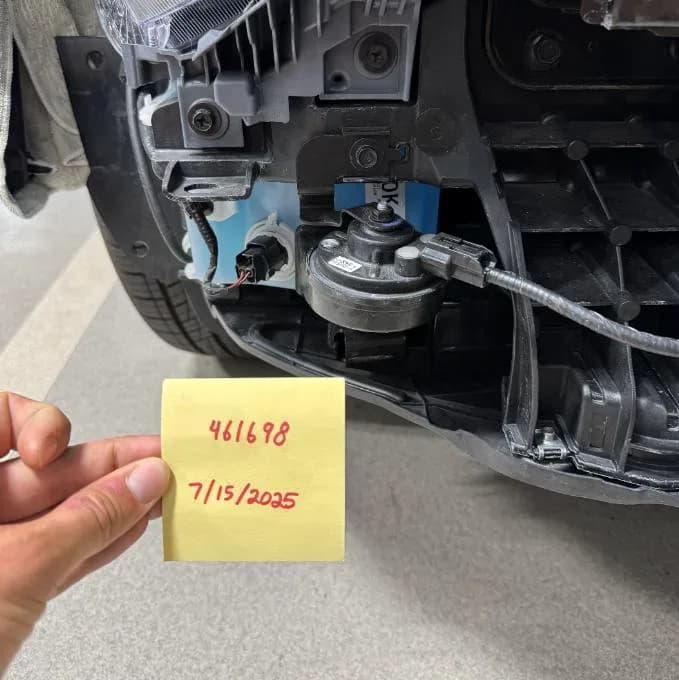
S'applique également à
- Hyundai Tucson
- 2023, 2025
Owners of 2023-2025 Hyundai Tucson (NX4A) vehicles may experience an "inoperable horn" due to internal components oxidizing from foreign substances. Hyundai has issued Technical Service Bulletin (TSB) 26-BE-003H to address this issue, providing a detailed procedure for replacing both the low-pitch and high-pitch horn assemblies.
This TSB applies to Tucson (NX4A) models produced between July 26, 2022, and March 30, 2025, specifically those with VINs starting with 5NM.
Symptoms
The primary symptom addressed by TSB 26-BE-003H is an "inoperable horn." This means that when the horn button is pressed, there is no sound or an inconsistent sound from the vehicle's horn.
Diagnosis and Trigger Conditions
The root cause identified for the "inoperable horn" condition is the oxidation of internal horn components, likely due to exposure to foreign substances. To confirm this issue, a technician will need to verify the customer's concern and confirm the horn's inoperability.
Important Warnings for Owners
Hyundai emphasizes that this field action requires a confirmed customer concern and a verified instance of the related symptom before any repair work can proceed. Claims submitted without meeting these justification requirements may be subject to debit. This means that simply requesting a horn replacement without a demonstrable issue will not be covered under warranty.
Repair Procedure Summary
The repair outlined in TSB 26-BE-003H involves replacing both the low-pitch and high-pitch horn assemblies. The general steps are as follows:
- Preparation: Turn off the ignition and disconnect the negative battery terminal. The battery terminal should be tightened to 6.5 lb-ft (78 lb-in or 8.8 N.m) during reassembly.
- Bumper Removal: The front bumper assembly must be removed to access the horns. This requires referring to the shop manual for specific instructions on removing the front bumper. Technicians are advised to use plastic trim removal tools and partially remove the fender garnish by detaching the front four clips to prevent damage. The removed portion should be protected with painter's tape and a microfiber rag.
- Digital Documentation: Before removing the original horns, a photo of the original horn must be taken using the STUI camera function and uploaded. If the STUI camera is not used, the last six digits of the VIN and the repair date must be written on a piece of paper and included in the photo.
- Horn Removal: Disconnect the electrical connectors from both horns and remove their mounting bolts. The horn mounting bolts should be tightened to 7.25 lb-ft (87 lb-in or 9.8 N.m) when installing the new horns.
- New Horn Installation: Install the new high-pitch and low-pitch horns in the reverse order of removal.
- Reassembly and Test: Reinstall the front bumper and reconnect the 12V battery. Finally, test the horns to ensure proper operation.
Required Parts
To perform this repair, the following parts are required:
- Horn Assy - Low Pitch: Part Number 96641-CW500QQH (Quantity: 1)
- Horn Assy - High Pitch: Part Number 96651-CW500QQH (Quantity: 1)
The causal part identified for warranty claims is 96611-N9000.
Warranty Information
Repairs performed under TSB 26-BE-003H are covered under the 5-year/60,000-mile New Vehicle Limited Warranty (NVLW). Claims should be submitted as a "Campaign" type with operation code 50DA07R0 and an estimated operation time of 0.6 hours. The nature code is I14 and the cause code is ZZ3. It is crucial for dealers to ensure the parts and repair procedures fall within the warranty coverage period based on mileage and start date. If parts are out of warranty, a goodwill consideration request may be submitted. All incident parts are subject to callback through the Warranty Technical Center (WTC) return process, and claims may be debited if parts are not returned.
Owner Action
If you own a 2023-2025 Hyundai Tucson (NX4A) and are experiencing an "inoperable horn," you should contact your authorized Hyundai dealership. Explain the symptom to them, as a confirmed customer concern is required for the repair to be covered under warranty. The dealership will diagnose the issue and perform the necessary horn assembly replacement according to TSB 26-BE-003H.
NHTSA ID: 11028954
Galerie
10 images
Frequently Asked Questions
- What is Hyundai TSB 26-BE-003H about?
- Hyundai TSB 26-BE-003H addresses the issue of an "inoperable horn" in certain 2023-2025 Hyundai Tucson (NX4A) vehicles, providing instructions for replacing both horn assemblies.
- What causes the Hyundai Tucson inoperable horn problem?
- The inoperable horn issue in the Hyundai Tucson is caused by foreign substances leading to oxidation of the internal parts of the horn assemblies.
- How is the inoperable horn repaired on a Hyundai Tucson?
- The repair involves replacing both the low-pitch and high-pitch horn assemblies. This procedure requires disconnecting the battery, removing the front bumper, and then replacing the horns before reassembling the vehicle.
- Is the repair for the Hyundai Tucson inoperable horn covered under warranty?
- Yes, the repair is covered under the 5-year/60,000-mile New Vehicle Limited Warranty, provided there is a confirmed customer concern and the vehicle meets the warranty criteria.
Related Articles
2024 Hyundai Tucson Health Check: Recalls and Bulletins
The 2024 Hyundai Tucson has faced two recalls, including a critical power steering issue, alongside numerous service bulletins addressing engine, electrical, and structural concerns. This report details the key problems and what owners should know.
2021-2024 Hyundai Starter Freezing & Solenoid Replacement TSB
Hyundai has issued Technical Service Bulletin 26-EE-003H for various 2021-2024 models experiencing difficulty starting in cold weather. This TSB outlines an inspection and potential replacement of the starter magnetic switch (solenoid) assembly.
2023-2026 Hyundai Lamp Condensation TSB 25-BD-012H
This Hyundai Technical Service Bulletin (TSB) 25-BD-012H addresses condensation in headlamps, rear combination lamps, daytime running lamps (DRL), and fog lamps across various 2023-2026 Hyundai models. It clarifies that lamp assembly replacement is often unnecessary and provides a diagnostic and…
2022-2024 Hyundai MSLA Feature: Speed Limit Assist Guide
This guide explains Hyundai's Manual Speed Limit Assist (MSLA) feature for 2022-2024 Tucson and Santa Cruz owners. Learn how to activate, use, and disengage MSLA to help avoid exceeding speed limits, along with important safety information.
2024 Hyundai Tucson / Sonata EGR Valve Electrical Short TSB
Hyundai has issued Service Campaign 9B3, documented in TSB 25-01-023H, to address an electrical short in the Exhaust Gas Recirculation (EGR) valve assembly in certain 2024 Hyundai Tucson and Sonata vehicles. This issue can lead to a Malfunction Indicator Lamp (MIL) illumination and various…
Leave a comment
Comments are moderated and may take a moment to appear. Only your first name and the initial of your last name are shown publicly.
Comments
Be the first to comment.