2021-2022 Audi e-tron Battery Software Update 93N6
Audi Technical Service Bulletin 93N6 addresses a software update for the battery modules control unit in 2021-2022 Audi e-tron and e-tron Sportback models. This update prevents issues with battery cell balancing and voltage measurement, optimizing high-voltage battery performance.
 Marcus Weber2021 Audi e-tron
S'applique également à
- Audi e-tron
- 2022
- Audi e-tron Sportback
- 2021–2022
Audi has issued Technical Service Bulletin (TSB) 93N6 to address a software update for the battery modules control unit in certain 2021-2022 Audi e-tron and e-tron Sportback vehicles. This proactive update aims to improve the performance and longevity of the high-voltage battery by optimizing cell balancing and voltage measurement.
The 93N6 update is crucial for maintaining the health of your vehicle's battery system. It ensures that individual battery cells operate efficiently, preventing issues that could arise from imbalances or inaccurate voltage readings.
Why This Update Matters: Battery Cell Balancing
The high-voltage battery system in electric Audi e-tron vehicles is composed of numerous individual battery cells. These cells, while designed to be similar, can have slight variations in capacity and voltage. Without proper management, the overall capacity of the battery system can be limited by the weakest cell, leading to potential overloading and accelerated aging of individual cells.
This software update, identified as 93N6, optimizes the function of the battery modules control unit to enhance the balancing process and stabilize cell voltage measurements. This ensures that all battery cells contribute effectively, improving the overall efficiency and lifespan of the high-voltage battery.
Important Warnings for Owners
Audi has provided several critical advisories regarding this software update:
- Eligibility: The procedure for the 93N6 update is only valid for vehicles that display the "93N6" code in the Elsa Campaign/Action Information screen on the day of repair.
- Dealer Inventory: This procedure must be performed on applicable vehicles in dealer inventory prior to sale.
- Prior Safety Recalls: "All Safety Recalls must be completed prior to completing this campaign."
- Specific Recall Precedence: "If the 93V2 or 93U9 safety recall is open, the evaluation step, if applicable, in those campaigns must be completed before the 93N6. The software update in the 93N6 will erase the high-voltage battery historical data and will lead to an inaccurate evaluation of the high-voltage battery cell modules. After the evaluation step has been completed and a response received, the 93N6 must be completed BEFORE the software update in the 93U9."
- Radiator Fan Hazard: "Radiator Fan(s) may cycle ON high speed during the Update Process! There is a serious risk that personal injury may result if contact is made with spinning fan blades. Keep hands and all objects away from Radiator Fan(s) during Update Process!"
- Bluetooth/WiFi Prohibited: "Using Bluetooth or WiFi for this action is PROHIBITED! Damage caused to electronic components (e.g. ECM, TCM, etc.) during the SVM flash process is not covered."
- Battery Voltage: The vehicle's battery voltage must remain above 12.5 volts throughout the software update. Failure to maintain this voltage can cause the update to fail and potentially damage the control module. Damages resulting from insufficient voltage will not be covered under warranty.
- Hazard Warning Lights: The vehicle's hazard warning lights must be switched on during the update. If they are not, the procedure may cancel itself, as the lights prevent the system from entering bus sleep mode.
- ODIS Hot-Fix Patches: Any ODIS "Hot-Fix" patches installed on the scan tool must be removed before starting this operation.
Repair Procedure Summary
The 93N6 software update is a dealership-performed service that involves several steps to ensure a successful flash of the battery modules control unit. The process requires specific diagnostic equipment and adherence to strict guidelines.
- Vehicle Preparation: The technician first verifies the vehicle's eligibility using the Elsa system, ensuring the 93N6 code is open. Any pending safety recalls, particularly 93V2 or 93U9, must be completed beforehand. The vehicle's hood and battery cover are opened, and a battery charger (such as the GRX3000VAS Tester/Charger) is connected to maintain a stable voltage above 12.5 volts. Hazard warning lights are activated, and screen saver/power saving settings are disabled on the diagnostic tester.
- Diagnostic Tool Setup: An Audi-approved diagnostic tester (VAS6150X/VAS6160X) is connected to the vehicle using a USB cable. It is critical that Bluetooth or WiFi connections are NOT used for this update. The ODIS software on the diagnostic tester must be fully up to date, and any "Hot-Fix" patches must be removed.
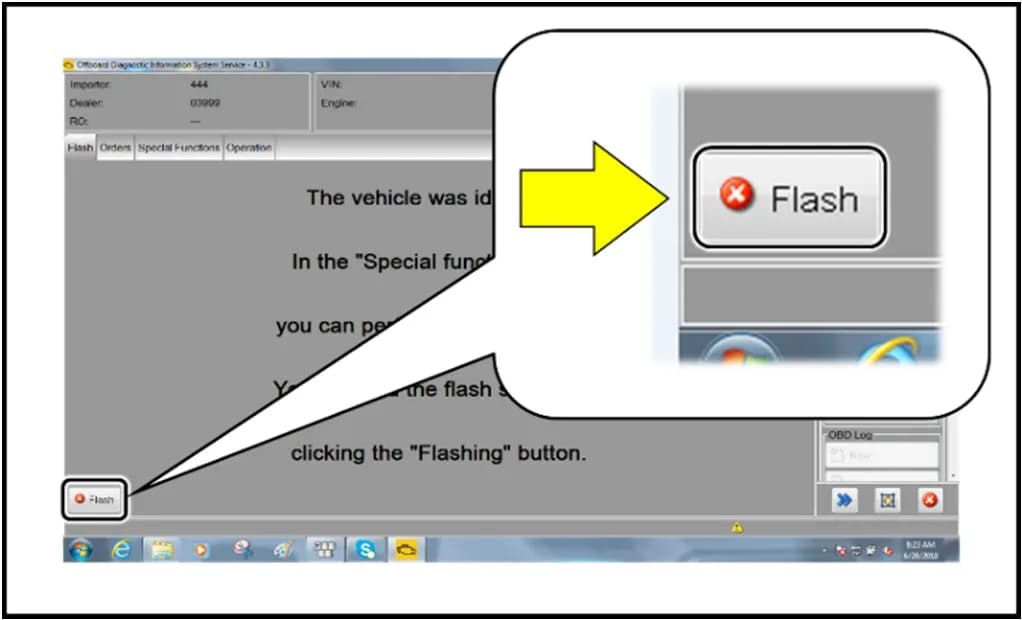
- Software Flash: The technician initiates the ODIS program, selects the "Flash" operating mode (avoiding "Guided Fault Finding" or GFF), and follows the on-screen prompts. The specific SVM code 93N6A268 is entered during the process. After the flash is successfully completed, the diagnostic protocol is sent online.
- Finalization: To clear any event memory entries generated during the flashing, the vehicle is put into bus sleep mode. This involves disconnecting the diagnostic tester, removing the key, and locking the vehicle with the remote for six minutes.
Required Tools or Parts
This software update requires specialized equipment that only authorized Audi service centers typically possess:
- Battery Tester/Charger: GRX3000VAS (or equivalent)
- Diagnostic Tester: VAS6150X/VAS6160X (or equivalent)
Warranty Information
This 93N6 software update is covered under the vehicle's High-Voltage Battery Warranty. Owners will not incur charges for this service. Dealerships will process the claim using specific labor operations:
- 2706 89 50: Connect battery charger
- 9301 25 99: Update battery module control module software
- 9035 33 99: Activate bus sleep mode
Audi requires that customers be informed in writing about all work performed, including this update, on their repair order.
What Owners Should Do
If you own a 2021-2022 Audi e-tron or e-tron Sportback, it is recommended to contact your authorized Audi dealer to check if your vehicle is eligible for the 93N6 software update. While this is a proactive update to prevent future issues rather than addressing an immediate symptom, ensuring your Audi e-tron battery software update is current can help maintain optimal performance and longevity of your high-voltage battery system.
Source: NHTSA ID: 11009209
Galerie
11 images
Frequently Asked Questions
- What is the purpose of the Audi TSB 93N6?
- The Audi TSB 93N6 provides a software update for the battery modules control unit in 2021-2022 Audi e-tron models. Its purpose is to optimize the battery cell balancing function and stabilize cell voltage measurements, which helps prevent potential issues with the high-voltage battery system and ensures its long-term performance.
- Which Audi e-tron models are affected by the 93N6 update?
- The 93N6 software update applies to certain 2021-2022 Audi e-tron and e-tron Sportback models. You should contact your Audi dealer to verify if your specific vehicle is eligible for this update.
- Is the Audi e-tron battery software update covered under warranty?
- Yes, the 93N6 software update is covered under the vehicle's High-Voltage Battery Warranty. Owners will not be charged for this service when performed by an authorized Audi dealer.
- Are there any special conditions for performing the 93N6 update?
- Yes, several critical conditions must be met. For example, the vehicle's battery voltage must remain above 12.5 volts throughout the update, hazard warning lights must be on, and the diagnostic tool must be connected via USB cable (Bluetooth or WiFi are prohibited). Any prior safety recalls must also be completed first.
- How can I check if my Audi e-tron needs the 93N6 software update?
- You should contact an authorized Audi dealer. They can check your vehicle's eligibility using the Elsa system, which will indicate if the 93N6 code is open for your specific vehicle.
Related Articles
2021 Audi e-tron Electrical Malfunction and Power Loss
A 2021 Audi e-tron owner reported a severe 'Electrical Malfunction' resulting in complete loss of power on the highway. The issue has persisted despite dealer attempts to fix it over five months, posing significant safety risks.
2021-2026 Audi UTR Troubleshooting & FAQs TSB 2081409/1
This Audi Technical Service Bulletin (TSB 2081409/1) provides comprehensive answers to frequently asked questions and troubleshooting steps for the Audi Universal Traffic Recorder (UTR) accessory, covering topics like SD card compatibility, video playback, Wi-Fi issues, and more.
2021-2025 Audi Emergency Call System Fault TSB
Audi has released Technical Service Bulletin 2059528/18 to address an "Emergency call function: malfunction! Function unavailable. Please contact service" warning, often accompanied by a red SOS LED and DTC B200000. This issue affects various 2021-2025 Audi models and is due to a software problem…
2021-2026 Audi Adaptive Light System Fault C12B3FA TSB
Audi has released Technical Service Bulletin 2054202/7 to address an intermittent 'Audi adaptive light: system fault' message and DTC C12B3FA in various 2021-2026 models. This TSB outlines diagnosis and resolution for driver assistance system malfunctions.
2021-2026 Audi Parking Aid False Warnings TSB 2024323/12
This Technical Service Bulletin (TSB 2024323/12) details diagnostic and repair procedures for 2021-2026 Audi vehicles experiencing false parking aid warnings. Learn about environmental factors, sensor checks, and proper installation to resolve issues like 'Parking aid does not work / warning is…
Leave a comment
Comments are moderated and may take a moment to appear. Only your first name and the initial of your last name are shown publicly.
Comments
Be the first to comment.