2025 Tesla Cybertruck Door Shaking and Noise TSB
Tesla has issued Service Bulletin SB-25-10-002 for 2025 Cybertruck vehicles experiencing low-pitched booming, shaking, rattling, or vibrations from the door assemblies and LH side mirror at high speeds. The repair involves applying new adhesive to reinforcement brackets and installing butyl pads.
 David Chen2025 Tesla Cybertruck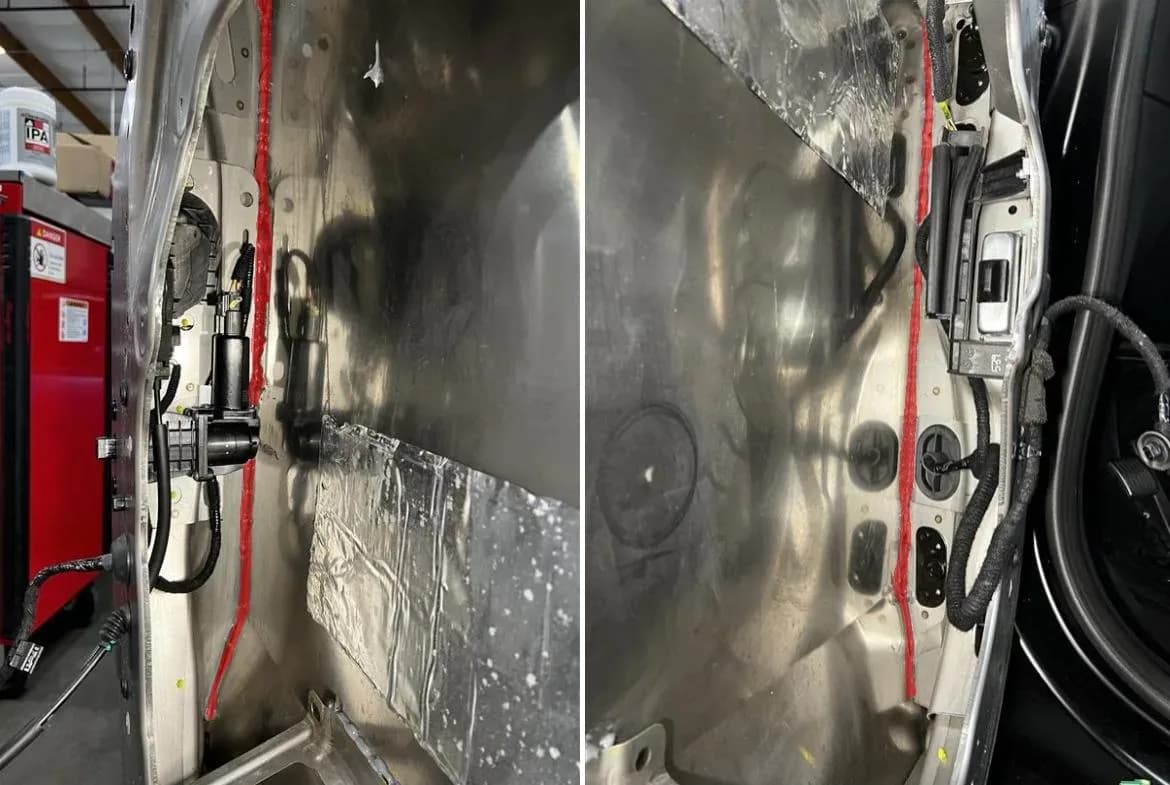
Symptoms
Owners of 2025 Tesla Cybertruck vehicles may notice specific issues related to their door assemblies and left-hand (LH) side mirror. These symptoms typically manifest as low-pitched booming, shaking, rattling, and/or vibrations.
The problem occurs at the door assemblies and/or the LH side mirror, particularly when the vehicle is driven at high speeds, specifically greater than 60 mph (96 km/h). These conditions do not meet Tesla's quality standards, indicating a potential manufacturing concern that leads to the Tesla Cybertruck door shaking.
Diagnosis / Trigger Conditions
To diagnose the issue, technicians will perform a test drive on the highway at speeds exceeding 60 mph (96 km/h). During this drive, they will listen for low-pitched booming or vibrations emanating from the doors and observe the LH side mirror glass for any visible shaking or rattling.
It is important to note the specific location of the noises, such as the LH front door, the front or rear of the vehicle, or if the issue is widespread. If no low-pitched booming, vibration, or LH side mirror shaking is observed during high-speed driving, the vehicle is not affected by this bulletin, and correction code S012510002 will be used. If symptoms are present, the repair procedure will proceed, using correction codes S022510002, S032510002, or S042510002 depending on the scope of the repair.
Important Warnings
When performing the repair, technicians must adhere to specific safety and procedural guidelines:
- "WARNING: Read the adhesive instructions and safety datasheet to achieve optimal adhesion and to ensure personal safety. If instructed, use appropriate Personal Protective Equipment (PPE), such as protective gloves and a respirator mask."
- "CAUTION: Do not apply adhesive to the drain holes (x2) at the bottom of the front and rear ends of the front door assembly (Figure 8)."
- "NOTE: Make sure adhesive is applied from the tops of the brackets down to the bottoms of the brackets, just before the drain holes."
Repair Procedure Summary
The repair addresses the Tesla Cybertruck door shaking by reinforcing the internal door structures. The procedure involves several steps for both front and rear door assemblies.
Front Door Rework:
- The LH front door closeout panel is removed, following Service Manual procedure 1150040051.
- Old adhesive is cleaned from the edges of the reinforcement brackets where they meet the inner door panel, using tools like a wire brush, gasket scraper, and Isopropyl Alcohol (IPA) wipes. Figures 1, 2, 3, and 4 illustrate these areas.
- New adhesive is then applied to these cleaned reinforcement bracket and inner door panel joints, as shown in Figures 5, 6, and 7.
- Any remaining butyl patch residue from the forward upper section of the inner front door panel is removed (Figures 9 and 10).
- The inner door panel is prepared for additional butyl patch installation by cleaning the indicated areas with IPA (Figure 11).
- Five new NVH butyl patches are installed on the inner door panel (Figure 12), followed by four additional butyl patches on top of the lower ones (Figure 13). These patches are then wet out with a pressure roller.
- Depending on the initial test drive findings, the rework steps (2-6) may be repeated for the RH front door assembly.
Rear Door Rework:
- The LH rear door closeout panel is removed, following Service Manual procedure 1150040112.
- The areas where the reinforcement brackets meet the inner rear door panel are cleaned with IPA wipes (Figures 1 and 3).
- New adhesive is applied to these reinforcement bracket and inner rear door panel joints.
- Similar to the front doors, any existing butyl patch residue is removed (Figures 9 and 10).
- The panel areas are cleaned, and five new butyl patches are installed (Figures 12 and 14), followed by four additional patches (Figure 13), which are then wet out with a pressure roller.
- These steps (14-22) are then repeated for the RH rear door assembly.
After the rework, the adhesive is allowed to cure for at least two hours. All removed parts are reinstalled, MV power is reconnected, and a final test drive is conducted at speeds over 60 mph (96 km/h) to confirm the repair and ensure the Tesla Cybertruck door shaking issue is resolved.
Required Tools or Parts
To perform this repair, the following parts and special tools are required:
Parts:
- 1004969-00-A: NVH BUTYL FOIL (9 pieces per door, maximum of 36)
- 2220427-00-A: PLEXUS MA8120 ADHESIVE - 50 mL (2 pieces per door, maximum of 8)
Special Tools:
- 2220406-00-A: 2-PART ADHESIVE DISPENSING GUN – 50ML
- 2220800-00-A: 1:1, 2:1 ADHESIVE MIXING NOZZLE
- 1082495-13-A: GASKET SCRAPER
- 1064740-00-A: SCRAPER, RAZOR BLADE
- 1588904-00-A: GLASS GAP AND FLUSH TOOL
- 1454796-00-A: WINDOW SWITCH TOOL
- 1081542-00-A: WIRE BRUSH
- 1465974-00-A: TOOL, PRESSURE ROLLER
Shop Supplies:
- Isopropyl Alcohol (IPA) wipes
Owner Action
If you own a 2025 Tesla Cybertruck and experience symptoms such as low-pitched booming, shaking, rattling, or vibrations from your door assemblies or LH side mirror, especially at speeds above 60 mph (96 km/h), it is recommended to contact your authorized Tesla service center. Inform them of the symptoms you are experiencing. The inspection and repair outlined in Service Bulletin SB-25-10-002 will be performed upon customer complaint to address the Tesla Cybertruck door shaking.
Source: NHTSA ID 11023639
Gallery
14 images
Frequently Asked Questions
- What are the common symptoms of the 2025 Tesla Cybertruck door issue?
- Owners may experience low-pitched booming, shaking, rattling, and/or vibrations from the door assemblies and/or the LH side mirror, particularly when driving at speeds greater than 60 mph (96 km/h).
- What causes the Tesla Cybertruck door shaking and noise?
- According to Service Bulletin SB-25-10-002, the issue is caused by reinforcement brackets inside the front and rear door assemblies that might lead to these unwanted noises and vibrations, which do not meet Tesla quality standards.
- How is the 'Tesla Cybertruck door shaking' issue fixed?
- The repair involves applying new adhesive to the reinforcement brackets and installing additional NVH butyl pads on the affected door assemblies. This procedure is detailed in Service Bulletin SB-25-10-002 and is performed by trained professionals.
- Will I be charged for the repair described in Service Bulletin SB-25-10-002?
- The service bulletin does not specify costs, implying that if your vehicle is within warranty and exhibits the described symptoms, the inspection and repair should be covered by Tesla.
Related Articles
2025 Tesla Cybertruck Health Check: Service Bulletins
The 2025 Tesla Cybertruck currently has no reported recalls, owner complaints, or federal investigations. However, Tesla has issued several service bulletins addressing issues like halfshaft bolt grinding, door shaking, and illegible emission labels.
2024-2025 Tesla Cybertruck Halfshaft Bolts Grinding Noise TSB
Tesla Cybertruck owners may experience a loud grinding noise due to loose halfshaft bolts. Tesla Service Bulletin SB-26-40-001 R1 outlines inspection and replacement procedures for these bolts, and potentially the hub and halfshaft, to resolve the issue.
2025 Tesla Cybertruck Illegible Emission Label TSB
A service bulletin (SB-25-19-001) has been issued for the 2025 Tesla Cybertruck regarding Vehicle Emission Control Information labels that were printed with illegible text. This non-safety-related condition requires replacement of the label by a Tesla service center.
2026 Tesla Model Y Health Check: Recalls and Bulletins
The 2026 Tesla Model Y has been subject to 5 recalls, addressing issues from a potential loss of drive power to inoperable horns and windshield wiper problems. Additionally, two service bulletins detail concerns like seat blower noise and front fascia camera malfunctions, providing owners with a…
2024 Tesla Model 3 Health Check: Service Bulletins and Concerns
For 2024 Tesla Model 3 owners and prospective buyers, this detailed profile examines the vehicle's reliability based on official manufacturer service bulletins. Learn about potential issues like HV battery quality, misrouted wheel speed sensors, and rattling air vents.
Leave a comment
Comments are moderated and may take a moment to appear. Only your first name and the initial of your last name are shown publicly.
Comments
Be the first to comment.