2021-2022 Hyundai Anti-Theft Software & Security Campaigns
Hyundai has launched several campaigns (993, 9A5, P32, 9A8) to address vehicle theft concerns in 2021-2022 models like the Tucson. These include anti-theft software, ignition cylinder protectors, and steering wheel locks.
 Marcus Weber2021 Hyundai Tucson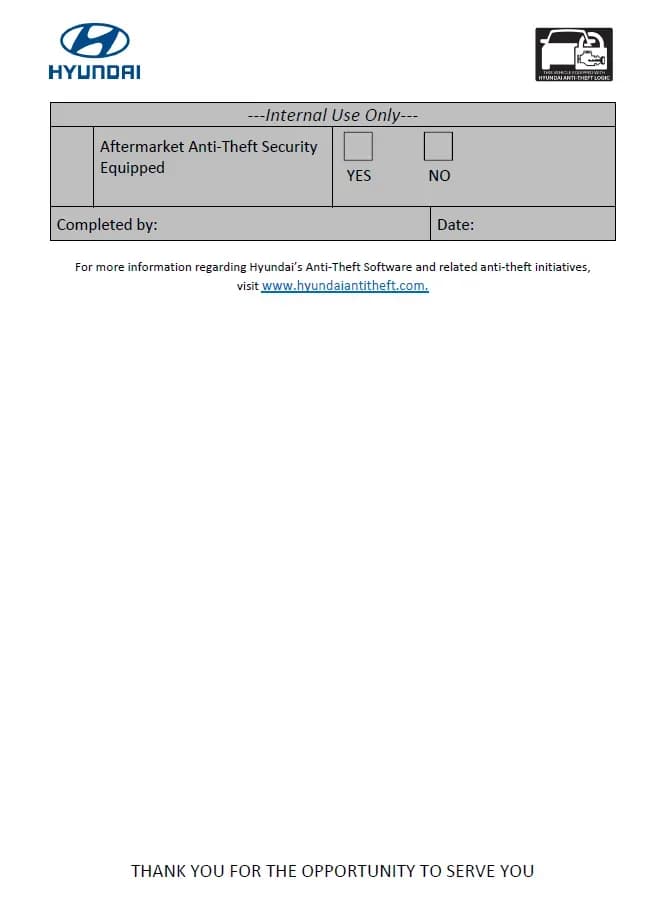
Also applies to
- Hyundai Accent
- 2021–2022
- Hyundai Elantra
- 2021–2022
- Hyundai Kona
- 2021–2022
- Hyundai Palisade
- 2021
- Hyundai Santa Fe
- 2021–2022
- Hyundai Tucson
- 2022
- Hyundai Veloster
- 2021
- Hyundai Venue
- 2021
▸ Show 2 more▾ Show fewer
Why This Matters
Hyundai has observed a significant increase in thefts targeting certain 2011-2022 model year vehicles that were not originally equipped with an engine immobilizer. These thefts have been widely publicized and promoted through social media platforms. In response, Hyundai Motor America (HMA) has initiated a series of service campaigns and a class action settlement to enhance vehicle security and provide owners with solutions.
The class action settlement addresses allegations that certain Hyundai vehicles were manufactured without an anti-theft device, making them more susceptible to theft. While Hyundai has not been found liable, a voluntary settlement was reached to provide relief to people who owned or leased Class Vehicles in the United States, including Puerto Rico, U.S. Virgin Islands, and Guam. Eligible class members may be entitled to compensation if they submit valid and timely claims. For more information on eligibility and how to file a claim, visit www.HyundaiTheftSettlement.com or call (833) 982-3330.
What's Being Addressed
Hyundai has developed a multi-faceted approach to combat vehicle theft for affected models. This includes: an anti-theft software upgrade (Campaign 993), the installation of an anti-theft ignition cylinder protector (Campaign 9A5), and the distribution of anti-theft steering wheel locks (Campaign P32). Additionally, Campaign 9A8 provides a revised software update for specific 2018 Elantra vehicles. These measures aim to improve the security of vehicles lacking an engine immobilizer, such as the 2021-2022 Hyundai Tucson, and deter theft. It's important to note that in November 2021, engine immobilizers became standard on all Hyundai vehicles produced.
Important Warnings for Owners
Owners should be aware of several critical points regarding these anti-theft campaigns:
- Aftermarket Alarms and Remote Start Systems: The anti-theft software upgrade (Campaign 993) may be incompatible with aftermarket or add-on alarms and remote start systems. Installing the software in vehicles with these devices could cause the software, the aftermarket system, or both to malfunction. Hyundai explicitly states: "This software upgrade may be incompatible with aftermarket/add-on alarms and remote start systems. Installation of the software upgrade in vehicles equipped with these devices may cause the software upgrade, the aftermarket/add-on alarm, and/or the remote start system not to function properly." If your vehicle has such systems, you may opt out of the software upgrade by signing a specific form provided by your Hyundai dealership. The opt-out form states: "I acknowledge that my vehicle is already equipped with an aftermarket alarm and/or anti-theft system. I further acknowledge that the Anti-Theft Software Upgrade (Service Campaign 993) may not be as effective when combined with the aftermarket alarm/anti-theft system on my vehicle and if installed, might interfere with the functionality of the aftermarket alarm/anti-theft system. Accordingly, I decline the Anti-Theft Software Upgrade (Service Campaign 993), which has been offered to me, to be performed on my vehicle."
- OEM Remote Start Systems: Vehicles equipped with an OEM Genuine Hyundai remote start system might exhibit horn honking when remote starting after receiving the software upgrade. If this occurs, refer to TSB 23-BE-010H (or its latest version) for an update to the remote start module to eliminate the issue.
- Window Tint: If your vehicle has aftermarket window tint installed on the front driver and passenger windows, the application of the anti-theft window decals required by Campaign 993 may affect the tint. Dealers will advise customers of this possibility, stating: "If you have aftermarket window tint, the decals may cause damage to the tint if you attempt to remove them later."
- Activating the System: After any software upgrade, it is crucial to lock and unlock your vehicle using the key fob buttons to activate and deactivate the anti-theft system. Hyundai warns: "Using the mechanical door lock may not activate the anti-theft system and your vehicle may not start."
- Opt-Out Consequence: If you decline the Campaign 993 software upgrade, Hyundai notes: "Service Campaign 993 will be considered closed on your vehicle at this time. If you later wish to receive the Anti-Theft Software Upgrade, please contact 1-877-446-2922. If you sell your vehicle, please provide the aforementioned contact number to the buyer in case they wish to have the Anti-Theft Software Upgrade performed."
Campaign 993: Anti-Theft Software Upgrade & Decals
Campaign 993 involves a free anti-theft software upgrade for the Integrated Body Control Unit/Body Control Module (IBU/BCM) and the installation of anti-theft window decals. This upgrade enhances the factory burglar alarm system operation and ignition start logic. The decals, which display "THIS VEHICLE EQUIPPED WITH HYUNDAI ANTI-THEFT LOGIC", are applied to the front driver's-side and front passenger-side windows, with additional decals available for rear windows at the owner's discretion.
Eligibility and Procedure
This campaign applies to certain 2011-2022 model year Hyundai vehicles that lack both a push-button ignition and an immobilizer lamp in the instrument cluster. Vehicles equipped with either of these features already have an immobilizer, and Campaign 993 software does not apply. Dealers verify eligibility using the WebDCS Vehicle Information Screen. The repair procedure, detailed in TSB 24-01-009H (or its latest version), involves performing the software upgrade and installing the decals. This TSB supersedes TSB 23-01-014H-6 and earlier versions like TSB 23-01-014H-5, TSB 23-01-014H-4, and TSB 23-01-014H-2.
The process is quick, typically not requiring a service rental car. Hyundai states that the software upgrade for the Hyundai Tucson anti-theft software is performed at no charge to the owner. Dealers are instructed to take specific STUI (Service Technical Update Information) photos for warranty claims. These photos must include the anti-theft decals clearly visible on the driver and passenger front windows, along with a piece of paper displaying the last 6 digits of the VIN and the date of the repair. For vehicles with a push-button ignition or immobilizer lamp, photos of the instrument cluster showing lighted lamps and telltale indicators (with ignition in Accessory mode) are required.
Warranty Information
Service Campaign 993 pays 0.3M/H (0.4 M/H for Elantra CN7/CN7a models) to perform the software upgrade. This labor time includes decal installation, STUI photo capture, and uploading.
Required Parts
Anti-theft decals (Part Number NP002-SC9A5) are required for installation. Dealers receive an initial supply and can reorder as needed through the Parts Bulletin SC993 Anti-Theft Decal Order Processing.
Owner-Facing Instructions for Campaign 993
Hyundai provides specific guidance for owners after the software installation:
- For vehicles with an exposed key cylinder on the driver's door lock: "Hyundai recommends using your key fob button to lock and unlock the vehicle to activate/deactivate the anti-theft system. However, your vehicle has an exposed key cylinder on the driver's door lock so you can also use your key to disarm the alarm/deactivate the “ignition kill” feature in addition to using your key fob. NOTE: this recommendation does not apply to Kona 2018-2022MY (OS), in which the key FOB button will need to be used to lock/unlock the vehicle and arm/dis-arm the security system."
- For vehicles with a covered key cylinder on the driver's door lock: "The key fob buttons to lock and unlock the vehicle are required to activate/deactivate the anti-theft system. After using the key fob to activate the anti-theft system, the key fob must be used to first disarm the system prior to attempting to start the vehicle."
Campaign 9A5: Ignition Cylinder Protector
For certain 2011-2017 model year Hyundai vehicles that cannot receive the Campaign 993 anti-theft software upgrade due to technical limitations, Hyundai offers Campaign 9A5. This campaign involves installing an anti-theft ignition cylinder protector and two anti-theft decals on the front windows.
Eligibility and Procedure
This campaign targets vehicles without engine immobilizers that are not compatible with the Campaign 993 software. Eligibility is confirmed via the WebDCS screen. TSB 24-01-007H (or its latest version) outlines the procedure for installing a key cylinder reinforcement protector assembly and two anti-theft decals for the front windows. This TSB revises the decal part number to NP002-SC9A5 and is related to TSB 23-01-092H-1 which added additional models.
Installation involves using JB Weld Steel Reinforced Epoxy (Dark Grey), which has a 4-6 hour set time. Dealers are reimbursed for the use of epoxy in sublet claims. Applicable vehicles include various 2011-2017 Accent, Santa Fe, Elantra Coupe, Elantra Touring, Veracruz, and Genesis Coupe models.
Required Parts
Specific protector kits are available depending on the vehicle model. Examples include:
- For models with 1 protector, 1 bracket, 2 safety bolts, and 1 deco-ring (if equipped with illuminated ring light):
- Santa Fe (CMa): 81921-0W000QQH
- Elantra Touring (FD): 81921-2L000QQH
- For models with 1 protector, 1 bracket, & 2 safety bolts:
- Accent (RB): 81921-1R000QQH
- Veracruz (EN): 81921-3J000QQH
- Elantra Coupe (JK): 81921-3X000QQH
- Genesis Coupe (BK): 81921-2M000QQH
- Accent (MC): 81921-1E000QQH
Additional protector kits can be ordered through the normal WebDCS ordering process, with some parts having lower CPM (Campaign Parts Management) limits.
Owner-Facing Instructions for Campaign 9A5
If Campaign 993 is not available for your vehicle, Hyundai advises: "The anti-theft software enhancement IS NOT available for your vehicle. Because your vehicle is not eligible, Hyundai would like to provide to you this anti-theft ignition protector. This anti-theft ignition protector may help deter the theft of your vehicle." If an owner declines the protector, the dealer will document: "We understand that you do not wish to have the anti-theft ignition protector installed on your vehicle. We will document on the Repair Order that you have declined this offer. Please sign on this line to acknowledge you are declining the procedure at this time."
Campaign P32: Steering Wheel Locks
Hyundai provides anti-theft steering wheel locks to owners of certain 2011-2017 model year Hyundai vehicles that are not eligible for the Campaign 993 software upgrade. This measure offers a physical deterrent against theft.
Eligibility and Procedure
This campaign applies to the same vehicle models as Campaign 9A5, which are those that cannot accommodate the Campaign 993 software. TSB 23-01-055H-1 (or its latest version) describes the process for distributing these steering wheel locks to affected customers through Hyundai dealerships on the service drive. Eligibility is confirmed via the WebDCS screen.
Required Parts
Steering Wheel Lock (Part Number 6009L) is provided to eligible customers at no cost. Dealers receive an initial shipment of 8 pieces and can order additional supplies through normal WebDCS ordering, with orders in multiples of 8. Initial CPM restriction is set at 16 pieces.
Owner-Facing Instructions for Campaign P32
If the software and decals are not available for your vehicle, Hyundai states: "The anti-theft software enhancement IS NOT available for your vehicle. Because your vehicle is not eligible, Hyundai would like to provide to you this anti-theft steering wheel lock at no cost to you. Using this anti-theft steering wheel lock may help deter the theft of your vehicle." If an owner declines the steering wheel lock, the dealer will document: "We understand that you do not wish to receive the anti-theft steering wheel lock. We will document on the Repair Order that you have declined this offer. Please sign on this line to acknowledge you are declining the procedure at this time."
Campaign 9A8: Revised Software Update
Service Campaign 9A8 specifically addresses certain 2018 model year Elantra (AD) vehicles with VINs starting with "KMH". This campaign involves an upgrade to the IBU/BCM (Integrated Body Control Unit/Body Control Module) software to revise the OEM Hyundai burglar alarm system operation and ignition logic. This revised logic ensures that the anti-theft software upgrade meets Campaign 9A8 requirements, especially for vehicles that previously received the Campaign 993 anti-theft software.
Customers with eligible vehicles for Campaign 9A8 will also receive an incentive for having this campaign performed at their Hyundai dealership. Additional details regarding this incentive will be communicated through first-class mailings to affected customers.
Historical Context and Superseded Bulletins
This manufacturer communication consolidates and updates information from several previous technical service bulletins and campaigns. Key revisions and supersessions include:
- Campaign 993: TSB 24-01-009H supersedes TSB 23-01-014H-6, which itself superseded TSB 23-01-014H-5. Earlier versions included TSB 23-01-014H-4 and TSB 23-01-014H-2, which provided additional models and inspection procedures.
- Campaign 9A5: TSB 24-01-007H revises decal part numbers and is related to TSB 23-01-092H-1, which added models to the campaign.
- Campaign P32: TSB 23-01-055H-1 details the distribution of steering wheel locks.
- Remote Start Horn Honking: TSB 23-BE-010H addresses horn honking issues in OEM remote start modules after the Campaign 993 software update.
These updates reflect Hyundai's ongoing efforts to refine and expand its anti-theft solutions.
Class Action Settlement Details
A class action settlement against Hyundai Motor America (HMA) was reached regarding allegations that certain 2011-2022 model year Hyundai vehicles were manufactured without an engine immobilizer, making them susceptible to theft. While Hyundai has not been found liable, the voluntary settlement aims to avoid lengthy litigation and provide relief to owners and lessees in the United States, Puerto Rico, U.S. Virgin Islands, and Guam. Eligible class members may receive compensation by submitting valid and timely claims. For more details on eligibility, potential benefits, and claim submission, visit www.HyundaiTheftSettlement.com or call (833) 982-3330.
What Owners Should Do
If you own a 2021-2022 Hyundai Tucson or another affected Hyundai vehicle, it is recommended to:
- Check Eligibility: Visit www.HyundaiTheftSettlement.com or contact your local Hyundai dealer to determine if your vehicle is eligible for any of these anti-theft campaigns based on its VIN. Vehicles with a push-button ignition or an immobilizer lamp in the instrument cluster are already equipped with an immobilizer and typically do not require the Campaign 993 software upgrade.
- Contact Your Dealer: Schedule an appointment with your Hyundai dealership to have the applicable anti-theft measures performed. These services are typically provided at no charge.
- Understand Your Options: Discuss with your dealer the implications of the software upgrade if you have aftermarket security or remote start systems. You may have the option to opt out of the software upgrade if it poses compatibility issues. For OEM remote start systems, a separate TSB (23-BE-010H) addresses potential horn honking issues after the software update.
- Claim Settlement Benefits: If you are a current or previous owner/lessee of an eligible vehicle, review the class action settlement information and submit a claim if applicable.
Source: NHTSA ID 10251282
Gallery
8 images
Frequently Asked Questions
- What is the Hyundai anti-theft software upgrade (Campaign 993)?
- The Hyundai anti-theft software upgrade (Campaign 993) is a free software update for the Integrated Body Control Unit/Body Control Module (IBU/BCM) that enhances the factory burglar alarm system and ignition start logic. It also includes the installation of anti-theft window decals. This upgrade is designed to deter theft in vehicles not originally equipped with an engine immobilizer, such as the 2021-2022 Hyundai Tucson.
- Is my 2021-2022 Hyundai Tucson affected by the anti-theft campaigns?
- Yes, certain 2021-2022 Hyundai Tucson models are among the vehicles identified for these anti-theft campaigns. You should check your vehicle's eligibility by visiting www.HyundaiTheftSettlement.com or contacting your Hyundai dealership with your VIN. Vehicles with a push-button ignition or an immobilizer lamp in the instrument cluster are already equipped with an immobilizer and typically do not require the Campaign 993 software upgrade.
- What if my Hyundai has an aftermarket alarm or remote start system?
- If your Hyundai has an aftermarket alarm or remote start system, the anti-theft software upgrade (Campaign 993) may interfere with its operation or cause malfunctions. Hyundai advises that you discuss this with your dealer, and you may have the option to sign an opt-out form to decline the software upgrade. For OEM remote start systems, a separate TSB (23-BE-010H) addresses potential horn honking issues after the software update.
- Will Hyundai provide a free steering wheel lock?
- Yes, Hyundai is offering free anti-theft steering wheel locks (Campaign P32) to owners of certain 2011-2017 model year vehicles that are not eligible for the anti-theft software upgrade (Campaign 993). You can check your vehicle's eligibility and obtain a steering wheel lock from your Hyundai dealership.
- What is the Class Action Settlement about?
- The Class Action Settlement is a voluntary agreement reached between Hyundai Motor America and plaintiffs who alleged that certain 2011-2022 Hyundai vehicles without an engine immobilizer were susceptible to theft. Hyundai has not admitted liability, but the settlement provides relief and potential compensation for eligible current and previous owners or lessees. You can find more information and file a claim at www.HyundaiTheftSettlement.com.
Related Articles
2021 Hyundai Tucson Health Check: Engine & Paint TSBs
For the 2021 Hyundai Tucson, there are no reported recalls, owner complaints, or federal investigations. However, owners should be aware of several manufacturer service bulletins (TSBs) addressing engine emissions, potential engine bearing issues, white paint peeling, and an anti-theft ignition…
2021 Hyundai Tucson Emissions Logic Update (9C2)
Hyundai Service Campaign 9C2 addresses elevated engine-out emissions in certain 2021 Hyundai Tucson models by updating the Engine Control Module (ECM) software. This update helps ensure compliance with emissions standards and prevents failed inspections.
2015 Hyundai Sonata GDS Event 1383 Campaign Suspended
Hyundai Motor America has temporarily suspended Service Campaign 9C2, related to software GDS event #1383, for the 2015 Hyundai Sonata (LFA) 2.4L. Vehicles will not show this campaign as open in WebDCS during the suspension period.
2021 Hyundai Tucson GDS Event #1383 Engine Investigation
Hyundai is actively investigating a software-related engine issue, identified as GDS event #1383. While primarily concerning 2015 Sonata 2.4L vehicles, this manufacturer communication is linked by NHTSA to the 2021 Hyundai Tucson, indicating an ongoing review for a resolution.
2010-2021 Hyundai Engine Bearing TSB 26-01-033H
Hyundai Technical Service Bulletin (TSB) 26-01-033H is a critical reference for Op codes and part numbers under Service Campaign T6G. This campaign addresses engine bearing inspection and replacement for various Hyundai models from 2010-2021, often triggered by DTC P1326 and "Abnormal Engine Noise."
Leave a comment
Comments are moderated and may take a moment to appear. Only your first name and the initial of your last name are shown publicly.
Comments
Be the first to comment.