2021-2022 Hyundai Anti-Theft Software Upgrade & Decals (Campaign 993)
Hyundai has issued Service Campaign 993 (TSB 24-01-009H) to upgrade the Integrated Body Control Unit (IBU/BCM) software and install anti-theft decals on various 2021-2022 models. This aims to enhance the burglar alarm system and ignition logic.
 Ahmet Topcu2021 Hyundai Tucson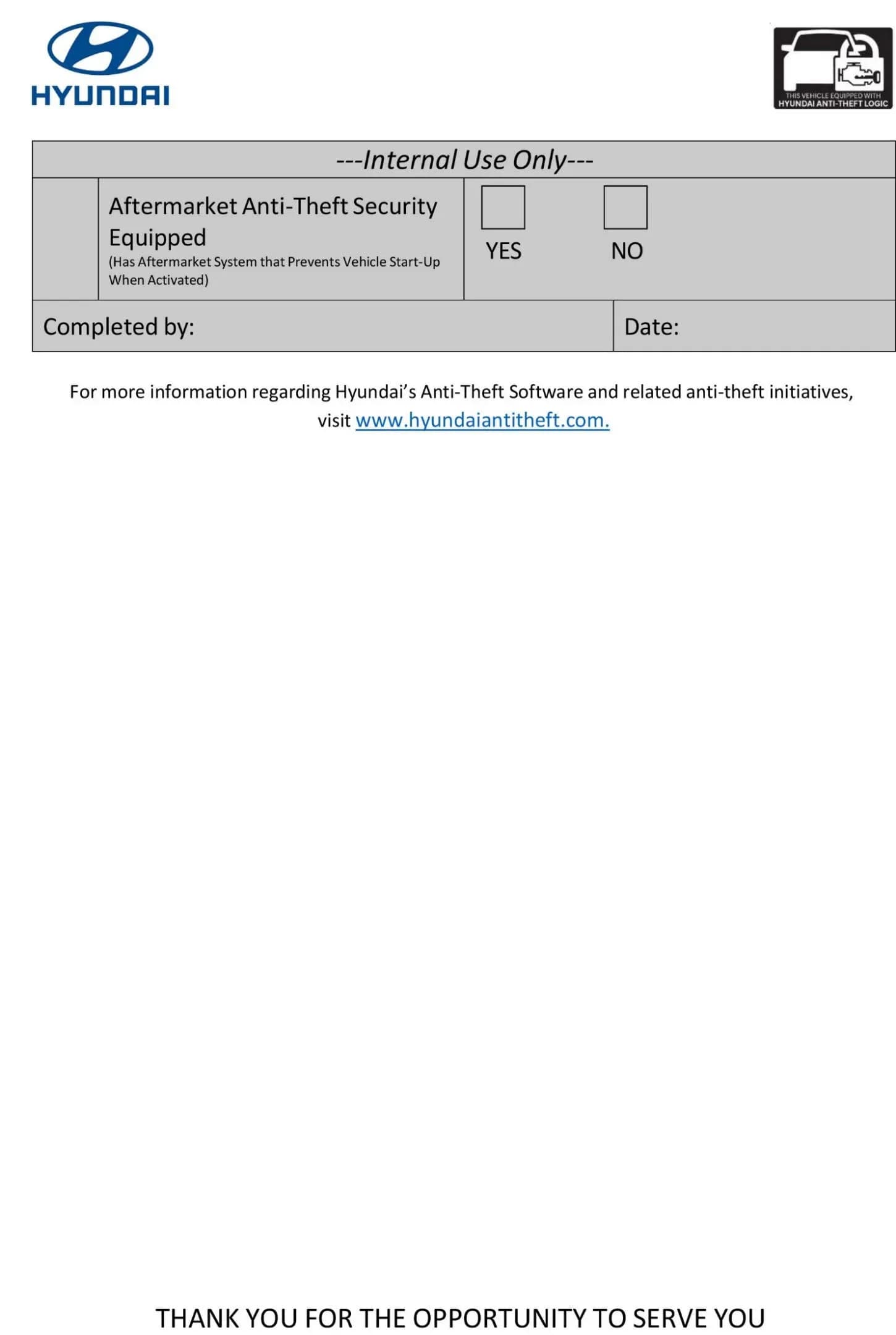
Si applica anche a
- Hyundai Accent
- 2021–2022
- Hyundai Elantra
- 2021–2022
- Hyundai Kona
- 2021–2022
- Hyundai Palisade
- 2021
- Hyundai Santa Fe
- 2021–2022
- Hyundai Veloster
- 2021
- Hyundai Venue
- 2021
▸ Mostra altri 1▾ Mostra meno
Hyundai has released Technical Service Bulletin (TSB) 24-01-009H, which outlines Service Campaign 993. This campaign focuses on enhancing the anti-theft measures for a range of 2021-2022 Hyundai vehicles, including the popular Hyundai Tucson anti-theft system. The core of this service involves a software upgrade to the Integrated Body Control Unit (IBU/BCM) and the application of new anti-theft decals.
This TSB supersedes a previous bulletin, 23-01-014H-6, by adding specific operation codes to address scenarios where an affected vehicle might be equipped with an aftermarket alarm system. The goal is to revise the OEM Hyundai burglar alarm system operation and ignition start logic, providing improved security for vehicles that may not have been originally equipped with an engine immobilizer.
Why This Matters
Vehicle theft remains a significant concern for many owners. For certain Hyundai models, the absence of an engine immobilizer can make them more vulnerable. This Service Campaign 993 directly addresses this by bolstering the vehicle's inherent security systems. The software update to the IBU/BCM aims to make it more difficult for unauthorized individuals to start and operate the vehicle, thereby reducing the risk of theft. The addition of anti-theft decals serves as a visual deterrent, signaling enhanced security features to potential thieves.
What's Being Addressed
This campaign focuses on two primary actions to improve vehicle security:
- IBU/BCM Software Upgrade: The Integrated Body Control Unit (IBU/BCM) software is updated to revise the OEM Hyundai burglar alarm system operation and ignition start logic. This electronic enhancement is critical for improving the vehicle's resistance to theft.
- Anti-Theft Decal Application: Two anti-theft decals are installed on the front windows of the vehicle. These decals serve as a visible indicator of the enhanced anti-theft system. Dealers may also install additional decals in the rear windows at the customer's discretion.
Important Warnings for Owners
Hyundai has issued several critical advisories regarding this service campaign:
- Dealers are mandated to perform this service campaign on all affected vehicles prior to customer retail delivery and whenever an affected vehicle is in the shop for any maintenance or repair.
- "This software upgrade may be incompatible with aftermarket/add-on alarms and remote start systems. Installation of the software upgrade in vehicles equipped with these devices may cause the software upgrade, the aftermarket/add-on alarm, and/or the remote start system not to function properly."
- "Vehicles equipped with the OEM Genuine Hyundai remote start system may exhibit the horn honking when remote starting the vehicle after receiving the software upgrade. Refer to TSB 23-BE-010H (or latest version) to upgrade the remote start module to eliminate the horn honking during remote start operation."
- "Before performing the AUTO software upgrade, write down or take a picture of the current ROM ID in case MANUAL upgrade is required. This information will be used to select the correct MANUAL passcode/event."
- "If Auto Mode upgrade is not available due to unidentified ROM ID, then DO NOT perform the upgrade using Manual Mode, call Techline for further instructions."
- "When selecting the MANUAL PASSCODE, pay close attention to the part number and software version in the table. The selected passcode and event should match with what was originally in the vehicle."
- If the software upgrade fails for reasons not related to GDS disconnection or battery issues, technicians are instructed to "Select OK when the error message pops up, and DO NOT SELECT ANYTHING ELSE, LEAVE EVERYTING AS IS. Turn the ignition OFF for 15 seconds and then turn it back ON. Proceed with MANUAL upgrade procedure following the GDS screen instructions."
- "The anti-theft decals can be installed over a tinted window film."
- Technicians are warned to "Avoid touching the bottom (glue side) of the decal as the fingerprint will reduce the adhesive strength to the window glass."
- "If the window is tinted with a non-legal shade, inform the customer of the possible poor visibility of the anti-theft decals."
- "Once the upgrade procedure has been completed, the key fob buttons to lock and unlock the vehicle are required to activate/deactivate the anti-theft system. After using the key fob to activate the anti-theft system, the key fob must be used to first disarm the system prior to attempting to start the vehicle."
Repair Procedure Summary
The service procedure for Service Campaign 993 (TSB 24-01-009H) involves a detailed inspection, software upgrade, and decal installation process:
Initial Inspection
- Vehicle Check: Technicians first inspect the vehicle to determine if it is equipped with a START/STOP push button or an immobilizer lamp. This is a crucial step to identify the vehicle's existing security configuration.
- Photo Documentation: If the vehicle has a START/STOP button or an immobilizer lamp, technicians use the Service Technical Update Information (STUI) system to take a picture of the relevant component. This photo must include the last 6 digits of the VIN and the date of inspection for validation. If the vehicle is equipped with either, the procedure is complete, and an "INSPECTION ONLY" claim is submitted.
- Proceed to Upgrade: If the vehicle is not equipped with a START/STOP button or an immobilizer lamp, the technician proceeds with the software upgrade and decal installation.
IBU/BCM Software Upgrade
- System Selection: The technician selects the IBU/BCM as the system to upgrade using the Global Diagnostic System (GDS).
- ROM ID Check: Before attempting the software upgrade, the current version of the IBU/BCM ROM ID is checked. Technicians must compare this to the ROM ID information tables provided within the TSB (found on pages 15-38, with specific tables for each model like the Hyundai Tucson anti-theft system). It is critical to record the current ROM ID, as it determines the correct manual upgrade passcode and event information if an automatic upgrade fails.
- GDS Software Upgrade: The upgrade is initially performed in Auto Mode using the GDS. If the Auto Mode upgrade fails or is unavailable due to an unidentified ROM ID, the technician must not attempt a manual upgrade without first contacting Techline for further instructions.
- Successful Upgrade Verification: After the software upgrade, technicians ensure it was successful by verifying the latest ROM ID. They then check for any Diagnostic Trouble Codes (DTCs) in all menus and erase them.
Anti-Theft Decal Installation
- Preparation: While the software upgrade is in progress, the anti-theft decals are prepared. Technicians print the template from the last page of the TSB, fold it, and cut out the two rectangular sections. Both front driver and passenger windows are rolled up to their highest position.
- Window Cleaning: The inside lower left corner of the front driver's side window and the lower right corner of the front passenger's side window are cleaned with rubbing alcohol and a new rag.
- Template Alignment: The template is aligned approximately 1¼ inches next to the existing label or decal on the window glass and secured with masking tape.
- Decal Application: Two anti-theft decals (part number NP001-SC993) are cut from the roll. Without touching the adhesive side, the paper backing is peeled halfway, and the decal is aligned within the cut-out rectangle of the template. The decal is then firmly pressed onto the window glass with a thumb.
- Final Steps: The template is removed, and the decal is pressed down further to ensure no visible bubbles. This process is repeated for the other window.
- Photo Validation: Finally, STUI is used to take pictures of both the driver and passenger anti-theft decals on the front windows. These photos must include a piece of paper displaying the last 6 digits of the VIN and the date of the repair, similar to the initial inspection for the Hyundai Tucson anti-theft system.
Required Tools or Parts
To perform this service campaign, technicians will utilize specific tools and parts:
- NP001-SC993: This is the part number for the anti-theft decals. These decals are typically ordered in rolls of 500.
- Global Diagnostic System (GDS): This diagnostic tool is essential for performing the IBU/BCM software upgrade.
- Service Technical Update Information (STUI): This system is used for photo documentation and validation of the inspection and decal installation steps.
Owner Action and Opt-Out Option
Owners of affected 2021-2022 Hyundai models, including the Hyundai Tucson anti-theft system, should be aware of this service campaign. Dealers are required to perform this update on all affected vehicles before retail delivery and during any maintenance or repair visit. This service is typically performed free of charge under warranty.
Owners who have aftermarket alarms or remote start systems installed in their vehicles have an important consideration. The TSB explicitly states that the software upgrade may be incompatible with these systems and could lead to malfunctions of the upgrade itself, the aftermarket system, or both. In such cases, owners have the option to decline the Anti-Theft Software Upgrade (Service Campaign 993) by signing an opt-out form. If an owner chooses to opt out, the campaign will be considered closed for their vehicle. However, if they later wish to receive the upgrade, they can contact Hyundai at 1-877-446-2922.
It is recommended that owners discuss any aftermarket security or remote start systems with their Hyundai dealer before the service is performed to understand the potential implications and make an informed decision.
NHTSA ID: 10251276
Galleria
19 immagini
Frequently Asked Questions
- What is Hyundai Service Campaign 993?
- Hyundai Service Campaign 993, identified by TSB 24-01-009H, is a program to upgrade the Integrated Body Control Unit (IBU/BCM) software and install anti-theft decals on certain 2021-2022 Hyundai vehicles, including the Hyundai Tucson anti-theft system. This aims to enhance the burglar alarm system operation and ignition start logic.
- How does the Hyundai anti-theft software upgrade affect my vehicle?
- The software upgrade revises the OEM Hyundai burglar alarm system operation and ignition start logic, making your vehicle more secure against theft. Additionally, anti-theft decals are installed as a visual deterrent.
- Can I decline the anti-theft software upgrade?
- Yes, if your vehicle has an aftermarket alarm or remote start system, you can decline the upgrade. Hyundai warns that the upgrade may be incompatible with these systems and could cause them to malfunction. You would need to sign an opt-out form at the dealership.
- What if my Hyundai has an OEM remote start system?
- If your vehicle has an OEM Genuine Hyundai remote start system, it might exhibit horn honking after the software upgrade. In this case, your dealer should refer to TSB 23-BE-010H to upgrade the remote start module to resolve the honking issue.
- What is the part number for the anti-theft decals?
- The anti-theft decals used in Service Campaign 993 are identified by part number NP001-SC993.
Related Articles
2021 Hyundai Tucson Health Check: Engine & Paint TSBs
For the 2021 Hyundai Tucson, there are no reported recalls, owner complaints, or federal investigations. However, owners should be aware of several manufacturer service bulletins (TSBs) addressing engine emissions, potential engine bearing issues, white paint peeling, and an anti-theft ignition…
2021 Hyundai Tucson Emissions Logic Update (9C2)
Hyundai Service Campaign 9C2 addresses elevated engine-out emissions in certain 2021 Hyundai Tucson models by updating the Engine Control Module (ECM) software. This update helps ensure compliance with emissions standards and prevents failed inspections.
2015 Hyundai Sonata GDS Event 1383 Campaign Suspended
Hyundai Motor America has temporarily suspended Service Campaign 9C2, related to software GDS event #1383, for the 2015 Hyundai Sonata (LFA) 2.4L. Vehicles will not show this campaign as open in WebDCS during the suspension period.
2021 Hyundai Tucson GDS Event #1383 Engine Investigation
Hyundai is actively investigating a software-related engine issue, identified as GDS event #1383. While primarily concerning 2015 Sonata 2.4L vehicles, this manufacturer communication is linked by NHTSA to the 2021 Hyundai Tucson, indicating an ongoing review for a resolution.
2010-2021 Hyundai Engine Bearing TSB 26-01-033H
Hyundai Technical Service Bulletin (TSB) 26-01-033H is a critical reference for Op codes and part numbers under Service Campaign T6G. This campaign addresses engine bearing inspection and replacement for various Hyundai models from 2010-2021, often triggered by DTC P1326 and "Abnormal Engine Noise."
Leave a comment
Comments are moderated and may take a moment to appear. Only your first name and the initial of your last name are shown publicly.
Comments
Be the first to comment.