2010-2021 Hyundai P1326 Engine Bearing TSB
Hyundai Technical Service Bulletin 22-01-023H-2 details the inspection and potential engine replacement for 2010-2021 Hyundai vehicles experiencing DTC P1326 or engine noise related to connecting rod bearing wear. This TSB applies to a wide range of Hyundai models and engines.
 David Chen2021 Hyundai Tucson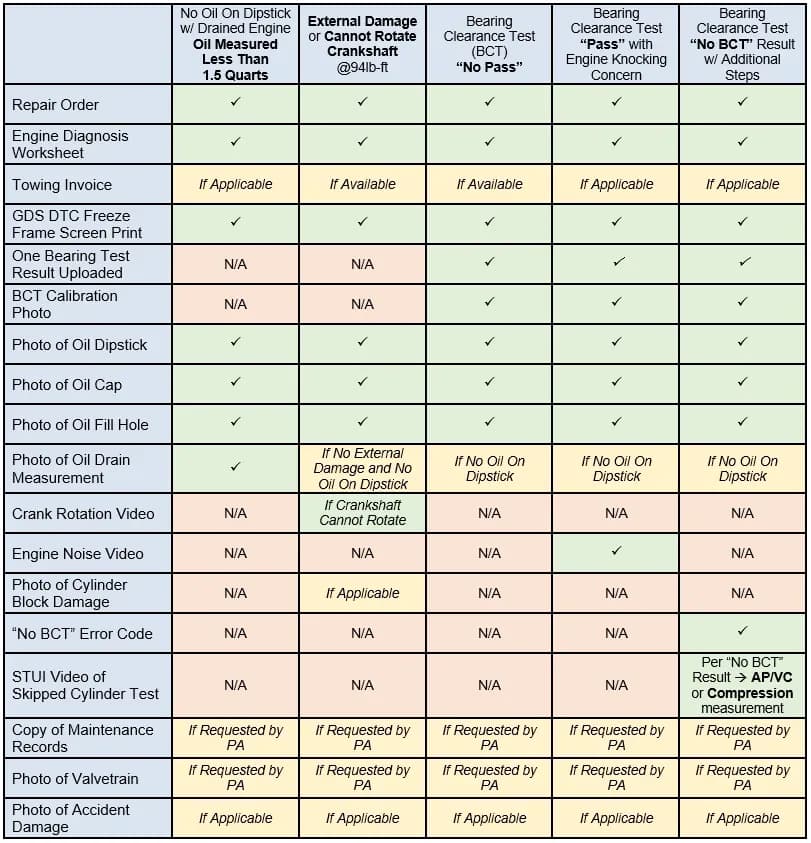
Hyundai has released Technical Service Bulletin (TSB) 22-01-023H-2 to address issues in various models manufactured between 2010 and 2021. This bulletin, identified as Service Campaign T6G, focuses on the inspection and potential replacement of engine bearings. It supersedes TSB 22-01-023H-1 and includes additional information regarding Hybrid Starter Generator (HSG) compatibility for certain 2016 model year Sonata Hybrid/Plug-in (LF HEV/PHEV) vehicles.
Owners of affected Hyundai vehicles may experience the "Check Engine warning lamp illuminated with DTC P1326" and/or an "engine concern/noise related to connecting rod bearing wear or damage." The TSB outlines a comprehensive procedure to inspect the vehicle and, based on the inspection results, either replace the engine or update the engine's Engine Control Unit (ECU) software if a new ROM is available.
Symptoms
Owners of affected 2010-2021 Hyundai vehicles may notice the following symptoms:
- The "Check Engine warning lamp illuminated with DTC P1326" on the dashboard.
- An "engine concern/noise related to connecting rod bearing wear or damage."
These symptoms suggest a potential internal engine problem that requires immediate attention to prevent further damage.
Fault Codes / DTCs
The primary Diagnostic Trouble Code (DTC) associated with this issue is:
- P1326: Engine Bearing Inspection / Engine Replacement
Diagnosis / Trigger Conditions
Diagnosing the root cause of the Hyundai P1326 engine bearing issue involves a multi-step process detailed in TSB 22-01-023H-2. Technicians begin by scanning for DTCs using a Global Diagnostic System (GDS) and capturing freeze frame data for Prior Approval (PA) documentation if any DTCs are present. This is followed by a visual inspection, which includes taking pictures of the dipstick, engine oil filler cap, and the inside of the valve cover oil filler opening. The VIN must be legible in all photographic evidence. Technicians also check for any external lower end damage to the cylinder block.
If no oil is found on the dipstick, an oil drain procedure is performed to measure the drained oil volume. The oil is drained into a 5-quart container (ULINE S-22984 or equivalent) with clear markings to indicate fluid levels. If the drained oil is below 1.5 quarts, additional documentation and PA submission are required. An engine rotation check is then conducted using a crank rotator Special Service Tool (SST) and a torque wrench. The crankshaft should rotate up to 720 degrees (2 full turns) with a torque of 94 lb-ft or less. If it requires more than 94 lb-ft of force or does not rotate, specific documentation and PA submission are necessary.
Finally, a Bearing Clearance Test (BCT) is performed using specialized bearing tools as outlined in TSB 21-EM-004H-1. This test assesses the condition of the engine bearings. The shop air supply must be at least 50 psi minimum, and the AP/VC pressures on the bearing tool must meet specific requirements (AP: 0.1~0.11MPa, VC Digital: -.073 ~ -.083MPa, VC Dial: -73 ~ -83kPa). Calibration procedures for the bearing tool are described in TSB 21-GI-009H.
Special Service Tools and Parts
Several specialized tools and parts are required for the inspection and repair process described in TSB 22-01-023H-2:
- Torque Wrench Socket (Part Number: 09314-3Q100-01): Required for GDI engines if engine replacement is necessary. Refer to TSB 19-FL-001H for detailed usage instructions.
- Injector Combustion Seal Ring Installer (Part Number: 09353-2B000): Replacements can be ordered through Bosch at 1-866-539-4248.
- 5 Quart Container (Part Number: ULINE S-22984): Required to drain oil if necessary. Can be ordered from ULINE at 800-295-5510 or ULINE.com. Alternative containers must have clear quart markings for PA approval.
- 17 mm 12-Point Metric Flank Drive® Reversible Ratcheting Box/ Speed Open-End Combination Wrench (Part Number: Snap-on SRXRM17): An optional tool for unfastening torque converter bolts if the engine cannot rotate.
- Bearing Clearance Tester Set (BEARING TOOL): Includes Test Hose, Main Hose, and Power Supply Cable. One set is provided to dealers, with additional units available for order.
- Spark Plug Rod (M12) (Part Number: KQ231-2T112QQH): For GD and Theta II MPI Hybrid engines, features a smooth upper body.
- Spark Plug Rod (M14) (Part Numbers: KQ231-2T101QQH, KQ231-2T107QQH): For MPI engines, features two machined identification grooves on the upper body.
Important Warnings and Owner Information
Hyundai TSB 22-01-023H-2 contains several critical advisories for technicians and owners:
- Engine Oil Maintenance: "Poor oil maintenance reduces the engine oil lubrication and cooling capacities. As a result, internal engine parts can be damaged resulting in abnormal wear to internal engine parts, excessive carbon deposits, sludge, and other various conditions." Owners are reminded that "Engine oil changes and engine oil level checks are required on a regular basis for all engines." Regular oil level checks and top-ups are recommended prior to the end of an oil change interval.
- Prior Approval (PA) Required: "PA Approval is required for engine replacement." General engine replacement for conditions outside of those contained in this TSB (Service Campaign T6G) are not covered by the campaign.
- Documentation for PA: A picture of lower end damage is required if present. If the engine does not rotate normally, a STUI video including the VIN Plate (at windshield or door jamb) and an attempt to rotate the crankshaft with a torque wrench set to 94 lb-ft is required. The crankshaft rotation torque value must be saved.
- Engine Accessory Belt: If other engine accessory components are seized, technicians must "remove the engine accessory belt prior to completing the engine rotation check."
- Knock Sensor Torque: "Ensure the knock sensor is torqued to specification using a torque wrench. Improper installation can result in DTC codes."
- Torque Converter Installation (Automatic Transmissions): "If the torque converter has moved from the fully inserted position, carefully push inward and rotate the torque converter until the converter is recessed approximately 5/16" - 9/16" (8-14 mm) into the transaxle case when reinstalling the automatic transaxle." Failure to confirm full installation can lead to "oil pump damage resulting in transmission failure."
- Clearing DTC P1326: "Clear DTC P1326 with engine ON. P1326 may reset if it's not cleared with the engine running. Reset engine adaptive values."
Repair Procedure Summary
The repair procedure for the Hyundai P1326 engine bearing issue is detailed through a series of flowcharts within TSB 22-01-023H-2. The process generally involves:
- Initial Inspection: Scan for DTC P1326 using the GDS, capture freeze frame data, and photograph the dipstick, oil filler cap, and engine block for external damage. Ensure the VIN is legible in all photos.
- Oil Drain Procedure: If no oil is on the dipstick, drain and measure the engine oil into a 5-quart container. If the drained oil is below 1.5 quarts, submit PA with required STUI pictures.
- Engine Rotation Check: Attempt to rotate the crankshaft with a crank rotator SST. If it rotates normally (up to 720 degrees), proceed to Flow Chart A. If it requires more than 94 lb-ft of force or does not rotate, proceed to Flow Chart B for further inspection and PA submission.
- Bearing Clearance Test (BCT): Perform the BCT as outlined in TSB 21-EM-004H-1. The results ("Pass," "No Pass," or "No BCT") determine the subsequent steps.
- If the test result is "Pass": Save a screenshot, follow remaining inspection steps, reinstall components, check for DTCs, update the Engine ECM (Campaign 966) if new software is available, and use the appropriate Op Code for "ENGINE INSPECTION."
- If the test result is "No Pass": A PA and Engine Diagnosis Worksheet will be auto-generated and saved in DRAFT. Submit PA for engine replacement approval, follow remaining steps to replace the engine, check for DTCs, update ECM (Campaign 966), and use appropriate Op Codes for "ENGINE INSPECTION" and engine replacement.
- If the test result is "No BCT": This may occur if cylinders were skipped. Save a screenshot, record the error code, follow "Skipped Cylinder STUI Video Submission" steps from TSB 21-EM-004H-1, submit PA for engine replacement, follow remaining steps, check for DTCs, update ECM (Campaign 966), and use appropriate Op Codes.
Engine Replacement Procedure
If engine replacement is required and approved by PA, technicians must follow the published Service Information from the applicable Shop Manual. Key steps include:
- Transferring Components: Take special care when transferring original engine parts, such as the engine knock sensor, to the new engine. The knock sensor must be torqued to 21Nm (15.5 lb-ft).
- GDI Engine Components: For GDI engines, follow TSB 19-FL-001H to remove and reinstall high-pressure fuel system components (GDI High Pressure Pump, Fuel Injectors, Fuel Rail). Replace newly supplied parts from Service Kits, including mounting flange O-rings, various O-rings, seals, and fuel pipes.
- Crankshaft Drive Plate: For certain engines with drill-through type drive plate mounting holes, apply a low/medium strength thread-locking adhesive (e.g., ThreeBond 2403, LOCTITE 200, LOCTITE 204, or LOCTITE 243) to prevent oil seepage. For 2011-2012MY Sonata Hybrid (YF HEV), drive plate bolts must be replaced with P/N 23231-25200 due to crankshaft design changes.
- Required Replacement Parts: If a Service Kit is applicable, replace the Oil Level Rod & Oil Level Guide Assy., Intake Manifold Gasket(s), Exhaust Manifold Gasket, and Fuel Pipe Assembly.
Hybrid Starter Generator (HSG) Compatibility
For 2016MY Sonata Hybrid/Plug-in (LF HEV/PHEV) vehicles produced before April 2015, the Hybrid Starter Generator (HSG) mounting boss type at the cylinder block must be checked. If the existing engine has the "Old" style cylinder block, a new style HSG (P/N 37390-2E930-SJ) compatible with the replacement long block (P/N 21101-2EG15FFF) must be installed. If the existing engine already has the "New" style cylinder block, the existing HSG should be transferred to the replacement long block.
Post-Repair Procedures
After engine replacement, several critical steps ensure proper vehicle operation:
- Cooling System: Reinstall and connect cooling system components, then fill with 50/50 to 70/30 (Water/Anti-Freeze) coolant mixture.
- Engine Crankcase: Fill with the specified initial dry fill engine oil capacity. Temporarily disable the fuel system and crank the engine for several seconds to prime the lubrication system. Recommended oil specifications include 5W-30 Full Synthetic type with API SN/SN+/SP, ILSAC GF4/GF5 or higher service grade.
- Engine Warm-up: Start the engine, warm it up, and begin the cooling system air bleeding process. Check for leaks and adjust the engine oil level to near the "F" mark once warm.
- ECM Update: Refer to TSB 21-01-023H-4 (or later) to update the Engine ECM if new software is available.
- Final Checks: Set customer's audio station presets, relearn the Steering Angle Sensor using the GDS, and "Clear DTC P1326 with engine ON." If not cleared with the engine running, P1326 may reset. Check for other DTCs and perform diagnostic service to ensure no warning lights are present. Reset engine adaptive values using the GDS and perform a short road test to confirm normal vehicle drivability.
Source: NHTSA ID: 10230232
Gallery
22 images
Frequently Asked Questions
- What does DTC P1326 mean for my Hyundai?
- DTC P1326 in your 2010-2021 Hyundai indicates a potential issue with engine bearing wear or damage. This often triggers the Check Engine light and may be accompanied by unusual engine noises, as detailed in Hyundai TSB 22-01-023H-2.
- What should I do if my Hyundai shows DTC P1326?
- If your Hyundai displays DTC P1326 or exhibits engine noise, you should have it inspected by a qualified Hyundai technician. TSB 22-01-023H-2 outlines a specific diagnostic procedure, including oil checks, engine rotation tests, and bearing clearance tests, to determine if an engine replacement or ECU software update is necessary.
- Is engine replacement covered under warranty for DTC P1326?
- Engine replacement for DTC P1326 typically requires Prior Approval (PA) from Hyundai. The TSB specifies that general engine replacement for conditions outside those covered by Service Campaign T6G may not be covered. Always consult your dealer regarding warranty coverage.
- Are there any specific tools required for the P1326 diagnosis?
- Yes, the diagnosis for the Hyundai P1326 engine bearing issue involves several specialized tools, including a Torque Wrench Socket (09314-3Q100-01), an Injector Combustion Seal Ring Installer (09353-2B000), a 17 mm 12-Point Metric Flank Drive® Reversible Ratcheting Box/ Speed Open-End Combination Wrench (Snap-on SRXRM17), and a Bearing Clearance Tester Set (KQ231-2T112QQH, KQ231-2T101QQH, KQ231-2T107QQH).
- Why is engine oil maintenance important for preventing issues like P1326?
- Poor engine oil maintenance significantly reduces the engine oil's lubrication and cooling capacities. This can lead to internal engine damage, including piston ring deposits, oil sludge, excessive wear, and ultimately connecting rod bearing issues that could trigger DTC P1326. Regular oil changes and level checks are crucial for engine health, as highlighted in Hyundai TSB 22-01-023H-2.
Related Articles
2021 Hyundai Tucson Health Check: Engine & Paint TSBs
For the 2021 Hyundai Tucson, there are no reported recalls, owner complaints, or federal investigations. However, owners should be aware of several manufacturer service bulletins (TSBs) addressing engine emissions, potential engine bearing issues, white paint peeling, and an anti-theft ignition…
2021 Hyundai Tucson Emissions Logic Update (9C2)
Hyundai Service Campaign 9C2 addresses elevated engine-out emissions in certain 2021 Hyundai Tucson models by updating the Engine Control Module (ECM) software. This update helps ensure compliance with emissions standards and prevents failed inspections.
2015 Hyundai Sonata GDS Event 1383 Campaign Suspended
Hyundai Motor America has temporarily suspended Service Campaign 9C2, related to software GDS event #1383, for the 2015 Hyundai Sonata (LFA) 2.4L. Vehicles will not show this campaign as open in WebDCS during the suspension period.
2021 Hyundai Tucson GDS Event #1383 Engine Investigation
Hyundai is actively investigating a software-related engine issue, identified as GDS event #1383. While primarily concerning 2015 Sonata 2.4L vehicles, this manufacturer communication is linked by NHTSA to the 2021 Hyundai Tucson, indicating an ongoing review for a resolution.
2010-2021 Hyundai Engine Bearing TSB 26-01-033H
Hyundai Technical Service Bulletin (TSB) 26-01-033H is a critical reference for Op codes and part numbers under Service Campaign T6G. This campaign addresses engine bearing inspection and replacement for various Hyundai models from 2010-2021, often triggered by DTC P1326 and "Abnormal Engine Noise."
Leave a comment
Comments are moderated and may take a moment to appear. Only your first name and the initial of your last name are shown publicly.
Comments
Be the first to comment.