2022 Hyundai ECU and TCU Update for P013E / P0456
Learn about Hyundai Technical Service Bulletin 22-FL-006H, which provides an Engine Control Unit (ECU) and Transmission Control Unit (TCU) software update to resolve diagnostic trouble codes P013E and P0456 in certain 2022 Hyundai Tucson, Santa Fe, Santa Cruz, and Sonata vehicles.
 David Chen2022 Hyundai Tucson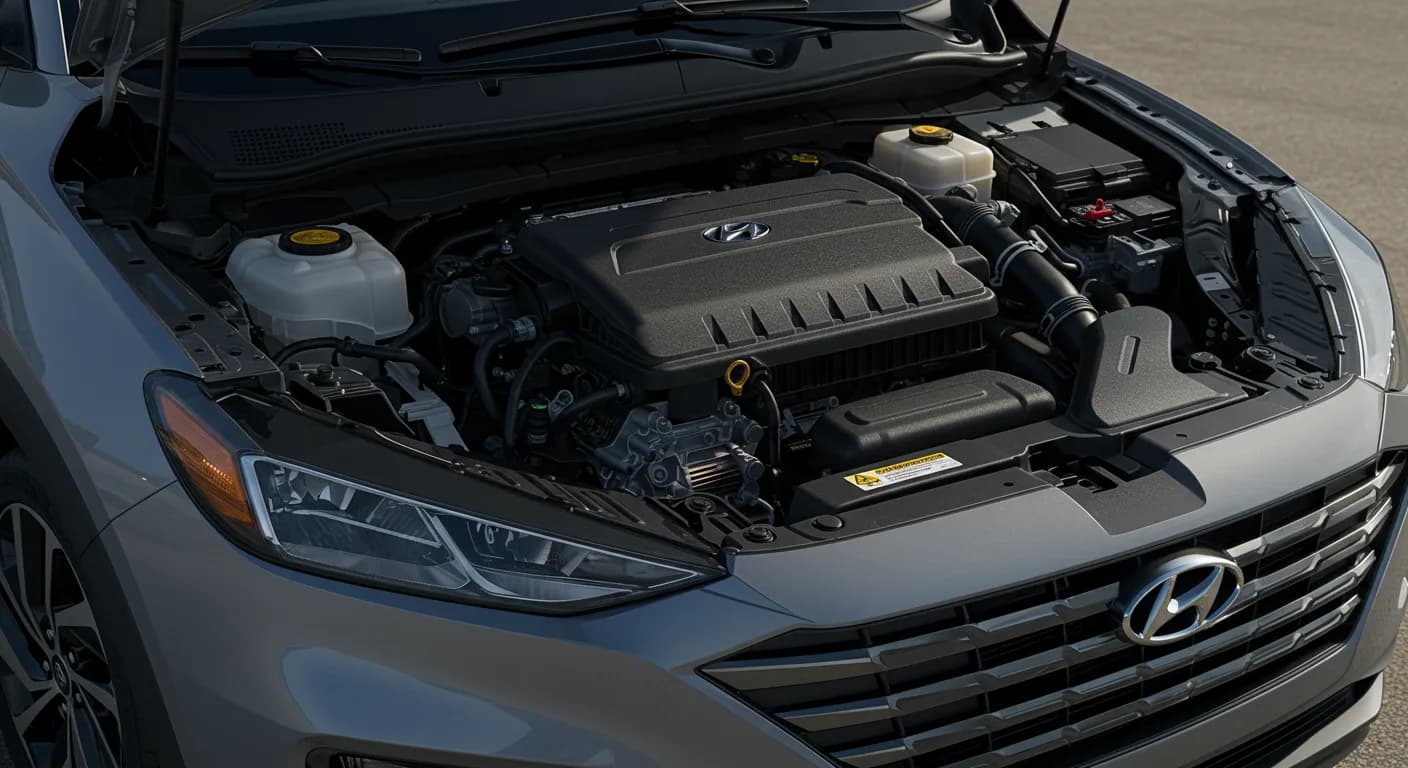
Also applies to
- Hyundai Santa Cruz
- 2022
- Hyundai Santa Fe
- 2022
- Hyundai Sonata
- 2022
Hyundai has issued Technical Service Bulletin (TSB) 22-FL-006H to address specific engine and transmission performance issues in several 2022 models. This bulletin outlines a procedure to update the Engine Control Unit (ECU) and Transmission Control Unit (TCU) software. The update is designed to correct conditions that lead to the illumination of the Malfunction Indicator Lamp (MIL) and the storage of certain diagnostic trouble codes (DTCs).
This software update for the ECU and TCU is applicable to 2022 Hyundai Tucson (NX4A / NX4), Santa Cruz (NXT), Santa Fe (TMa), and Sonata (DN8 / DN8a) vehicles. Specifically, it targets those equipped with the 2.5L GDI engine and 8-Speed transmission. Owners experiencing the symptoms associated with a Hyundai P013E P0456 fault should consult their dealership for this update.
Important Warnings for Owners
Hyundai TSB 22-FL-006H includes critical warnings regarding the vehicle's battery state during the software update process. These models may experience an automatic ignition shutoff if the 12V battery's State of Charge (SOC) falls below 60% after extended time with the ignition on. To prevent ECU update failure, owners are advised to stop and run the engine for at least 20 minutes if a "Battery Warning" is observed at the start of the ECU update attempt. This practice helps ensure the battery is sufficiently charged, as stock vehicles are more prone to low SOC.
Furthermore, technicians are warned about the "GDS-M Vehicle Battery Low Voltage Warning." If the vehicle battery voltage drops below 12 volts, the GDS-M diagnostic tool will trigger this warning, displaying a message such as "Warning! lower Battery Voltage. BATTERY VOLTAGE: 11.7". In such cases, the technician must either connect a fully charged battery jump pack or a GR8 charger in "Power Supply Mode" to continue the update, or exit the software update by selecting "BACK", idle the engine with headlights on for 20 minutes to charge the battery, and then restart the update process.
Symptoms
Owners of affected 2022 Hyundai vehicles may notice their Malfunction Indicator Lamp (MIL) illuminating, indicating a stored diagnostic trouble code. The primary symptoms addressed by this TSB are related to:
- O2 Sensor Delayed Response: This can manifest as issues with the engine's air-fuel mixture control.
- Evaporative System (EVAP) Leak: A very small leak in the EVAP system can trigger the MIL.
- Rough Shift and Hesitation: For certain models, the TCU update specifically targets improving transmission performance, addressing instances of rough shifting and hesitation.
Fault Codes / DTCs
This TSB specifically targets vehicles experiencing the following diagnostic trouble codes:
| Code | Description | Module | Condition |
|---|---|---|---|
| P013E | O2 Sensor Delayed Response - Rich to Lean Bank 1 Sensor 2 | ECU | Indicates a slow response from the oxygen sensor. |
| P0456 | Evaporative System (EVAP) - Very Small Leak | ECU | Detects a minor leak in the vehicle's evaporative emissions system. |
It's also noted that this ECU update incorporates a prior update designed to address DTC P2074.
Diagnosis / Trigger Conditions
The primary trigger for this service action is the presence of DTC P013E or P0456 in the vehicle's Engine Control Unit. For specific models, issues like rough shifting or hesitation in the transmission also indicate the need for the TCU update. Technicians will use the GDS-M diagnostic system to identify the specific software event number applicable to the vehicle's model and engine type. The diagnosis process also involves ensuring the vehicle's 12V battery has sufficient charge to prevent update failures, as indicated by the "GDS-M Vehicle Battery Low Voltage Warning."
Repair Procedure Summary
The repair process for the Hyundai P013E P0456 issue involves updating the ECU and TCU software. The initial step is to perform the GDS ECU and TCU Update in Auto Mode. If the update starts but then fails in Auto Mode, technicians must disconnect the battery cables, touch them together for one minute, and then reconnect them. A battery charger should then be attached, and the update performed in Manual Mode to recover. For detailed instructions on manual mode recovery, technicians are referred to TSB 15-GI-001 (GDS Mobile).
Technicians must select the correct GDS event number for the specific vehicle model and engine type. For ECU updates, events such as 854, 855, 856, and 863 are used, while TCU updates utilize events like 776, 784, 774, and 782. The TSB provides detailed ROM ID tables that list the 'OLD' software versions and their corresponding 'NEW' updated versions for various part numbers and models (e.g., NX4AT THETA3 2.5GDI ECU S/W IMPROVEMENT FOR DTC P013E / P0456). After successfully completing the software update, technicians are required to check for any remaining Diagnostic Trouble Codes and erase them.
Warranty Information
For this service action, claims must be submitted on the Campaign Claim Entry Screen. The operation codes vary by model:
- 20D063R0: Santa Cruz (NXT)
- 20D063R1: Tucson (NX4a/NX4)
- 20D063R2: Sonata (DN8/DN8a)
- 20D063R3: Santa Fe (TMa)
The standard operation time for this ECU + TCU UPGRADE is 0.6 Man-Hours (M/H). The Nature Code for this repair is 13T, and the Cause Code is ZZ3. If a part requires replacement during this service campaign and is still under warranty, a separate claim must be submitted using the same repair order. For parts found to be out of warranty, a Prior Approval request for goodwill consideration is necessary before proceeding with the repair.
Required Tools or Parts
Performing this software update requires the use of the GDS-M diagnostic tool. In cases of low battery voltage, a fully charged battery jump pack or a GR8 charger in "Power Supply Mode" is necessary to ensure a stable power supply during the software update process.
NHTSA ID: 10224497
Frequently Asked Questions
- What does Hyundai TSB 22-FL-006H address?
- Hyundai TSB 22-FL-006H addresses diagnostic trouble codes P013E and P0456, which relate to an O2 sensor delayed response and a very small evaporative system leak, respectively. It also includes an update for rough shifting and hesitation in the transmission for certain models.
- Which Hyundai models are affected by the P013E P0456 ECU and TCU update?
- This ECU and TCU update applies to certain 2022 Hyundai Tucson (NX4/NX4a), Santa Cruz (NXT), Santa Fe (TMa), and Sonata (DN8/DN8a) vehicles equipped with the 2.5L GDI engine and 8-Speed transmission.
- What should I do if my battery warning light comes on during the software update?
- If a battery warning is seen at the start of the ECU update attempt, you should stop and run the engine for at least 20 minutes. This helps ensure the 12V battery's State of Charge (SOC) is above 60% to prevent automatic ignition shutoff and update failure. If a "Warning! lower Battery Voltage. BATTERY VOLTAGE: 11.7" message appears, the update should be paused to charge the battery.
- What is the repair procedure for the Hyundai P013E P0456 issue?
- The repair involves performing a software update for the Engine Control Unit (ECU) and Transmission Control Unit (TCU) using the GDS-M diagnostic system. The update is initially attempted in Auto Mode, but if it fails, a manual update procedure involving battery cable cycling and charging is required, followed by clearing any stored DTCs.
- How long does the repair take and is it covered under warranty?
- The repair has an estimated operation time of 0.6 Man-Hours. It is covered under warranty, and claims should be submitted on the Campaign Claim Entry Screen using specific operation codes (e.g., 20D063R1 for Tucson). If a part replacement is needed and the part is out of warranty, prior approval for goodwill consideration is required.
Related Articles
2021-2024 Hyundai Santa Fe / Tucson DTC U028700 EOP
Hyundai has issued Technical Service Bulletin (TSB) 26-AT-002H for certain 2021-2024 Santa Fe and Tucson vehicles. This TSB addresses diagnostic trouble code U028700, indicating a "Lost Communication With Trans Fluid Pump Module," which can cause the Idle Stop & Go (ISG) system to become…
2022 Hyundai Tucson Inoperable Horn Warranty Extension
Hyundai has issued a warranty extension for certain 2022 Tucson (NX4A) vehicles experiencing an inoperable horn. This issue, detailed in TSB 26-BE-004H, is caused by foreign substances oxidizing internal horn parts. Coverage is extended to 10 years/120,000 miles.
2022 Hyundai Tucson Inoperative Horn TSB 26-BE-004H
Hyundai has issued Technical Service Bulletin 26-BE-004H for certain 2022 Tucson (NX4A) vehicles experiencing an inoperative horn. This TSB extends warranty coverage to 10 years/120,000 miles for horn replacement due to internal oxidation from foreign substances.
2021-2022 Hyundai Anti-Theft Ignition Cylinder Protector TSB
Hyundai has issued Technical Service Bulletin 25-01-089H (Customer Satisfaction Campaign P33) to address vehicle theft concerns by installing an anti-theft ignition cylinder protector and anti-theft decals on various 2021-2022 models.
2021-2022 Hyundai Anti-Theft Ignition Cylinder Protector Campaign P33
Hyundai has launched Customer Satisfaction Campaign P33 for 2021-2022 models, offering a free anti-theft ignition cylinder protector and decals. This hardware upgrade, detailed in TSB 25-01-089H, is available upon customer request to counter social media theft methods.
Leave a comment
Comments are moderated and may take a moment to appear. Only your first name and the initial of your last name are shown publicly.
Comments
Be the first to comment.