2021-2026 Honda CR-V Oil Leak at Timing Chain Tensioner
Honda Service Bulletin 25-077 addresses oil leaks from the timing chain tensioner inspection cover in 2021-2026 CR-V 1.5L Turbo models. This issue is often caused by insufficient sealant adhesion. Diagnosis involves a special leak detection kit, followed by resealing or replacing the cover.
 David Chen2024 Honda CR-V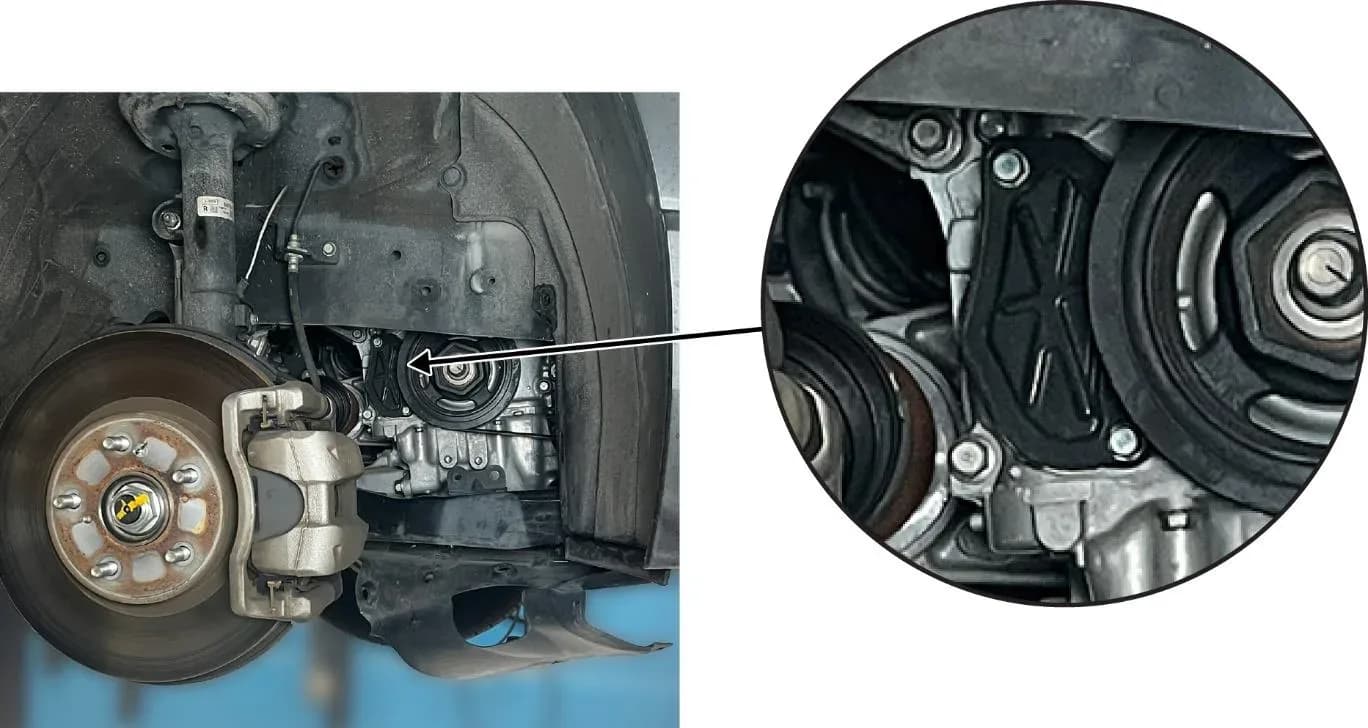
Também se aplica a
- Honda CR-V
- 2021, 2022, 2023, 2025, 2026
Honda has released Service Bulletin 25-077 to address an oil leak issue affecting 2021-2026 CR-V models equipped with the 1.5L Turbo engine. This bulletin provides detailed diagnostic and repair procedures for technicians to resolve the Honda CR-V oil leak originating from the timing chain tensioner inspection cover.
The primary cause identified for this Honda CR-V oil leak is insufficient sealant adhesion on the inspection cover. Owners who notice oil leaks in this area should have their vehicle inspected by an authorized Honda dealer.
Symptoms
The most direct symptom of this issue is an "Oil leak at timing chain tensioner inspection cover."
Diagnosis
To accurately identify the source of the oil leak, technicians are instructed to perform an engine oil leak diagnostic using the specialized Honda Leak Detection Kit. This process involves several steps:
- With the engine off and the engine cover removed, technicians will use specific pliers to pinch off the breather tube and the PCV tube.
- The engine oil dipstick is removed.
- An appropriately sized fitting is inserted into the engine oil level dipstick hole.
- An air pump hose is connected to the fitting and then to the supplied air pump.
- The air pump is turned on.
- After two minutes, the crankcase's air pressure is confirmed by pulling out the fitting and listening for a pressure release. If no pressure release is heard, technicians must check for properly pinched or blocked hoses and repeat the process.
- The right front wheel is removed, and the underbody splash shield is pulled down to access the tensioner inspection cover.
- The suspected engine oil leak area is sprayed with soapy water.
- Technicians then look for air bubbles, which confirm the presence and location of the leak.
Repair Procedure Summary
If the leak is confirmed at the Cam Chain Tensioner Inspection Cover, the following steps are taken:
- The Timing Chain Tensioner Inspection Cover is removed.
- Any old sealant is thoroughly removed from both the Timing Chain Cover and the Inspection Cover using a scouring pad.
- A 2.5 mm bead of new sealant, specifically Hondabond HT Silicone Gasket (Part Number 08718-0004), is applied to the Inspection Cover. It is crucial that the cover is reinstalled within four minutes of sealant application.
- The cover is reinstalled, and the bolts are torqued to 9 lb-ft.
- Finally, the Engine Oil Leak Detection Kit is removed, and all previously removed parts are reinstalled in reverse order.
Required Tools or Parts
To perform this repair, specific tools and materials are necessary:
- LEAK DETECTION KIT (Part Number: 07AAJ-5A2A100): This is a special tool auto-shipped to Honda dealers. Additional kits can be ordered through the Honda Tool and Equipment Program by calling (888) 424-6857 or searching "engine oil leak detection kit" on the iN system.
- Hondabond HT Silicone Gasket (Part Number: 08718-0004): One tube is sufficient for approximately five repairs.
- Cover, Chain Case (Part Number: 11412-59B-000): This part should only be ordered if the original cover is damaged and cannot be reused.
Warranty Claim Information
For warranty claims related to this Honda CR-V oil leak, technicians should use the following information:
- Operation Number 1107A3: For performing the engine oil leak diagnosis and resealing the timing chain inspection cover. Flat Rate Time: 0.6 hours. Defect Code: 07408. Symptom Code: 05011. Template ID: A25077A. Failed Part Number: 11412-59B-000.
- Operation Number 1101KH: For performing the engine oil leak diagnosis and replacing the timing chain inspection cover. Flat Rate Time: 0.6 hours. Defect Code: 07408. Symptom Code: 05011. Template ID: A25077B. Failed Part Number: 11412-59B-000.
Important Warnings
Honda emphasizes that the information in this bulletin is intended for use exclusively by skilled technicians who possess the proper tools, equipment, and training required to correctly and safely maintain vehicles. These procedures are not recommended for
Galeria
2 imagens
Frequently Asked Questions
- What is Honda Service Bulletin 25-077 about?
- Honda Service Bulletin 25-077 addresses an oil leak that can occur at the timing chain tensioner inspection cover in certain 2021-2026 Honda CR-V models with 1.5L Turbo engines. The bulletin provides diagnostic and repair instructions for technicians.
- Which Honda CR-V models are affected by the oil leak at the timing chain tensioner inspection cover?
- This oil leak issue, detailed in TSB 25-077, applies to Honda CR-V models from the 2021 to 2026 model years that are equipped with the 1.5L Turbo engine.
- What causes the Honda CR-V oil leak described in TSB 25-077?
- The primary cause of the oil leak at the timing chain tensioner inspection cover is identified as insufficient sealant adhesion. This allows oil to seep past the cover, leading to the leak.
- How is the oil leak at the timing chain tensioner inspection cover diagnosed and repaired?
- Diagnosis involves using a special Honda Leak Detection Kit to pressurize the crankcase and identify the leak location with soapy water. The repair procedure, outlined in Service Bulletin 25-077, typically involves removing the inspection cover, cleaning off old sealant, applying new Hondabond HT Silicone Gasket, and reinstalling the cover, or replacing it if damaged.
- What are the warranty claim details for this repair?
- For warranty claims, technicians will use Operation Number 1107A3 for resealing or 1101KH for replacing the cover, both with a 0.6-hour flat rate. The Defect Code is 07408, and the Symptom Code is 05011, with Failed Part Number 11412-59B-000.
Related Articles
2024-2026 Honda Civic, CR-V, HR-V A/C Compressor Seizure
American Honda Motor Co., Inc. (AHM) is actively investigating A/C compressor seizure issues in specific 2024-2026 Honda Civic, CR-V, and HR-V vehicles. If your A/C is not blowing cold air and a technician finds a seized compressor, your vehicle may qualify for a special inspection.
2024-2026 Honda Civic, CR-V, HR-V A/C Compressor Seizure Investigation
American Honda Motor Co., Inc. (AHM) is actively searching for specific 2024-2026 Honda Civic, CR-V, and HR-V vehicles experiencing A/C compressor seizure. If your vehicle's A/C is "not blowing cold air" and the compressor is seized, Honda wants to inspect it before any repairs are made.
2022-2026 Honda Civic/CR-V/HR-V Front Wiper Motor Inop
American Honda Motor Co., Inc. (AHM) is investigating customer complaints regarding inoperative (inop) or misaligned front wiper motors in certain 2022-2026 Honda Civic, 2023-2026 Honda CR-V, and 2023-2026 Honda HR-V vehicles. AHM is requesting dealers to identify and report qualifying vehicles…
2023-2024 Honda CR-V Head Cover Oil Leak Investigation
American Honda Motor Co., Inc. (AHM) is actively searching for specific 2023-2024 FHEV Accord and CR-V vehicles experiencing an oil leak from the head cover gasket. This investigation aims to understand the root cause before any repairs are attempted.
2024-2026 Honda Civic, CR-V, HR-V A/C Compressor Seizure
Honda is actively collecting data on A/C compressor seizures in 2024-2026 Civic, CR-V, and HR-V vehicles experiencing a lack of cold air. This initiative, identified as 'A/C Compressor Seizure (ACTION REQUIRED)', aims to understand the root cause of the issue by examining specific parts.
Leave a comment
Comments are moderated and may take a moment to appear. Only your first name and the initial of your last name are shown publicly.
Comments
Be the first to comment.