2016-2021 Honda Civic A/C Compressor Shaft Seal Leak TSB 23-012
Honda Service Bulletin 23-012 describes a common issue in 2016-2021 Honda Civic and Civic Type R models where the A/C system fails to blow cold air due to an oil/refrigerant leak from the A/C compressor main shaft seal. This bulletin outlines the inspection and repair procedure for technicians.
 Ahmet Topcu2021 Honda Civic Type R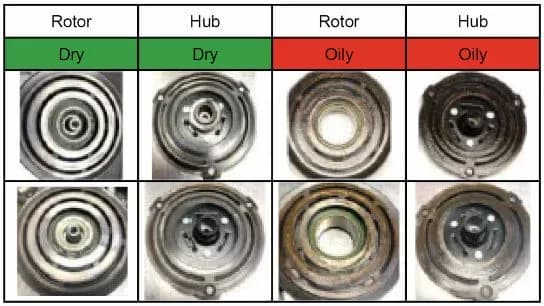
Also applies to
- Honda Civic
- 2021
Owners of 2016-2021 Honda Civic and Civic Type R vehicles may experience their air conditioning system failing to blow cold air. This issue is addressed by Honda Service Bulletin 23-012, which identifies the root cause as an oil/refrigerant leak from the A/C compressor main shaft seal. This bulletin provides technicians with a detailed inspection and repair procedure to resolve the problem.
Symptoms
The primary symptom reported by customers is the "A/C not blowing cold air." This indicates a loss of refrigerant, often accompanied by an oil residue near the A/C compressor.
Possible Cause
The underlying cause of the A/C not blowing cold air is identified as an oil/refrigerant leak originating from the A/C compressor main shaft seal. This leak allows refrigerant to escape, compromising the A/C system's ability to cool.
Corrective Action
Honda Service Bulletin 23-012 directs technicians to perform a thorough inspection procedure. If a leak from the A/C compressor main shaft seal is confirmed during this inspection, the corrective action involves replacing the compressor shaft seal.
Repair Procedure Summary
The repair process outlined in Honda Service Bulletin 23-012 is comprehensive and requires specialized tools and expertise. It begins with an initial inspection for oil leaks around the A/C compressor's clutch area, felt washer, and a sniffer test to detect refrigerant leaks. If a leak is confirmed, the following steps are performed:
- Refrigerant Recovery: The A/C refrigerant is recovered from the system.
- Hose Disconnection: Discharge and suction hoses are disconnected, and port plugs are immediately used to prevent moisture and dust contamination of the A/C compressor.
- Compressor Removal: The A/C compressor is carefully removed from the vehicle, taking care not to damage radiator fins.
- Disassembly: The compressor clutch is disassembled, including the removal of shims, the felt washer, the pulley, and the seal C-ring.
- Cleaning: The compressor's bore and shaft are thoroughly cleaned with a lint-free cloth. Compressed air is explicitly not to be used to prevent debris from entering the compressor.
- Seal Extraction: Specialized tools, including a press tool, press adapter, cylinder tool, and extractor tool, are used to carefully remove the old A/C compressor main shaft seal.
- Inspection and Lubrication: The compressor shaft bore and seal guide are inspected for any damage or contamination. The new seal's outer surface, seal guide, and bore are lubricated with new POE compressor oil.
- New Seal Installation: The new A/C compressor main shaft seal is installed using the seal guide tool and press adapter, ensuring it is correctly oriented (metal side upwards) and properly seated about 5 mm below the bore.
- C-Ring Installation: The new seal C-ring is inserted with its rounded edge facing down into the bore.
- Final Seating: The press tool is used to fully seat the new seal and C-clip until a sound or vibration indicates the C-clip is fully set.
- Surface Cleaning: The pulley and A/C compressor friction surfaces are cleaned with contact cleaner or a non-petroleum solvent.
- Reassembly: The pulley, new pulley outer C-ring, new felt washer, clutch plate, spacers, and clutch center flange bolt are reinstalled, with the bolt torqued to 17 N·m (13 lb-ft).
- Oil and Refrigerant: The compressor is filled with one complete can of POE compressor oil, and the A/C system is filled with the correct amount of refrigerant after a vacuum check.
- System Test: The vehicle is run for ten minutes with the A/C system set to MAX COOL and the engine at 1,500-2,000 RPM.
- Final Leak Check: A final leak check is performed with a calibrated sniffer around the shaft seal and O-ring areas.
If a leak is detected after the first seal replacement, the seal is replaced again. If a leak persists after a second seal replacement, the entire compressor assembly must be replaced.
Required Tools or Parts
To perform the repair described in Honda Service Bulletin 23-012, specific parts and a special tool are required:
- Seal Set Assembly Kit: Contains Bolt, Washer Set, Pulley C-Ring, Felt Washer, Shaft Seal, C-Ring Seal, Suction Port Plug, Discharge Port Plug. Part Number: 38918-64A-318 (Quantity: 1)
- O-Ring (1/2"): Part Number: 80872-SN7-003 (Quantity: 1)
- O-Ring (5/8"): Part Number: 80871-SN7-003 (Quantity: 1)
- POE Compressor Oil: Part Number: 38899-RLV-A01 (Quantity: 1)
- 6CVC Seal Replacement Kit (Special Tool): Part Number: 07AAC-5AAA1Z0 (Quantity: 1) - This tool kit was auto-shipped to dealers in December 2022.
Important Warnings
Honda emphasizes several critical points for technicians and owners:
- Technician-Only Repair: "The information in this bulletin is intended for use only by skilled technicians who have the proper tools, equipment, and training to correctly and safely maintain your vehicle. These procedures should not be attempted by 'do-it-yourselfers,' and you should not assume this bulletin applies to your vehicle, or that your vehicle has the condition described. To determine whether this information applies, contact an authorized Honda automobile dealer."
- Safety Precaution: "Chance for fluids to enter eyes and/or hands which can cause injury. Use safety glasses and rubber gloves."
- Contamination Prevention: Do not use compressed air during cleaning, as it can introduce debris. Also, avoid touching the center of the new seal with bare hands to prevent cross-contamination of the A/C refrigerant system.
- Radiator Protection: Be careful not to damage the radiator fins when removing the A/C compressor.
- Persistent Leak: "If a leak is detected, replace the seal again. After a second seal is replaced, if a leak is detected, then replace the compressor assembly."
Warranty Claim Information
Standard warranty procedures apply for this repair. The following details are provided for warranty claims:
- Operation Number: 614130
- Description: AC compressor seal replacement (includes inspection)
- Flat Rate Time: 1.4 hr
- Defect Code: 07408
- Symptom Code: 03217
- Template ID: A23012A
- Failed Part Number: 38810-5BA-A03
- Operation Number: 620025
- Description: Evacuate and recharge
- Flat Rate Time: 0.7 hr
Source: NHTSA ID 10234575
Gallery
40 images
Frequently Asked Questions
- What are the symptoms of an A/C compressor shaft seal leak in a Honda Civic?
- The primary symptom of a Honda Civic A/C compressor shaft seal leak is the A/C system not blowing cold air. This indicates a loss of refrigerant from the system.
- Which Honda Civic models are affected by Service Bulletin 23-012?
- Honda Service Bulletin 23-012 applies to 2016-2021 Honda Civic models with 1.5T and 2.0 engines, and 2017-2021 Honda Civic Type R models with 2.0T engines.
- What is the repair for the Honda Civic A/C compressor shaft seal leak?
- The repair, as detailed in Honda Service Bulletin 23-012, involves a detailed inspection, recovery of refrigerant, removal and disassembly of the A/C compressor, replacement of the main shaft seal using specialized tools, and then reassembly and recharging of the A/C system.
- Can I perform this A/C compressor shaft seal repair myself?
- Honda explicitly states that this repair procedure is intended for skilled technicians with proper tools and training and should not be attempted by 'do-it-yourselfers' due to its complexity and the need for specialized equipment.
- What specific parts are needed for the A/C compressor shaft seal repair?
- Key parts include the Seal Set Assembly Kit (Part Number 38918-64A-318), O-Rings (80872-SN7-003, 80871-SN7-003), and POE Compressor Oil (38899-RLV-A01). A special 6CVC Seal Replacement Kit (07AAC-5AAA1Z0) is also required for the repair.
Related Articles
2021 Honda Civic Type R P0304 Misfire TSB 25-062
Honda has issued Service Bulletin 25-062 for 2021 Civic Type R vehicles experiencing a 'Misfire No. 4 Cylinder' and diagnostic trouble code P0304. This issue is caused by water entering the hood scoop, leading to corrosion of the ignition coil, plug tube, and spark plug.
2021 Honda Civic Type R Misfire DTC P0304
Honda Service Bulletin 25-062 details a common issue in the 2021 Honda Civic Type R where water from the hood scoop can lead to corrosion in the No. 4 spark plug hole, causing a misfire and triggering DTC P0304. This bulletin outlines inspection and repair procedures, including potential cylinder…
2021 Honda Civic A/C Compressor Shaft Seal Leak Warranty
Honda has issued Service Bulletin 23-039, extending the warranty for A/C compressor shaft seal leaks on certain 2021 Civic models. This issue stems from new refrigerant and oil requirements, which can cause the seal to swell and leak. Owners will be notified and eligible vehicles will receive a…
2021 Honda Civic Type R A/C Condenser Warranty
Honda has issued Service Bulletin 21-014, extending the warranty for the A/C condenser on 2021 Civic Type R vehicles to 10 years/unlimited miles due to potential manufacturing defects causing refrigerant leaks.
2021 Honda Civic A/C Compressor Shaft Seal Leak TSB 23-039
American Honda has issued Service Bulletin 23-039, extending the warranty for the A/C compressor shaft seal on 2021 Honda Civic models. This addresses potential leaks caused by new refrigerant and oil requirements, offering a 10-year, unlimited mileage warranty from the original purchase date.
Leave a comment
Comments are moderated and may take a moment to appear. Only your first name and the initial of your last name are shown publicly.
Comments
Be the first to comment.