2023-2026 BMW Emissions Recall 26E-A01 OBD Update
BMW has announced Emissions Recall 26E-A01, a voluntary emissions recall for certain 2023-2026 models. This recall addresses an issue where an implementation error in OBD diagnostics can prevent stored fault memory codes (DTCs) and the Malfunction Indicator Lamp (MIL) from clearing.
 Marcus Weber2026 BMW X5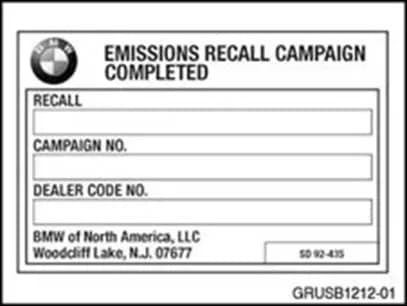
También aplica a
- BMW 230i
- 2023–2026
- BMW 530i
- 2023–2026
- BMW 740i
- 2023–2026
- BMW X1
- 2023–2026
- BMW X2
- 2023–2026
- BMW X3
- 2023–2026
- BMW X5
- 2023–2025
- BMW X6
- 2023–2026
- BMW X7
- 2023–2025
- BMW XM
- 2023–2025
▸ Mostrar 4 más▾ Mostrar menos
Why This Matters
BMW AG is conducting a Voluntary Emissions Recall, identified as EMISSIONS RECALL 26E-A01 (also known as SIB 12 03 26), for certain Model Year 2023-2026 BMW vehicles. This recall is crucial because an error in the On-Board Diagnostics (OBD) system can lead to persistent fault memory codes (DTCs) and an illuminated Malfunction Indicator Lamp (MIL) or "check engine" light, even after a repair has been completed. This condition does not comply with statutory OBD specifications, which are in place to ensure proper emissions control and vehicle performance.
What's Being Recalled
This recall specifically targets an implementation error within the OBD diagnostics of the vehicle's control units. This error, in rare cases, prevents the automatic deletion of stored fault memory codes (DTCs) and the MIL warning light, even when the original malfunction has been rectified. The underlying hardware is not faulty; rather, it's a software issue affecting how the vehicle reports and clears diagnostic trouble codes.
How to Check if Your Vehicle is Affected
Vehicles requiring this campaign will be marked as "Open" when checked in BMW's systems, including AIR, AWP, Campaign Summary, or Warranty Vehicle Inquiry. BMW dealers can verify if your specific vehicle is part of this BMW emissions recall OBD by checking their inventory campaign details (ICD) under ROSS.
Manufacturer's Remedy
The correction for this BMW emissions recall OBD involves programming the vehicle's control units. This procedure will update the software to correctly manage OBD diagnostics, ensuring that stored fault memory codes (DTCs) and the MIL warning light clear automatically once the underlying issue is resolved. The programming is performed via ISTA (Integrated Service Technical Application).
Repair Procedure Summary:
- Connect a battery charger to the vehicle to maintain stable voltage during programming.
- Connect the programming system (ISTA 4) to the vehicle.
- Determine the necessary measures plan.
- Accept and execute the entire measures plan to program and encode the control units, activating them if necessary.
- Follow any instructions on the rework list.
- Depending on the rework list, perform a vehicle test and clear any remaining fault memory.
Important Warnings and Software Requirements
- Programming Lock: If your vehicle has Wave-01 software and an I-level of 25-03 or older, a programming lock may be active. To resolve this, programming should be executed with the backup I-level 25-11-5xx to deactivate the lock. Afterward, a new measures plan should be calculated, and programming should proceed at I-level 26-03-530 or higher.
- Required Software: ISTA 4.58.2x with the installed service data package is mandatory for this programming and encoding procedure.
- Required I-levels: The programming must achieve specific I-levels or later versions, including:
- I-level G045-26-03-532 or later
- I-level G070-26-03-530 or later
- I-level S18A-26-03-532 or later
- I-level U006-26-03-530 or later
Labeling Requirements
After the vehicle has been checked and corrected, a special "Emissions Recall Campaign Completed Label" (SD 92-435) must be obtained. The Recall name, Recall number, and center code (5 digits) must be legibly printed on this label. This label is then affixed to the right (passenger) rear side of the hood in the engine compartment, near the windshield. For California centers, an executed orange "Vehicle Emission Recall - Proof of Correction" certificate (SD92-084) must also be provided to the customer for vehicles registered in California.
Claim Information for Dealers
Dealers will process this recall under specific labor operation codes. The Repair Code for this action is 0099020300. Various labor operations are available depending on whether the repair is a Remote Software Upgrade (RSU) or involves vehicle programming and encoding, and if the vehicle is already at the target integration level. Dealers should refer to SI B10 02 15 for label ordering information and SI B01 01 20 or SI B01 07 20 for documentation procedures.
What Owners Should Do
If you own a 2023-2026 BMW model, especially if you've experienced persistent fault codes or an MIL warning light that won't clear, contact your authorized BMW dealership. They can check if your vehicle is affected by EMISSIONS RECALL 26E-A01 and perform the necessary software update to ensure your vehicle complies with emissions regulations and functions correctly.
Source: NHTSA ID: 11030061
Galería
1 imagen
Frequently Asked Questions
- What is BMW Emissions Recall 26E-A01?
- BMW Emissions Recall 26E-A01 is a voluntary recall addressing a software error in the On-Board Diagnostics (OBD) system of certain 2023-2026 BMW vehicles. This error can prevent stored fault memory codes (DTCs) and the Malfunction Indicator Lamp (MIL) from clearing, even after a repair has been performed.
- Which BMW models are affected by the Emissions Recall 26E-A01?
- The recall affects various 2023-2026 BMW models, including the X5, X3, 530i, 740i, X1, X2, X6, 230i, XM, and X7, produced between January 14, 2022, and September 16, 2025. Your BMW dealership can confirm if your specific vehicle is included.
- What is the fix for the BMW emissions recall OBD issue?
- The fix involves programming the vehicle's control units using BMW's ISTA system to update the software. This update ensures that OBD fault codes and the MIL warning light clear correctly once any underlying malfunction is resolved, bringing the vehicle into compliance with statutory OBD specifications.
- Will I receive a notification for this BMW emissions recall OBD update?
- BMW is conducting this as a voluntary emissions recall. Your dealership can check if your vehicle is affected. If it is, they will perform the necessary software update free of charge.
- What are the specific I-levels required for the software update?
- The programming must achieve I-levels such as G045-26-03-532, G070-26-03-530, S18A-26-03-532, or U006-26-03-530, or later versions, depending on the specific vehicle model.
Related Articles
2024-2026 BMW X5/X7 Rear Seat Stuck When Folded
If your 2024-2026 BMW X5 or X7 second-row seat is stuck in the folded position and unresponsive to switch buttons, BMW Service Information Bulletin SIB 52 01 26 details the causes and a no-parts-required repair procedure.
2025-2026 BMW Multifunction Display Black Screen SIB 65 28 25
BMW SIB 65 28 25 addresses multifunction display issues like intermittent or permanent black screens and non-functional head unit features in various 2025-2026 models with HU-H4, HU-H5, or HU-H6 head units.
2025-2026 BMW Infotainment Software Issues TSB SIB 65 27 25
BMW has released Service Information Bulletin SIB 65 27 25 to address various infotainment software issues in 2025-2026 models equipped with HU-H4, HU-H5, or HU-H6 head units. Symptoms include head unit resets, delayed startup, navigation problems, Bluetooth issues, and missing displays. The fix…
2025-2026 BMW Head Unit Software Issues TSB SIB 65 27 25
BMW has issued Technical Service Bulletin SIB 65 27 25 to address various software-related issues affecting the head unit (infotainment system) in 2025-2026 models. Symptoms include resets, delayed startup, and problems with navigation, Bluetooth, and audio.
2026 BMW X5 Expansion Tank Return Bulletin TEC808
BMW Parts Bulletin C32-1125-0660 (TEC808) addresses the inspection and return of specific expansion tank part number 17 13 8 689 765 for 2026 BMW X5, 740i, 530i, X7, and X6 models. Affected parts have index 1 or 8 inside the plastic screw.
Leave a comment
Comments are moderated and may take a moment to appear. Only your first name and the initial of your last name are shown publicly.
Comments
Be the first to comment.