2021-2025 Audi A3/S3/RS3/Q3 Tire Pressure Warning
Audi Technical Service Bulletin 2075088/1 addresses a common issue in 2021-2025 Audi A3, S3, RS3, and Q3 models where a 'tire pressure warning' appears despite no actual pressure loss. The TSB details how dirt or grease on ABS speed sensors can cause distorted signals, leading to false warnings…
 Ahmet Topcu2025 Audi S3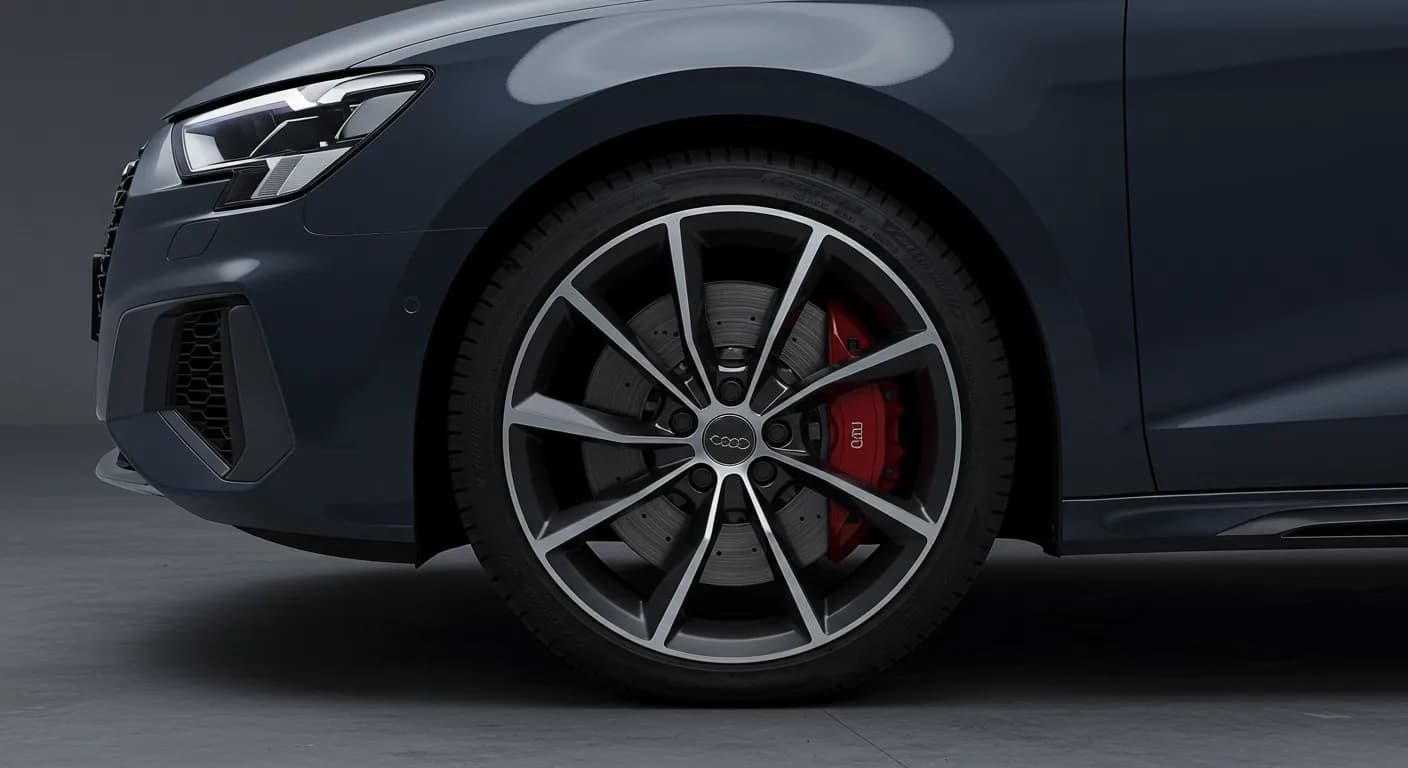
Also applies to
- Audi A3
- 2022–2025
- Audi Q3
- 2021–2025
- Audi RS 3
- 2022–2025
- Audi S3
- 2022–2024
Audi has issued Technical Service Bulletin (TSB) 2075088/1 to address a specific concern where a "tire pressure warning" appears in the instrument cluster of certain 2021-2025 Audi A3, S3, RS3, and Q3 models. This warning occurs even when there is no actual loss of tire pressure, leading to unnecessary concern for drivers. This TSB provides essential guidance for technicians on accurately diagnosing and effectively resolving this particular issue, ensuring that owners searching for "Audi tire pressure warning" can find relevant and actionable information.
Symptoms
Owners of the affected Audi vehicles frequently report seeing a persistent or recurring "tire pressure warning" message displayed prominently in the instrument cluster. A key characteristic of this problem is that the warning appears despite all tires maintaining their correct and recommended pressure levels. Furthermore, the warning often reappears shortly after the tire pressures have been manually reset or stored within the vehicle's system, indicating an underlying fault rather than a genuine pressure drop. This intermittent or constant false "Audi tire pressure warning" can be both confusing and inconvenient for drivers.
Fault Codes / DTCs
When this condition is present, diagnostic scans performed by workshop technicians typically reveal Diagnostic Trouble Codes (DTCs) that are directly related to the tire pressure warning. These DTCs are stored specifically within the Anti-lock Braking System (ABS) control unit. Although TSB 2075088/1 does not list specific DTCs by their alphanumeric codes, it confirms that the presence of these codes signifies an anomaly within the tire pressure monitoring system, triggered by the distorted signals from the ABS sensors.
Diagnosis and Trigger Conditions
The technical background detailed in TSB 2075088/1 provides a clear explanation for the occurrence of the false "tire pressure warning." The primary cause is identified as the accumulation of dirt, foreign objects, or grease on the ABS speed sensors or their corresponding sensor rings, which are located on the wheel bearings. Such contamination leads to distorted signals being transmitted by the ABS speed sensors. This signal distortion prevents the vehicle's tire pressure monitoring system, which relies on ABS sensor data, from accurately adapting tire pressure readings after they have been stored. Consequently, the erroneous warning message reappears after the vehicle has been driven for a short distance.
Repair Procedure Summary
The recommended service procedure outlined in TSB 2075088/1 for resolving the "Audi tire pressure warning" involves a meticulous inspection and thorough cleaning of the implicated components. Technicians are instructed to carefully examine both the ABS speed sensors and the sensor rings located on the wheel bearings for any signs of foreign objects, excessive grease, or accumulated dirt. It is crucial that all identified contaminated components are meticulously cleaned to restore proper signal transmission. Following this comprehensive cleaning process, any Diagnostic Trouble Codes (DTCs) related to the tire pressure warning that are stored in the ABS control unit must be erased to clear the system. The TSB notes that no production changes have been implemented to address this issue, meaning the solution focuses on maintenance and cleaning rather than component replacement.
Important Warnings for Owners and Technicians
Audi has included a critical "NOTICE" within TSB 2075088/1, emphasizing that this repair should only be performed under specific conditions. Technicians must first successfully reproduce the customer's reported complaint and ensure that all specified criteria, including the exact model, year, chassis number, engine type, and other vehicle-specific details, are precisely met. Failure to confirm these conditions before proceeding with the repair may result in the problem persisting or recurring, leading to repeat service visits. Furthermore, Audi explicitly states that in such instances, they reserve the right to reject warranty claims and charge back the cost of any parts or labor involved. This highlights the importance of accurate diagnosis before undertaking the cleaning procedure.
Warranty Information
For dealerships processing warranty claims related to this Technical Service Bulletin, Audi of America (AoA) has provided specific accounting instructions. The service numbers designated for this repair include 4526 for the front sensor ring, 4527 for the rear sensor ring, 4511 for the front speed sensor, and 4515 for the rear speed sensor. The appropriate damage code to be used when submitting these warranty claims is 010. This ensures proper tracking and reimbursement for the service performed.
Frequently Asked Questions
- What is Audi TSB 2075088/1 about?
- Audi Technical Service Bulletin 2075088/1 addresses a common issue where a "tire pressure warning" falsely appears in the instrument cluster of certain 2021-2025 Audi A3, S3, RS3, and Q3 models, even when tire pressures are correct.
- What causes the false "tire pressure warning" in my Audi?
- According to TSB 2075088/1, the false "tire pressure warning" is typically caused by dirt, foreign objects, or grease accumulating on the ABS speed sensors or their sensor rings on the wheel bearings, which distorts their signals.
- How is the "tire pressure warning" issue resolved according to this TSB?
- The resolution involves technicians carefully inspecting and thoroughly cleaning the ABS speed sensors and sensor rings. After cleaning, any related Diagnostic Trouble Codes (DTCs) stored in the ABS control unit must be erased.
- Are there specific fault codes associated with this Audi tire pressure warning issue?
- TSB 2075088/1 states that DTCs related to the tire pressure warning are stored in the ABS control unit, but it does not list specific alphanumeric codes. The presence of these general DTCs indicates the problem.
Related Articles
2021-2025 Audi A3, S3, RS 3, Q3 Front End Creaking Noises TSB
Audi Technical Service Bulletin 2043424/19 addresses creaking and squeaking noises from the front end of 2021-2025 Audi A3, S3, RS 3, and Q3 models. The issue stems from the rear elastomer bush of the control arm on the front axle, requiring specific lithium grease application.
2024-2026 Audi A3/S3/RS3 AC Not Working TSB 2080697/1
Audi has issued Technical Service Bulletin 2080697/1 for 2024-2026 A3, S3, and RS3 models regarding an intermittent air conditioning system malfunction. This issue may store DTCs B10AE22 and U193500 in the HVAC Electronics module.
2023-2025 Audi S3, A3, A5, Q5, Q7, Q8 Analysis List
Audi has released an on-car analysis list dated December 8, 2025, detailing diagnostic information for several issues affecting 2023-2025 Audi models. These include DTC P0A8200 related to the 48V battery cooling fan, problems with B&O extendable tweeters, and vehicles showing incorrect time by one…
2025 Audi A3/S3/RS3 Reversing Camera MMI View Issue
Audi has issued TSB 2076961/2 for 2025 A3, S3, and RS3 models regarding a software issue where the reversing camera's rear corner view cannot be activated via the MMI. Owners may see soft keys with no function. A fix is anticipated by the end of 2025, and no repairs are needed currently.
2022-2025 Audi Emergency Call Fault U178500 TSB
Audi has released TSB 2073131/4 for 2022-2025 A3, S3, RS3, and Q3 models experiencing an 'Emergency call function: fault' message and DTC U178500. This bulletin details a software error in the emergency call module and outlines a temporary service procedure.
Leave a comment
Comments are moderated and may take a moment to appear. Only your first name and the initial of your last name are shown publicly.
Comments
Be the first to comment.