2022-2024 Audi e-tron GT High-Voltage Battery TSB
Audi TSB 2077772/2 addresses the replacement of the high-voltage battery assembly in 2022-2024 e-tron GT and RS e-tron GT vehicles, detailing required parts and procedures for technicians.
 David Chen2022 Audi RS e-tron GT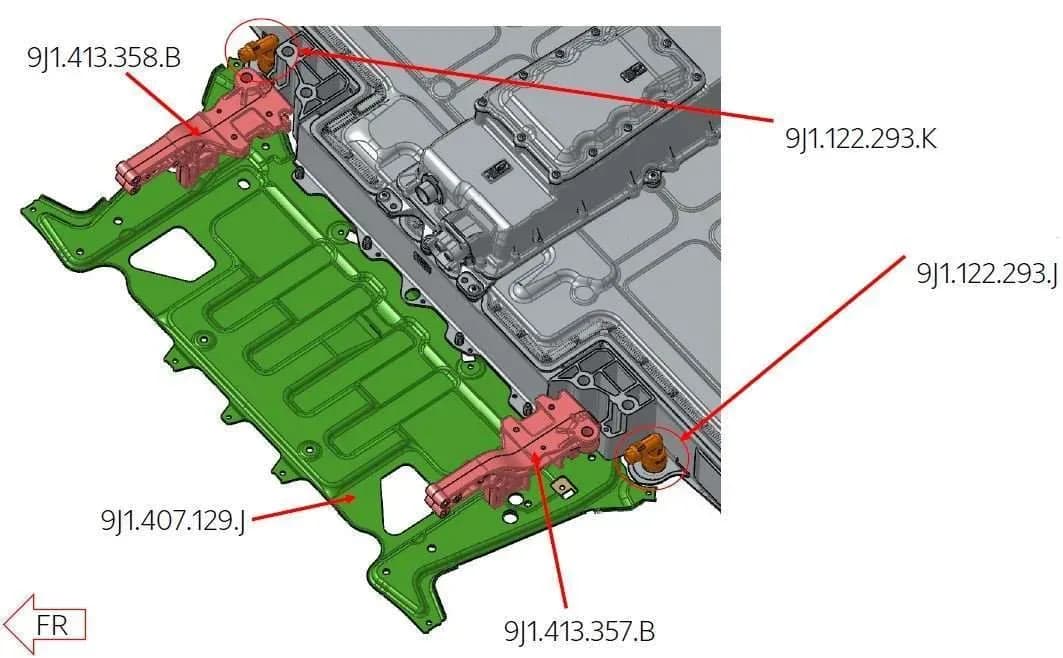
Also applies to
- Audi e-tron GT
- 2022–2024
- Audi RS e-tron GT
- 2023–2024
Technical Background and Customer Complaints
Audi has issued Technical Service Bulletin (TSB) 2077772/2 to address customer complaints concerning the high-voltage battery assembly in certain e-tron GT and RS e-tron GT models. The primary workshop finding indicates that the high-voltage battery assembly must be replaced when these issues are identified. This TSB provides comprehensive guidance for technicians on the correct procedure and necessary components for this critical repair.
This bulletin is specifically relevant for 2022-2024 Audi e-tron GT and RS e-tron GT vehicles. The previous high-voltage battery assembly, identified by part number 9J1.915.100., is no longer available for new deliveries. Therefore, any replacement of the high-voltage battery assembly will require the updated part, 9J1.915.590., along with several other attachments and components detailed within this document. If your 2022 Audi RS e-tron GT high-voltage battery replacement is being performed, it will involve these updated parts and procedures.
TSB Information and Revisions
This Technical Service Bulletin, referenced as TSB 2077772/2, underwent revisions to ensure accuracy and completeness for technicians. The initial publication date for this TSB was May 5, 2025. It was subsequently revised on February 12, 2026. Revision 1, published on May 5, 2025, added a comprehensive model table to clarify the affected vehicles. Revision 2, dated February 12, 2026, further enhanced the document by including essential information regarding campaign handling, which is crucial for proper service execution and warranty claims. This ensures that all necessary steps are followed for a successful 2022 Audi RS e-tron GT high-voltage battery replacement.
Repair Procedure Summary
The replacement of the high-voltage battery assembly is a multi-step process that requires adherence to specific Audi workshop manual procedures and the use of precise parts. The overall process ensures the safe and effective installation of the new battery and associated components.
Ordering Parts and Removing the Faulty High-Voltage Battery
Technicians must begin by entering the vehicle's VIN number into the electronic parts catalogue. This step is crucial to ensure that the correct high-voltage battery and all necessary additional parts are ordered for the replacement. Once the parts are secured, the existing high-voltage battery must be carefully removed. This involves following the detailed instructions outlined in the workshop manual section titled "Electric drive motor 0EG, 0EM; Rep. gr. 93; High-voltage battery unit; Removing and installing high voltage battery unit 1 AX2." Additionally, the rear bracket, identified by part numbers 9J1.804.695/.696, needs to be removed and set aside for later use, as described in the workshop manual section "Electric drive motor 0EG, 0EM; Rep. gr. 93; High-voltage battery unit; Assembly overview – installed high-voltage battery." This initial phase is critical for safely disconnecting and extracting the old battery unit.
Converting and Installing the New High-Voltage Battery
Once the old battery is removed, the new high-voltage battery, part number 9J1.915.590.*, is prepared for installation. This involves placing the new battery onto a scissor-type lifting table, as depicted in Figure 2 (Label position location). This step is detailed in the workshop manual section "Electric drive motor 0EG, 0EM; Rep. gr. 93; High-voltage battery unit; Lifting high-voltage battery 1 AX2." Technicians then proceed to fit the necessary attachments for the front coolant connections, specifically parts 9J1.122.293.J (left side) and 9J1.122.293.K (right side), which are visible in Figure 1 (Overview of attachments).
Labeling Requirements
Accurate labeling is a crucial step in the replacement process. A notice, part number 9J1.01.003.B (E test mark), must be affixed next to the high-voltage battery type plate, as shown in Figure 2. Furthermore, a KBA-92109 label needs to be printed using a label printer and applied adjacent to the high-voltage battery type plate. The TSB notes that the KBA-92109 label is currently under development and will soon have an official part number. Until then, workshops are instructed to use a label printer or labeling machine to create a label with the text "KBA-92109" for application on the high-voltage battery next to the type plate.
Vehicle Changes and Component Replacement
To accommodate the new high-voltage battery and maintain vehicle integrity, several other components require replacement. Stabilizer links on both sides of the vehicle must be replaced to match the updated geometry of the e-tron GT PU (Power Unit). This involves replacing the left-side stabilizer link 9J1.413.357.A with 9J1.413.357.B, and the right-side stabilizer link 9J1.413.358.A with 9J1.413.358.B. These links are visually represented in Figure 3 (Stabilizer link). Technicians are also required to inspect all bolts, especially stretch bolts, and rubber bushes (shown in Figure 4) for any signs of wear and replace them if necessary. The procedure for replacing stabilizer links is found in the workshop manual section "Running gear, axles, steering; Rep. gr. 40; Subframe; Removing and installing subframe bracket." The process also includes renewing the reinforcement plate, replacing part number 9J1.407.129.F with 9J1.407.129.J, as illustrated in Figure 6 (Reinforcement plate). This is covered under "Running gear; Rep. gr. 40; Subframe; Assembly overview – Removing and installing subframe reinforcement."
Fitting Rear Brackets and Re-energizing the High-Voltage System
After the new high-voltage battery is installed, the rear brackets 9J1.804.695/.696 must be fitted to the high-voltage battery and torqued to specification, as shown in Figure 5. This is a critical step to ensure the battery is securely mounted. Following the physical installation of the new battery and associated components, the high-voltage system must be re-energized. This is performed according to the workshop manual's instructions up to the "Re-energizing high-voltage system" step. The re-energization process involves entry via "Flash" mode and utilizing the SVM (Authorized Multiple Code Entry) system. Specific SVM codes that must be entered are XCHG1HVBGTPA, XCHG2HVBGTPA, and DUCHISRES008CEGT. These codes ensure proper communication and functionality of the new high-voltage battery within the vehicle's electrical system.
Handling Open Field Campaigns
As part of the comprehensive repair, technicians are mandated to check for and process any open field campaigns related to the vehicle. If campaigns such as 931B, 931A, or 931D have not been marked as processed, they must be manually completed. Should any difficulties arise or further queries be needed regarding these campaigns, a ticket must be created within the WISH system for campaign coordination. This ensures all outstanding service actions are addressed during the 2022 Audi RS e-tron GT high-voltage battery replacement.
Required Parts and Tools
For the successful completion of the high-voltage battery replacement, technicians must use specific parts as outlined in TSB 2077772/2. It is explicitly stated that these part numbers differ from those listed in ETKA, and only the parts specified in this TSB, including any superseding part numbers, should be used. The following table details the required components:
| Part number | Designation | Quantity |
|---|---|---|
| 9J1122293K | Coolant connection (right side) | 1 |
| 9J1122293J | Coolant connection (left side) | 1 |
| 9J1413357B | Link for stabilizer (left side) (side panel) | 1 |
| 9J1413358B | Link for stabilizer (right side) | 1 |
| 9J1407129J | Reinforcement plate | 1 |
| N10831701 | Screw with int. serrations for front stabilizer link | 2 |
| N10435506 | Self-locking hexagon collar nut for stabilizer link bolts | 2 |
| N10782201 | Hexagon bolt for side panel ONLY RIGHT SIDE | 1 |
| N10435506 | Self-locking hexagon collar nut for side panel ONLY RIGHT SIDE | 1 |
| N91244301 | Hexagon collared bolt with hexagon socket head (duo), bolt with washer for bottom of side panel | 2 |
| N91006202 | Hexagon bolt head (combi) for stabilizer clamp | 4 |
| N10664503 | Hex collared bolt Z for mounting bracket on front axle | 4 |
| 971411313K | Rubber bush | 4 |
| 9J1010003B | Notice (E test mark) | 1 |
| See ETKA | High-voltage battery (9J1.915.590.*) | 1 |
In addition to these parts, the repair procedure requires specialized tools and diagnostic equipment for tasks such as draining and filling coolant, removing and installing the high-voltage battery, and performing software updates. The labor operations are categorized with specific service numbers and time units (TU) for warranty claims:
| Labor Operation | Description | Time Units (TU) |
|---|---|---|
| 1938 1700 | Drain and fill coolant | See SRT with associated operations |
| 9303 1950 | Remove and install high-voltage battery | See SRT with associated operations |
| 9303 5599 | Replace high-voltage battery | See SRT with associated operations |
| 4007 2099 | Remove and install 2 subframe brackets | 80 TU |
| 9303 4999 | Rework high-voltage battery (Coolant connection both sides, affix label/type plate) | 30 TU |
| 0151 0060 | Software update | Time stated on the diagnostic protocol |
Warranty Information
All warranty claims submitted for the high-voltage battery replacement, identified by Service Number 9303 and Damage Code 0040, must strictly adhere to the guidelines outlined in the Audi Warranty Policies and Procedures Manual. Claims are subject to review and audit by Audi Warranty to ensure compliance and validity. The claim comment for this specific TSB is "As per TSB 2077772/2."
Important Warnings for Owners
Owners of 2022-2024 Audi e-tron GT and RS e-tron GT vehicles should be aware of specific warranty conditions related to this TSB. The claim type indicates that "If the vehicle is outside of any warranty, this Technical Service Bulletin is informational only." This means that Audi may not cover the costs associated with the 2022 Audi RS e-tron GT high-voltage battery replacement, and owners might be responsible for the full expense of parts and labor if their vehicle is no longer under warranty. It is advisable to consult with an authorized Audi service center to understand your specific warranty coverage before proceeding with any repairs.
Source: NHTSA ID: 11029385
Gallery
3 images
Frequently Asked Questions
- What is Audi TSB 2077772/2 about?
- Audi TSB 2077772/2 provides detailed instructions for technicians on how to replace the high-voltage battery assembly in 2022-2024 Audi e-tron GT and RS e-tron GT vehicles, including required parts and procedures.
- Which Audi models are affected by this high-voltage battery replacement TSB?
- This TSB applies to 2022, 2023, and 2024 model year Audi e-tron GT and RS e-tron GT vehicles, addressing complaints regarding the high-voltage battery assembly.
- What are the key part numbers involved in this high-voltage battery replacement?
- The previous high-voltage battery part number 9J1.915.100.* is superseded by 9J1.915.590.*, which is the required replacement battery. Several other components, such as coolant connections (9J1.122.293.J, 9J1.122.293.K) and stabilizer links (9J1.413.357.B, 9J1.413.358.B), are also specified.
- Are there specific SVM codes mentioned for the high-voltage battery re-energization?
- Yes, the high-voltage system is re-energized using SVM Authorized Multiple Code Entry with codes XCHG1HVBGTPA, XCHG2HVBGTPA, and DUCHISRES008CEGT.
- Will the high-voltage battery replacement be covered under warranty?
- Warranty claims, identified by Service Number 9303 and Damage Code 0040, are subject to Audi's warranty policies. If your vehicle is outside of its warranty period, this TSB is for informational purposes only, and costs may not be covered for the 2022 Audi RS e-tron GT high-voltage battery replacement.
Related Articles
2022-2024 Audi e-tron GT Radiator Fan Stuck DTC P2B3000 P2B3200
Audi has issued Technical Service Bulletin 2073599/3 for 2022-2024 e-tron GT and RS e-tron GT models. This TSB addresses issues with the thermal management system, specifically radiator fan 1 and/or 2 getting stuck, which can lead to DTCs P2B3000 or P2B3200, reduced heating/cooling, and lower…
2022-2024 Audi e-tron GT Charging Issue TSB 2078782/3
Audi has released Technical Service Bulletin (TSB) 2078782/3 for 2022-2024 e-tron GT and RS e-tron GT models experiencing charging complaints or diagnostic trouble codes (DTCs). Due to a temporary shortage of 22 kW high-voltage battery chargers, this TSB outlines a procedure to replace it with an…
2022 Audi e-tron GT Charging Flap Status TSB 2079475/2
This Technical Service Bulletin (TSB) 2079475/2 addresses an issue in 2022 Audi e-tron GT and RS e-tron GT vehicles where the virtual cockpit incorrectly displays the charging flap as open, even when it is closed. This software update resolves the misleading warning messages.
2022 Audi e-tron GT Charging Flap Status Warning TSB
Audi Technical Service Bulletin 2079475/1 addresses an issue in 2022 Audi e-tron GT and RS e-tron GT vehicles where the virtual cockpit incorrectly displays the charging flap as open, even when it's closed. This software update resolves the misleading warning messages.
2022-2024 Audi e-tron GT 22kW to 11kW Charger Conversion TSB
Audi has issued Technical Service Bulletin 2078782/2 for 2022-2024 e-tron GT models concerning the high-voltage battery charger. Due to the temporary unavailability of the 22 kW charger, a conversion to an 11 kW unit is required, involving specific part replacements and an SVM code C6A018 flash.
Leave a comment
Comments are moderated and may take a moment to appear. Only your first name and the initial of your last name are shown publicly.
Comments
Be the first to comment.