2021-2023 Audi e-tron Rear Axle Rumbling Noises TSB
Audi has issued Technical Service Bulletin 2064019/4 to address rumbling and rattling noises from the rear axle of 2021-2023 e-tron and e-tron Sportback models. This TSB explains that the noise is caused by frozen water or dirt restricting shock absorber mounting operation in cold temperatures.
 Sarah Mitchell2021 Audi e-tron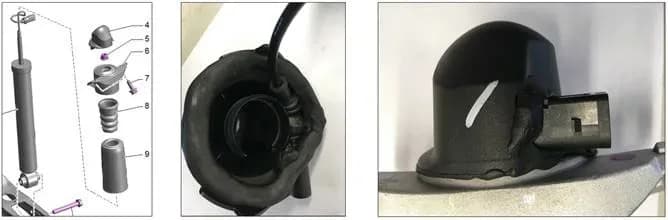
Also applies to
- Audi e-tron
- 2022–2023
- Audi e-tron Sportback
- 2021–2022
Owners of 2021-2023 Audi e-tron and e-tron Sportback vehicles may experience a specific type of noise from the rear axle, particularly in cold conditions. Audi has released Technical Service Bulletin (TSB) 2064019/4 to address these concerns, providing diagnostic information and a repair procedure for what is described as an Audi e-tron rear axle noise.
This bulletin, dated September 6, 2024, supersedes a previous bulletin, Group 42 number 23-51, which was issued on March 27, 2023. The latest revision, Revision 4, includes updated information regarding the condition, warranty, and service notes. Earlier revisions, Revision 3 (March 27, 2023) and Revision 2 (June 9, 2022), also included header updates and added model years.
This TSB applies to various Audi e-tron models, including the 2019, 2021-2023 e-tron; 2020-2023 e-tron Sportback; and 2024-2025 Q8 e-tron, Q8 Sportback e-tron, SQ8 e-tron, and SQ8 Sportback e-tron vehicles.
Symptoms
Customers may report "Rumbling/rattling noises from the rear axle area" when driving over irregularities in the road surface. This Audi e-tron rear axle noise is typically reproducible at speeds between 5 and 20 mph, specifically when outside temperatures are below 32°F. The noise originates from the rear shock absorbers or their mountings.
Diagnosis and Technical Background
The root cause of the rumbling or rattling noise is frozen water or dirt accumulating above the shock absorber mountings. When temperatures drop below 32°F, this frozen material restricts the normal operation of the shock absorber mounting, leading to the audible complaint. Technicians can confirm the issue by carefully heating the shock absorber mounting to see if the noise subsides.
Repair Procedure Summary
The repair outlined in TSB 2064019/4 involves replacing the rear shock absorber mountings and sealing them to prevent future accumulation of frozen debris. The procedure includes the following steps:
- Remove Shock Absorbers: Both rear shock absorbers must be removed. Technicians should refer to the Elsa Repair Manual, specifically the sections for Chassis >> Suspension, Steering, Wheels >> 42 Rear Suspension >> Suspension Strut, Shock Absorber, Spring, for detailed instructions.
- Replace Mountings: The shock absorber mountings on both sides of the vehicle (item 6 in Figure 1, picture 1 of the TSB) are to be replaced with new ones.
- Apply Sealing Cord: After installing the new mountings, approximately 10 inches of butyl sealing cord (part number AKD49701004R10) must be applied on each side. This cord creates a seal between the protective cap (item 4 in Figure 1, picture 1) and the new shock absorber mounting (item 6 in Figure 1, picture 1). Figure 1, pictures 2 and 3 illustrate this sealing process.
- Prepare Surfaces: Before applying the butyl sealing cord, it is crucial to ensure that the sealing surfaces of both the new shock absorber mounting and the corresponding shock-absorber protective cap are clean and dry. The original shock absorber cap (item 4) can be reused if it is in good condition.
Required Parts and Warranty Information
For this repair, the following parts are required:
- Shock absorber mounting: Quantity 02 (refer to ETKA for specific part numbers).
- Butyl Sealing Cord: Part number AKD49701004R10, Quantity 0.1.
- Fasteners, Bolts, Nuts, and Screws: Refer to ETKA and the Repair Manual for necessary quantities.
This service is identified by Service Number 4295 and Damage Code 0020. The labor operations associated with this repair include:
- Replace 2 shock absorber mountings: Labor operation 4295 5650 (time units vary, refer to SRT).
- Seal 2 shock absorber mountings: Labor operation 4295 5299 (30 TU).
- Road test prior to service: Labor operation 0121 0002 (10 TU).
- Road test after service: Labor operation 0121 0004 (10 TU).
- GFF (Guided Fault Finding): No allowance (0 TU).
Warranty claims should be submitted as per TSB 2064019/4 and must comply with the Audi Warranty Policies and Procedures Manual. Claims are subject to review by Audi Warranty. If the vehicle is outside its warranty period, this Technical Service Bulletin serves as informational guidance only, and the repair costs may not be covered.
Important Notes for Owners
Audi advises that technicians must reproduce the customer complaint to ensure it aligns with the conditions described in this TSB. The repair should only be performed if all specified criteria (model/type, VIN, PR numbers) are met. Failing to do so may result in the problem not being resolved, requiring repeat repairs, and potentially leading to the rejection of warranty claims for parts and labor.
NHTSA ID: 11009338
Frequently Asked Questions
- What causes the Audi e-tron rear axle noise?
- The Audi e-tron rear axle noise, specifically rumbling or rattling, is caused by frozen water or dirt accumulating above the rear shock absorber mountings when outside temperatures are below 32°F. This accumulation restricts the normal operation of the shock absorber mounting.
- How is the Audi e-tron rear axle noise fixed?
- The repair involves removing both rear shock absorbers, replacing the shock absorber mountings on both sides, and then applying approximately 10 inches of butyl sealing cord to create a seal between the protective cap and the new shock absorber mounting. This procedure is detailed in TSB 2064019/4.
- Is the repair for the Audi e-tron rear axle noise covered by warranty?
- If your vehicle is still under warranty, the repair described in Technical Service Bulletin 2064019/4 is typically covered. However, if the vehicle is outside its warranty period, this Technical Service Bulletin is for informational purposes only, meaning the repair cost may not be covered.
- What is TSB 2064019/4?
- TSB 2064019/4 is an Audi Technical Service Bulletin that addresses rumbling and rattling noises originating from the rear axle area of certain e-tron models. It outlines the cause of the noise (frozen water/dirt on shock absorber mountings in cold weather) and provides a detailed repair procedure for technicians.
Related Articles
2021 Audi e-tron Electrical Malfunction and Power Loss
A 2021 Audi e-tron owner reported a severe 'Electrical Malfunction' resulting in complete loss of power on the highway. The issue has persisted despite dealer attempts to fix it over five months, posing significant safety risks.
2021-2026 Audi UTR Troubleshooting & FAQs TSB 2081409/1
This Audi Technical Service Bulletin (TSB 2081409/1) provides comprehensive answers to frequently asked questions and troubleshooting steps for the Audi Universal Traffic Recorder (UTR) accessory, covering topics like SD card compatibility, video playback, Wi-Fi issues, and more.
2021-2025 Audi Emergency Call System Fault TSB
Audi has released Technical Service Bulletin 2059528/18 to address an "Emergency call function: malfunction! Function unavailable. Please contact service" warning, often accompanied by a red SOS LED and DTC B200000. This issue affects various 2021-2025 Audi models and is due to a software problem…
2021-2026 Audi Adaptive Light System Fault C12B3FA TSB
Audi has released Technical Service Bulletin 2054202/7 to address an intermittent 'Audi adaptive light: system fault' message and DTC C12B3FA in various 2021-2026 models. This TSB outlines diagnosis and resolution for driver assistance system malfunctions.
2021-2026 Audi Parking Aid False Warnings TSB 2024323/12
This Technical Service Bulletin (TSB 2024323/12) details diagnostic and repair procedures for 2021-2026 Audi vehicles experiencing false parking aid warnings. Learn about environmental factors, sensor checks, and proper installation to resolve issues like 'Parking aid does not work / warning is…
Leave a comment
Comments are moderated and may take a moment to appear. Only your first name and the initial of your last name are shown publicly.
Comments
Be the first to comment.