2021-2025 Audi Whistling Noise from Turbocharger TSB 2071243/3
Audi Technical Service Bulletin 2071243/3 details a whistling noise that may come from the turbocharger in 2021-2025 Audi A4, A5, and Q5 models. This TSB clarifies that the noise is a comfort complaint and not indicative of a fault.
 Sarah Mitchell2022 Audi A5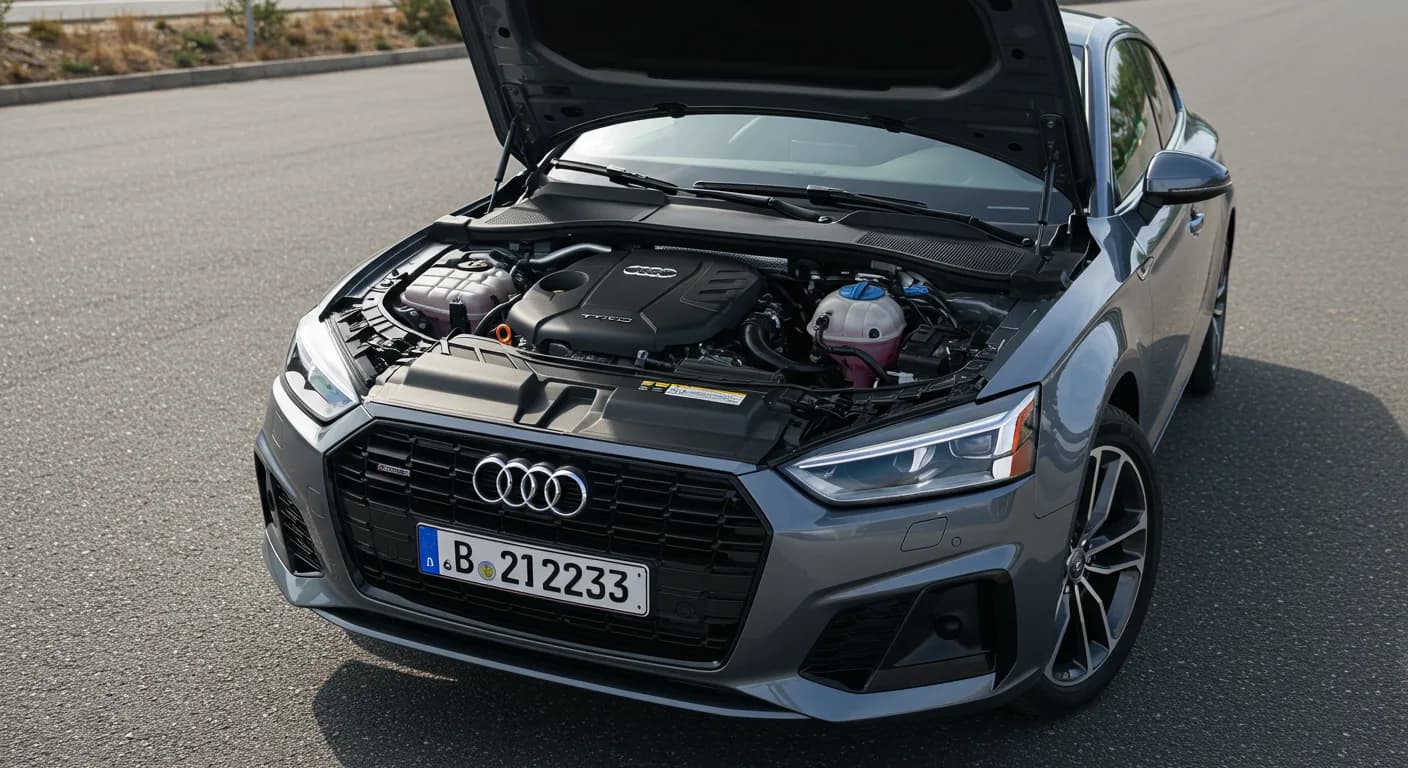
Also applies to
- Audi A4
- 2021–2023
- Audi A4 allroad
- 2021–2023
- Audi A5
- 2021, 2023
- Audi Q5
- 2021–2025
The Audi Technical Service Bulletin (TSB) 2071243/3, issued on November 27, 2024, provides information regarding a whistling noise that may originate from the turbocharger in certain 2021-2025 Audi A4, A5, and Q5 models. This TSB supersedes an earlier bulletin, Group 01 number 24-14, dated March 20, 2024, and offers guidance for diagnosing and addressing this specific Audi turbocharger whistling noise.
Symptoms of Turbocharger Whistling Noise
Owners of affected Audi vehicles may notice a distinct whistling noise when driving or accelerating. This Audi turbocharger whistling noise is typically heard under specific conditions:
- While accelerating or maintaining a constant speed, particularly when the engine is operating in combustion mode.
- The noise occurs within an engine speed range of 1500 to 2200 rpm.
- It is most noticeable when the engine is under approximately 70% load.
- The presence of the noise is independent of the selected transmission position.
- Workshop findings indicate the noise has a frequency between 2.8 kHz and 3.2 kHz.
Important Warnings for Owners
Audi has provided critical information for owners regarding this whistling noise:
- "The noise described is a normal turbocharger operating noise." This means the sound is generally considered part of the turbocharger's normal function.
- "This is only a comfort complaint." The TSB explicitly states that this noise does not indicate a defect or a safety issue.
- "Please explain to the customer that no negative effects on wear or vehicle condition are to be expected." Owners should be reassured that the whistling noise will not cause damage or negatively impact the vehicle's longevity or performance.
- "Replacing the turbocharger with an identical part number (06N.145.702.D or 06N.145.701.D) will not fix the problem." This is a crucial warning, as attempting to replace the turbocharger with the same part number will not resolve the whistling sound. An alternative part number must be identified.
Diagnosis and Workshop Findings
When a customer reports an Audi turbocharger whistling noise, technicians are instructed to first duplicate the concern. The TSB recommends using specialized equipment for accurate diagnosis. The VAS tool 611015, also known as the PICO NVH tool, is specified for performing noise, vibration, and harshness (NVH) measurements to identify the noise. Technicians should also consult TSB 2070568 for professional noise analysis with the PICO-NVH tool and TSB 2075194/1 for information on engine compartment noises in Q5 FY models.
Repair Procedure Summary
The primary solution for the whistling noise involves replacing the turbocharger, but with a critical caveat. The TSB explicitly states that replacing the turbocharger with an identical part number (06N.145.702.D or 06N.145.701.D) will not resolve the issue. Instead, technicians must consult ETKA (Audi's electronic parts catalog) to find an alternative, updated part number for the turbocharger.
The repair process generally includes:
- Noise Analysis: Using the VAS 611015 (PICO NVH tool) to confirm the whistling noise and its characteristics.
- Turbocharger Replacement: Removing the existing turbocharger and installing an alternative, updated turbocharger part.
- System Checks: Performing a Guided Fault Finding (GFF) procedure and charging the battery as necessary.
- Road Tests: Conducting road tests both before and after the service procedure to verify the repair.
Required Tools and Parts
For this repair, technicians will require:
- VAS 611015 (PICO NVH tool): A specialized tool for noise analysis.
- Turbocharger: An alternative part number, which must be sourced via ETKA, not the original part numbers 06N.145.702.D or 06N.145.701.D.
- Fasteners, Bolts, Nuts, and Screws: As specified in the repair manual and available through ETKA.
Warranty Information
This Technical Service Bulletin 2071243/3 outlines specific warranty claim procedures. If the vehicle is outside of its warranty period, the information provided in this TSB is for informational purposes only. The Service Number for this bulletin is 2130, and the Damage Code is 0020. Labor operations include specific time units (TU) for noise analysis setup, turbocharger check, removal and installation, GFF, battery charge, and road tests. All warranty claims must adhere to the Audi Warranty Policies and Procedures Manual.
Owner Action
If you own a 2021-2025 Audi A4, A5, or Q5 and experience a whistling noise from your engine, especially under the conditions described, you should contact your authorized Audi dealership. While the TSB indicates this is a comfort complaint and not detrimental to your vehicle's health, a qualified technician can perform the diagnostic steps outlined in TSB 2071243/3. They will use specialized tools like the VAS 611015 to confirm the noise and, if necessary, replace the turbocharger with an updated part number to mitigate the sound.
Source: NHTSA ID: 11011243, TSB 2071243/3.
Frequently Asked Questions
- What does Audi TSB 2071243/3 address?
- Audi TSB 2071243/3 addresses a whistling noise that may come from the turbocharger in 2021-2025 Audi A4, A5, and Q5 models, particularly between 1500 and 2200 rpm at approximately 70% load.
- Is the Audi turbocharger whistling noise a serious problem?
- No, according to Audi TSB 2071243/3, the whistling noise is considered a normal turbocharger operating noise and primarily a comfort complaint. It is not expected to have negative effects on wear or the vehicle's condition.
- How is the Audi turbocharger whistling noise diagnosed and repaired?
- Diagnosis involves using a specialized VAS 611015 (PICO NVH tool) for noise analysis. The repair procedure involves replacing the turbocharger with an alternative, updated part number, as replacing it with an identical original part (06N.145.702.D or 06N.145.701.D) will not resolve the issue.
- Will replacing the turbocharger with the same part number fix the whistling noise?
- No, Audi explicitly states in TSB 2071243/3 that replacing the turbocharger with an identical part number (06N.145.702.D or 06N.145.701.D) will not fix the problem. An alternative, updated part number must be used.
Related Articles
2022-2025 Audi A/C Control Buttons Not Working TSB 2078655/3
Audi has issued Technical Service Bulletin 2078655/3 to address issues with unresponsive A/C control unit buttons in 2022-2025 A4, A5, S4, S5, RS 5, Q5, and SQ5 models. This TSB outlines diagnosis for the 'B131207: Button(s) in control panel, mechanical fault' and repair procedures.
2022 Audi A4, A5, Q5 Lane Departure Warning Steering Input TSB
Audi Technical Service Bulletin 2079617/1 addresses an issue in 2022 A4, A5, and Q5 models where the 'Steering input' setting for the lane departure warning system is unavailable in the MMI. This TSB outlines a software update to resolve the problem.
2021-2025 Audi A4, A5, Q5 Cracking/Creaking Noises TSB
Audi Technical Service Bulletin (TSB) 2062633/5 addresses 'Cracking/creaking noises during load changes or severe vehicle body torsion' in 2021-2025 Audi A4, A5, and Q5 models. This issue stems from a loose bonded joint in the subframe connection, causing various noises in the footwells.
2021-2025 Audi A4/A5/Q5 Camera Coded Incorrectly TSB
Audi has released TSB 2076008/1 to address DTC U101400, "Control module coded incorrectly," in the Front Camera for Driver Assist Systems -R242- for 2021-2025 A4, A5, Q5, S4, S5, RS 5, and SQ5 models. This can lead to incorrect signals from driver assist systems.
2022-2025 Audi Continental Tire Safety Recall 44CT Update
Audi has issued a dealer communication, 44CT_REV20241004, providing an update on the Continental Tire Safety Recall 44CT. This update includes additional guidance for identifying affected tires and reminds dealers of their legal obligations regarding new and pre-owned vehicles with unremedied…
Leave a comment
Comments are moderated and may take a moment to appear. Only your first name and the initial of your last name are shown publicly.
Comments
Be the first to comment.