2021-2023 Audi 2.0 TFSI Whistling Turbocharger Noise TSB
Audi has issued Technical Service Bulletin (TSB) 2071243/1 to address customer complaints of whistling noises originating from the turbocharger in 2021-2023 Audi A4, A5, and Q5 models equipped with the 2.0 TFSI engine. This bulletin outlines the specific conditions under which the noise occurs and…
 Sarah Mitchell2023 Audi A5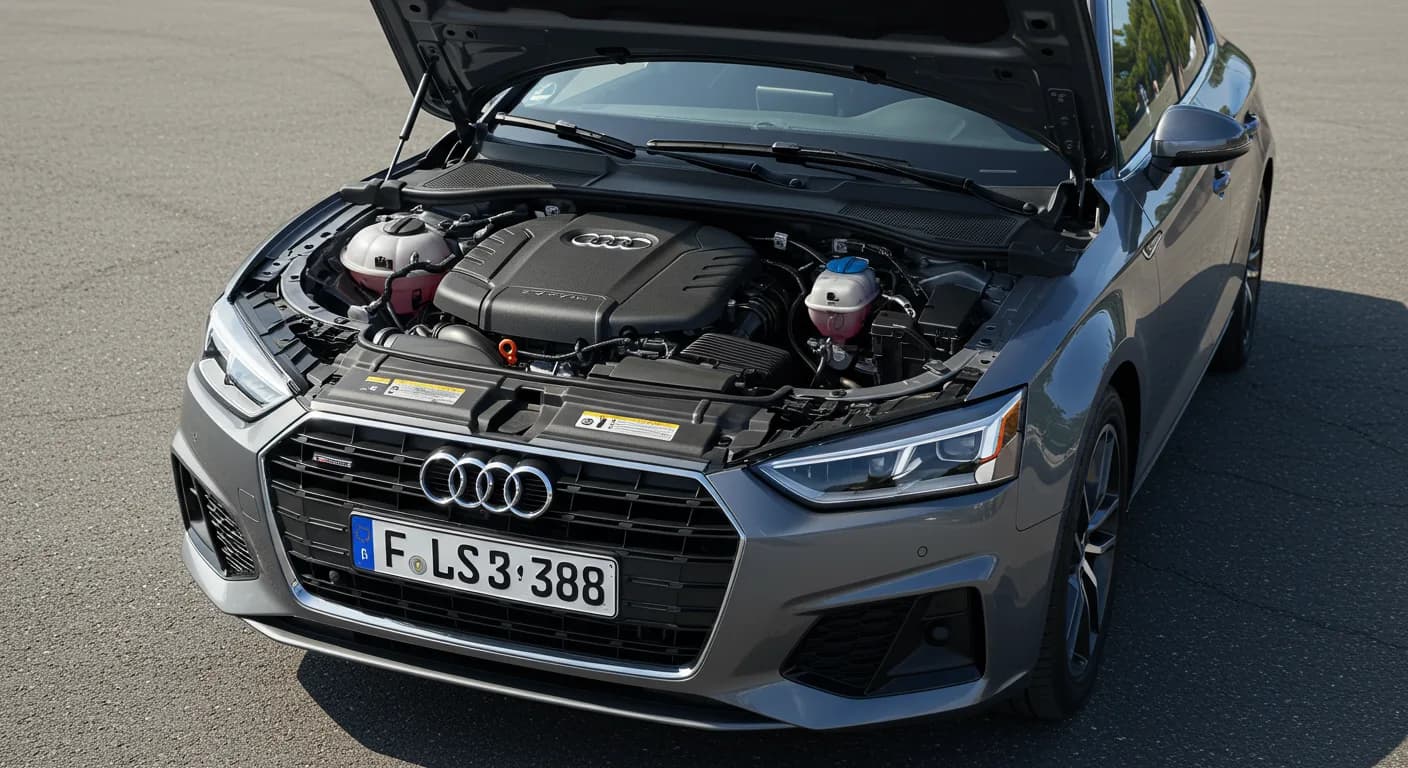
Also applies to
- Audi A4
- 2021–2023
- Audi A4 allroad
- 2021–2023
- Audi A5
- 2021–2022
- Audi Q5
- 2021–2023
Symptoms
Owners of affected Audi models may experience a distinct whistling noise from the turbocharger. This Audi 2.0 TFSI whistling noise typically occurs under specific driving conditions. The noise is usually heard when accelerating or maintaining a constant speed, particularly when the engine is operating in combustion mode.
Technicians have identified that the whistling noise is most noticeable between 1500 and 2200 RPM and at approximately 70% engine load. The presence of this noise does not depend on the selected transmission position. Workshop findings indicate that the noise has a frequency ranging from 2.8 kHz to 3.2 kHz, which can be precisely measured using a PICO NVH tool.
Important Warnings
Audi has issued a critical warning regarding the repair of this whistling noise:
NOTICE Replacing the turbocharger with one with an identical part number (part number 06N.145.702.D) will not fix the problem. Check ETKA for an alternative available part number.
This means that simply replacing the faulty turbocharger with another unit bearing the original part number 06N.145.702.D will not resolve the Audi 2.0 TFSI whistling noise. Owners and technicians must ensure that an updated or alternative part number is sourced through the ETKA parts catalog to ensure a successful repair.
Diagnosis
To accurately diagnose the Audi 2.0 TFSI whistling noise, technicians are advised to use the VAS tool 611015, also known as the PICO NVH tool. This specialized equipment helps identify the noise and its specific characteristics, such as frequency.
For comprehensive noise analysis and billing procedures related to the VAS 611015 tool, technicians should also refer to TSB 2070568, titled "Engine/Gearbox: professional noise analysis with PICO-NVH tool." This additional bulletin provides detailed information on the configuration, measurement positions, and analysis techniques necessary for an effective diagnosis.
Repair Procedure Summary
The primary solution for the Audi 2.0 TFSI whistling noise involves replacing the turbocharger. However, as highlighted in the important warning, it is crucial not to replace the faulty turbocharger with another unit that has the identical part number 06N.145.702.D. This specific part number has been identified as the source of the audible whistling noise in rare cases.
Technicians must consult the ETKA parts catalog to identify and order an alternative, updated turbocharger part number. The repair process will involve removing the existing turbocharger and installing the new, updated unit. Following the replacement, a road test is recommended to confirm that the whistling noise has been eliminated.
Required Tools or Parts
To perform the diagnosis and repair outlined in TSB 2071243/1, specific tools and parts are necessary:
- VAS 611015 (PICO NVH tool): Essential for accurate noise, vibration, and harshness (NVH) measurement and analysis.
- Turbocharger: An updated turbocharger unit, which must be sourced by checking the ETKA parts catalog for an alternative to part number 06N.145.702.D.
- Fasteners, Bolts, Nuts, and Screws: As needed for the repair, these should also be referenced in ETKA or the repair manual.
Warranty Information
This Technical Service Bulletin 2071243/1 outlines the warranty coverage for the repair of the Audi 2.0 TFSI whistling noise. The claim type is generally covered for up to 48 months or 50,000 miles, whichever comes first. For Certified Pre-Owned (CPO) vehicles, the G10 claim type applies, and ownership verification is required.
If the vehicle falls outside of these warranty parameters, the information provided in this TSB is for informational purposes only. All warranty claims must adhere to the Audi Warranty Policies and Procedures Manual and are subject to review by Audi Warranty.
Owner Action
If you own a 2021-2023 Audi A4, A5, or Q5 with the 2.0 TFSI engine and are experiencing a whistling noise from the turbocharger, it is recommended to schedule an appointment with an authorized Audi service center. Inform them about the Audi 2.0 TFSI whistling noise and mention Technical Service Bulletin 2071243/1. The technicians will use specialized tools like the VAS 611015 to diagnose the issue and replace the turbocharger with an updated part, ensuring the problem is resolved correctly.
Source: NHTSA ID: 10249578
Frequently Asked Questions
- What is TSB 2071243/1 about?
- TSB 2071243/1 addresses whistling noises emanating from the turbocharger in certain 2021-2023 Audi A4, A5, and Q5 models equipped with the 2.0 TFSI engine, providing diagnostic and repair instructions.
- What are the symptoms of the Audi 2.0 TFSI whistling noise?
- Owners typically hear a whistling noise from the turbocharger when accelerating or driving at a constant speed, especially between 1500-2200 RPM and around 70% engine load. This specific Audi 2.0 TFSI whistling noise has a frequency between 2.8 kHz and 3.2 kHz.
- Can I replace the turbocharger with the same part number?
- No, Audi explicitly warns that replacing the turbocharger with one bearing the identical part number 06N.145.702.D will not resolve the whistling noise. An alternative, updated part number must be sourced through the ETKA parts catalog.
- Is this turbocharger whistling noise covered under warranty?
- Generally, the repair for this Audi 2.0 TFSI whistling noise is covered under warranty for up to 48 months or 50,000 miles. For Certified Pre-Owned (CPO) vehicles, specific G10 coverage applies. Always check with your Audi dealer for exact warranty eligibility.
- What tools are used to diagnose this whistling noise?
- Audi technicians use a specialized tool called VAS 611015 (PICO NVH tool) to accurately identify and measure the characteristics of the whistling noise. Further guidance for its use is provided in TSB 2070568.
Related Articles
2016-2026 Audi Upper Link Rumbling Noise TSB
Audi Technical Service Bulletin 2060855/4 details a common complaint of rumbling, thumping, or chattering noises from the front suspension. This TSB provides diagnostic steps and a repair procedure for damaged upper link rubber mountings in various 2016-2026 Audi models.
2021-2026 Audi A4/A5/RS5/S5 Steering Parts Return Notice
Audi has issued Special Notice SM 26-2025, instructing dealers to return specific steering component part numbers produced within a defined date range. This measure ensures that only compliant parts are available for customer vehicles.
2021-2025 Audi Active Lane Assist Malfunction TSB
Audi has issued Technical Service Bulletin 2061932/10 for 2021-2025 A4, A5, S4, S5, RS 5, Q5, and SQ5 models. It addresses the 'Audi Active Lane Assist: fault!' message and DTC U112300, which can disable driver assistance features. The fix involves replacing the capacitive steering wheel.
2022-2025 Audi A5, S4, S5 Continental Tire Safety Recall
Audi has issued a safety recall (NHTSA 24T009, Audi recall code 44CT) for certain 2022-2025 A5, S4, and S5 models equipped with specific Continental ProContact GX AO tires. These tires may develop tread separation, increasing crash risk. Owners should have their tires inspected and replaced free…
2022-2024 Audi A4/A5/Q5 Lineup Engine ECU Faults P060C00 U041600
Audi has issued Technical Service Bulletin PSS 01 (2072710/4) for 2022-2024 A4, A5, and Q5 models experiencing an illuminated EPC light and 'Drive system: fault' message. This TSB addresses engine control unit software issues, noting DTCs P060C00 and U041600. A solution is expected Q2 2025.
Leave a comment
Comments are moderated and may take a moment to appear. Only your first name and the initial of your last name are shown publicly.
Comments
Be the first to comment.